




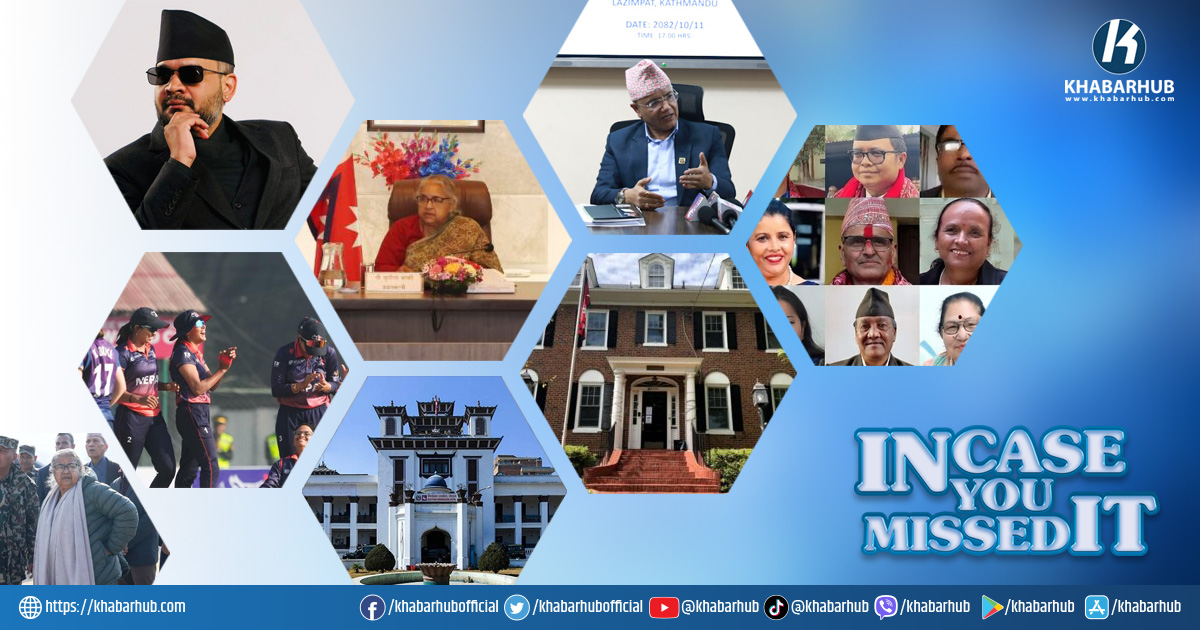
KATHMANDU: Last week’s events in Nepal, anchored by the election of 18 new members to the National Assembly, collectively revealed the country’s current political temperament—one marked by cautious continuity, controlled contestation, and persistent structural tensions.
From the composition of the upper house and the sharpening rhetoric of party leaders, to judicial intervention in electoral eligibility, diplomatic warnings to citizens abroad, and institutional responses to governance challenges, the week offered a layered snapshot of where Nepali democracy stands as it approaches another decisive electoral moment.
At the heart of these developments lies the National Assembly election itself. Though often overshadowed by the more politically charged House of Representatives contests, the upper house plays a critical role in Nepal’s federal architecture. The election of 18 new members—almost entirely through coordinated party nominations—underscored both the strengths and limitations of Nepal’s current political consensus model.
National Assembly Elections
The most striking feature of the National Assembly results was not who won, but how they won. The coordinated candidacies of the Nepali Congress, CPN-UML, and the Loktantrik Samajwadi Party ensured predictable outcomes, leaving independent or unaligned efforts without success. This reflects a broader trend in Nepal’s post-2015 political practice: power-sharing arrangements are increasingly prioritized over open competition, especially in indirect elections.
On one hand, this coordination provided stability. The National Assembly is constitutionally designed as a forum for experience, continuity, and deliberation rather than populist disruption. The entry of seasoned leaders such as Mahantha Thakur, Lalit Jung Shahi, and Sunil Bahadur Thapa reinforces this vision. These figures bring institutional memory, constitutional experience, and political gravitas to the upper house—qualities often lacking in Nepal’s volatile lower house politics.
On the other hand, the absence of electoral uncertainty raises concerns about democratic vibrancy. When outcomes are largely predetermined through elite negotiations, the National Assembly risks becoming an extension of party headquarters rather than a chamber of independent legislative scrutiny. This tension—between stability and democratic openness—remains unresolved.
Inclusion and Representation
The composition of the newly elected members nevertheless reflects meaningful progress in representation. The election of Roshni Meche from the marginalized Meche community, Som Portel under the Dalit quota, and figures such as Dharmendra Paswan, a long-time Dalit rights activist, highlights the institutionalization of inclusion within Nepal’s federal framework.
These outcomes suggest that while Nepal’s political system may be elite-driven, it is no longer socially exclusive in the way it once was. Representation of women, Dalits, indigenous nationalities, youth, academics, farmers’ advocates, and development experts points to a gradual broadening of the political class.
Yet inclusion in numbers does not automatically translate into influence. The real test for the National Assembly will be whether these voices shape legislation, policy debate, and oversight—or remain symbolic participants within party-dominated decision-making. Nepal’s history offers mixed evidence on this front.
Electoral Law, Justice, and the Limits of Redemption
The Supreme Court’s decision barring Resham Lal Chaudhary from contesting the House of Representatives election added a sharp legal dimension to the week’s political developments. The ruling reaffirmed a critical principle: presidential pardons do not automatically erase legal records or restore full political eligibility.
This decision may disappoint sections of the public that view Chaudhary’s pardon as a political settlement, but it strengthens institutional clarity. In a democracy still consolidating the rule of law, the court’s refusal to grant interim relief sends a message that electoral integrity cannot be subordinated to political expediency.
At the same time, the case exposes unresolved questions about reconciliation, justice, and political reintegration in post-conflict and post-violence contexts. Nepal continues to struggle with balancing accountability and political accommodation—a challenge that will persist beyond this election cycle.
Oli, Opposition Politics, and the Politics of Confrontation
CPN-UML Chair KP Sharma Oli’s statements last week signaled an opposition strategy built on both mobilization and confrontation. His warning that the party may need to “take to the streets” while preparing for elections reflects a dual-track approach: institutional participation paired with extra-parliamentary pressure.
Oli’s rhetoric framed the political moment as existential—casting the contest as one between those who “build the country” and those who “burn it.” This language is not merely campaign hyperbole; it reflects a deepening polarization in Nepal’s political discourse. While Oli positioned UML as a party with vision and direction, he also implicitly delegitimized newer political forces, suggesting they lack purpose or national commitment.
This posture may energize UML’s base, but it also risks narrowing the space for constructive dialogue at a time when public trust in political institutions remains fragile.
The Debate That Won’t Happen
Oli’s subsequent call for a public debate among prime ministerial candidates initially appeared as a democratic gesture—an invitation to transparency and accountability. However, the immediate refusal by Balen Shah to participate revealed the deep emotional and moral fractures shaping contemporary Nepali politics.
Shah’s refusal was not procedural but ethical. By citing past tragedies and assigning responsibility, he reframed the debate from a contest of ideas to a question of moral legitimacy. Whether one agrees with Shah’s stance or not, his position reflects a broader sentiment among sections of the electorate: a refusal to normalize politics as usual without reckoning with past actions.
The episode illustrates a paradox of Nepal’s evolving democracy. While calls for debate and openness are increasing, shared norms of engagement are eroding. The result is parallel political conversations that rarely intersect.
State Capacity and Institutional Vigilance
Beyond electoral politics, several developments last week highlighted the state’s uneven but evolving capacity to regulate, warn, and intervene.
The Nepal Embassy’s warning to Nepali nationals in the United States was unusually blunt. By cautioning against visa misuse, benefit fraud, and illegal employment—and explicitly referencing stricter US policies—the embassy signaled a more proactive diplomatic posture. The warning also reflected reputational anxiety: the actions of individuals abroad increasingly shape how Nepal is perceived internationally.
Similarly, the arrest of six travel agency operators involved in fake rescue scams demonstrated law enforcement’s growing attention to crimes that damage Nepal’s global image, particularly in tourism. Fake rescues not only defraud insurance systems but undermine trust in Nepal as a responsible destination for high-altitude travel.
These actions suggest a state increasingly aware that governance failures now carry international consequences.
Governance, Development, and Administrative Continuity
Administrative decisions, such as the appointment of Chandrakala Paudel as chair of the Nepal Insurance Authority and the Cabinet’s approval of forest land use for hydropower projects, indicated continuity rather than transformation. These decisions may not capture headlines, but they shape the institutional environment in which economic policy and regulation unfold.
Likewise, Prime Minister Sushila Karki’s inspection of the Kathmandu–Tarai Fast Track served as a symbolic reaffirmation of commitment to national pride projects. While such inspections are routine, they reflect the political importance attached to infrastructure as a marker of state performance.
Electoral Preparedness and Democratic Routine
The Election Commission’s release of sample ballots and voter awareness materials ahead of the March 5 House of Representatives election underscored the procedural maturity of Nepal’s electoral system. Despite political turbulence, the mechanics of elections—ballot printing, constituency differentiation, voter education—continue with relative efficiency.
This contrast between procedural order and political discord is one of the defining features of Nepal’s democracy today. Institutions function, but consensus on values, accountability, and direction remains elusive.
Sporting Setback and National Reflection
Finally, Nepal’s elimination from the ICC Women’s T20 World Cup Global Qualifier added a non-political but emotionally resonant note to the week. The team’s struggles, despite moments of excellence in bowling, highlighted familiar themes of potential undermined by structural limitations.
As with politics, talent exists, but consistency, support systems, and long-term planning remain challenges.
Conclusion
Taken together, last week’s events suggest that Nepal is neither in crisis nor in comfort. The election of 18 new National Assembly members reaffirmed political continuity and inclusion, but also exposed the dominance of party coordination over competition. Legal interventions reinforced the rule of law, even as political rhetoric sharpened divisions. Institutions acted with growing assertiveness, yet public trust remains contested.
Nepal’s democracy is functioning, but it is also arguing with itself about what it should become. The weeks ahead, particularly as the March 5 elections approach, will test whether this argument leads to renewal or further polarization.




Comment