




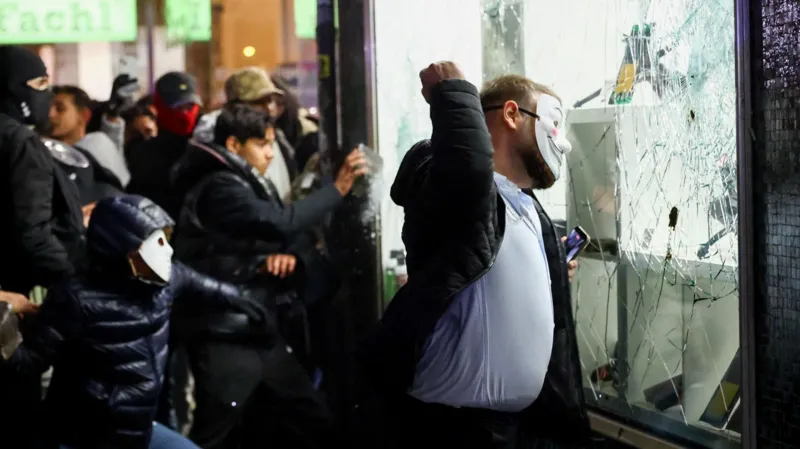
FRANKFURT: Looting and violent clashes with police broke out in central Frankfurt late Saturday following large-scale demonstrations over the rising cost of living and cuts to public services. Although the protests remained largely peaceful during the day, tensions escalated after nightfall, leading to confrontations between demonstrators and security personnel.
Apart from Frankfurt, incidents of violence were reported in Berlin, Cologne and Hamburg. Police used water cannons to disperse protesters who allegedly attacked emergency responders and security personnel with fireworks, stones and bottles.
Thousands of people had earlier participated in demonstrations organised by the youth-led campaign group Gen Z regelt, which translates as “Gen Z takes charge”. The protesters raised concerns over inadequate funding for schools, increasing living costs, reductions in public spending and compulsory military service.
The demonstrations in Germany coincided with similar youth-led protests in France, where more than 320,000 people took to the streets on Saturday.
According to AFP, police cordoned off a large section of Frankfurt’s main shopping street following reports of unrest. A police spokesperson confirmed that numerous arrests had been made in the city.
Authorities in Frankfurt, Munich and Berlin estimated that up to 18,000 people had participated in the demonstrations, approximately half the number projected by organisers. However, German media reported that tens of thousands of people had taken part in protests across the country.
Gen Z regelt spokesperson Lina Friedrich said the movement was advocating peace and freedom rather than war and coercion. She emphasised the need for greater investment in healthcare and education, opposed compulsory military service and called for a fairer distribution of social and economic responsibilities.
While the demonstrations initially proceeded peacefully, the situation deteriorated as evening approached.
In a statement posted on X, Frankfurt police reported violent disturbances in the city centre, including the smashing of shop windows and attacks on emergency personnel with Molotov cocktails.
In subsequent updates, police said the windows of a gun shop had also been broken. Authorities recovered two firearms after arresting a suspect.
Hesse Interior Minister Roman Poseck, whose state includes Frankfurt as its largest city, claimed that around 100 identified left-wing extremists had infiltrated the demonstration. He described the violent conclusion to the protests as shameful and cautioned against a repeat of the unrest witnessed in France.
Poseck said Germany should not regard the scenes of looting, arson and attacks on police officers witnessed in France as an example to follow.
The demonstrations in Germany were part of a wider wave of public protests across Europe over economic hardship, deteriorating public services and government policies.
In France, more than 320,000 people participated in a third consecutive weekend of largely peaceful demonstrations in several cities, demanding action to address the rising cost of living and shortcomings in public services, particularly education.
Thousands of police personnel were deployed across the country to maintain order. Security forces used tear gas in some locations, while clashes in Toulouse, Lyon and Marseille resulted in more than 500 arrests.
French Interior Minister Laurent Nuñez said a police officer had sustained injuries after being struck by a Molotov cocktail. Meanwhile, Paris police reported that several hundred rioters had attacked security personnel with projectiles.
Demonstrations were also reported in Italy, where clashes occurred between police and protesters in Rome and Turin.
In Portugal, police intervened to dismantle a newly established tent camp following a protest involving thousands of people against proposed rental legislation. Demonstrators argued that the proposed measures could further aggravate the country’s housing crisis, amid a sharp increase in property prices over the past decade.
Youth-led demonstrations have recently spread across several European countries, including France, Belgium, Ireland, Spain, Portugal, Italy, Greece, Serbia and Albania, reflecting growing dissatisfaction among younger generations over economic conditions, public services and government policies.
(Inputs from BBC)




Comment