




KATHMANDU: Nepal has expressed strong objection after China and India recently agreed to open a trade route via Lipulekh Pass, territory claimed by Nepal, during Chinese Foreign Minister Wang Yi’s visit to New Delhi earlier this month.
Nepal’s Ministry of Foreign Affairs reiterated that Lipulekh, along with Kalapani and Limpiyadhura east of the Kali River, is an integral part of Nepal under the 1816 Sugauli Treaty. Kathmandu formally conveyed its dissatisfaction with the agreement.
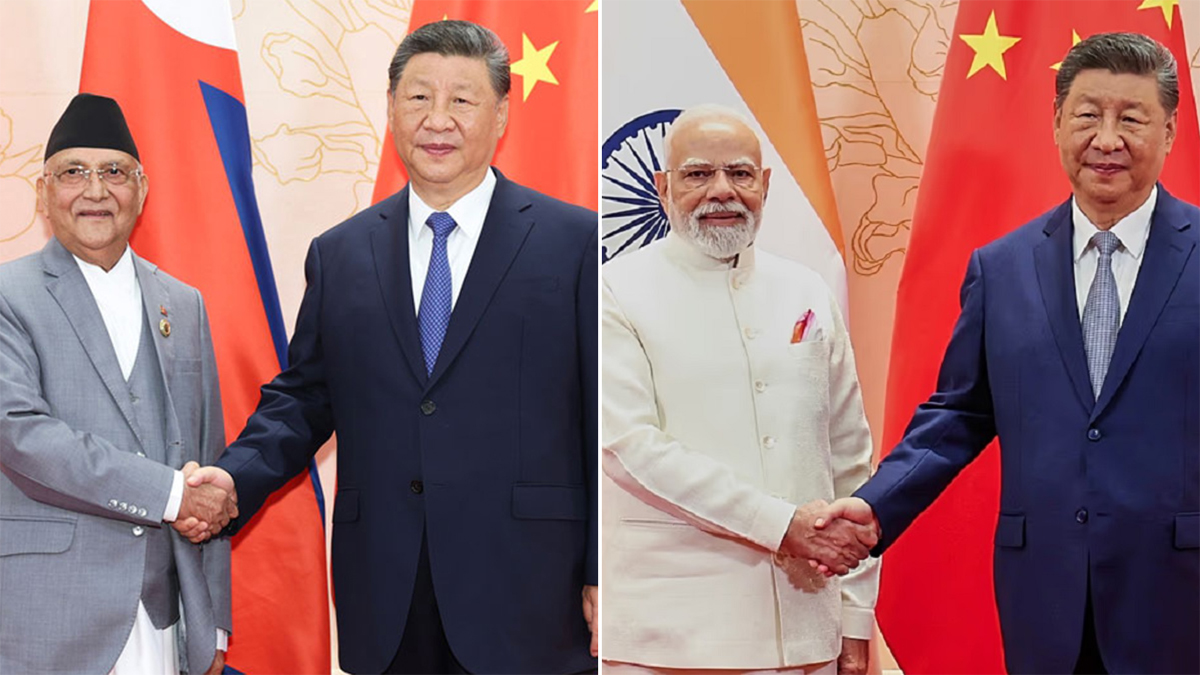
During a bilateral meeting with Chinese President Xi Jinping in Tianjin on Saturday, Prime Minister KP Sharma Oli objected to the China–India understanding on Lipulekh. Foreign Secretary Amrit Bahadur Rai said PM Oli made it clear that bypassing Nepal on matters concerning its territory is “unacceptable.”
In response, President Xi acknowledged Nepal’s claim and assured that China would not undermine Nepal’s position. “We will not take steps that dilute Nepal’s claim. The border issue is for Nepal and India to resolve,” Xi was quoted as saying.
Meanwhile, Indian Prime Minister Narendra Modi held 50 minutes of talks with President Xi on Sunday morning on the sidelines of the Shanghai Cooperation Organisation (SCO) Summit.
The two leaders discussed post-Galwan border disengagement, resumption of direct flights, visa facilitation, and the reopening of the Kailash Mansarovar pilgrimage route. Modi, speaking in Hindi, highlighted that relations between India and China were moving in a “positive direction.”
He underlined four key points: Relations are now moving positively, Peace and stability have been restored after disengagement on the border, the Kailash Mansarovar Yatra has resumed, and direct flights between the two countries will restart.
Although Modi mentioned the reopening of trade routes and the Mansarovar Yatra, he did not explicitly refer to Lipulekh Pass by name.
Despite the controversy, neither India’s Ministry of External Affairs nor China’s Foreign Ministry mentioned Lipulekh in their official readouts. India’s seven-point statement emphasized people-to-people ties, visa facilitation, direct flights, and the resumption of Mansarovar pilgrimages.
However, a 12-point joint statement issued earlier on August 20 during Wang Yi’s Delhi visit had explicitly noted that the two sides agreed to reopen trade through Lipulekh Pass, Shipki La, and Nathu La.
That agreement triggered protests in Nepal, which considers Lipulekh part of its sovereign territory.
In 2020, Nepal formally issued a new political map incorporating Kalapani, Lipulekh, and Limpiyadhura within its borders after India inaugurated a road to Lipulekh for Kailash Mansarovar pilgrims. Kathmandu lodged strong diplomatic protests at the time, citing the Sugauli Treaty of 1816.
Nepal maintains that all areas east of the Kali River, including Lipulekh, belong to Nepal. Despite repeated objections, India continues to develop road infrastructure through the disputed territory.




Comment