




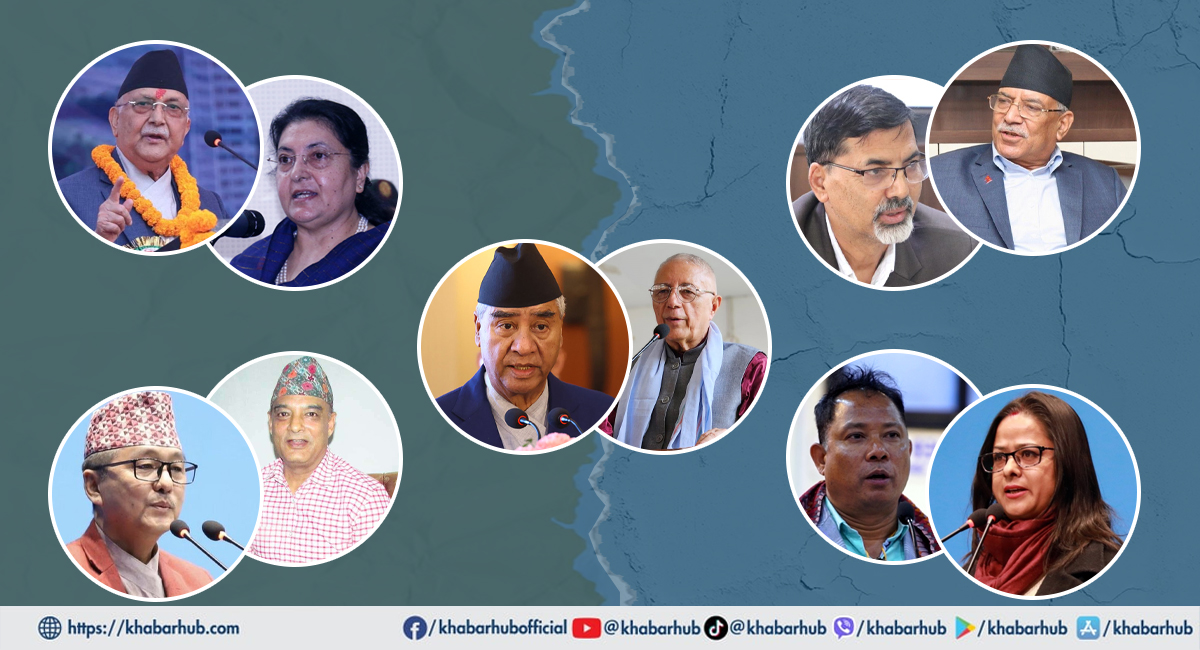
KATHMANDU: The Nepali Congress (NC), one of Nepal’s major political parties, has recently faced growing internal turmoil. The second-largest party, CPN-UML, and the Maoist Centre, which once led a decade-long armed movement, have also seen a rise in internal disputes and power struggles.
In newer political formations, the Nagrik Unmukti Party has also been affected. Founded by Resham Chaudhary—currently in prison for the Tikapur incident—the party is now divided due to tensions between Chaudhary and his wife Ranjita Shrestha.
Initially, the party could not be registered legally. Later, Ranjita Shrestha led the registration process with the Election Commission under her leadership.
The party had unexpected success at the local, provincial, and federal levels during its first electoral participation. However, disputes between Resham and Ranjita Shrestha have led to factionalism. The party’s internal crisis deepened as a majority of the executive committee members decided to oust Chairperson Ranjita Shrestha in a meeting held recently. The meeting resolved to recommend her removal to the Election Commission.
In response, Ranjita Shrestha handed over the position of working chair to senior leader Ganga Ram Chaudhary, as selected by the parliamentary party. The internal division in the Nagrik Unmukti Party mirrors a broader trend of younger factions challenging established leadership—not only within the party but also within major parties like the Nepali Congress.
In the Rastriya Prajatantra Party (RPP), internal conflict has also intensified. The party, which advocates for a return to constitutional monarchy and the reversal of federal republicanism, is witnessing a leadership rift between Chairman Rajendra Lingden and senior leader Dr. Prakash Chandra Lohani.
Meanwhile, the Nepali Congress has been rocked by internal strife since its Central Disciplinary Committee took action against 18 leaders and workers accused of indiscipline during the last parliamentary elections. These individuals have since aligned with senior leader Shekhar Koirala, forming a splinter group in protest.
Koirala is dissatisfied with how party president Sher Bahadur Deuba handled the disciplinary actions. His faction held a meeting at his contact office in Baneshwor and announced a political resistance campaign against what they deemed an unjust decision by the committee. They demanded reinstatement and called the actions unfair.
Following the meeting, Koirala intensified his political engagements. Recently, he met with Maoist Centre Chairperson Pushpa Kamal Dahal ‘Prachanda’. This was interpreted as a strategic political move, possibly to exert pressure on Deuba by building external alliances. Further discussions were held with ministers and MPs at a hotel in Tinkune, signaling a broader political maneuver.
Observers suggest that Koirala’s increasing engagement with Prachanda may signal an effort to shake up the current government or challenge Deuba’s leadership within the party.
Meanwhile, CPN-UML is also experiencing internal instability. After a Central Committee meeting, the party suspended the active membership of long-time leader Binda Bhandari. This has triggered widespread dissatisfaction. Bhandari, a UML member for 45 years and once endorsed by Madan Bhandari himself, publicly protested the decision. He stated, “No one has the right to strip me of my party membership.”
These developments in all three parties—Nepali Congress, CPN-UML, and Nagrik Unmukti Party—reflect growing internal fragmentation, generational clashes, and leadership struggles across Nepal’s political spectrum.
Kathmandu: Controversy has erupted within the CPN-UML as former President Bidya Devi Bhandari appears to be stepping back into active politics. The party leadership has made efforts to prevent her return to political engagement, but Bhandari has publicly criticized this move.
Bhandari’s actions reignited the debate when the UML made public a decision from its Central Committee meeting. The party announced that Bhandari’s activities violated its internal code of conduct, undermined party discipline, and disrespected party leadership.
The UML accused Bhandari of engaging in political activities after officially severing ties with the party and her presidential role. A statement from the party emphasized, “While former President Bhandari should be respected as a national figure, engaging in active politics must adhere to the party’s code of conduct and discipline.”
Meanwhile, in the Maoist Centre, internal friction has grown between Chairman Pushpa Kamal Dahal ‘Prachanda’ and Deputy General Secretary Barshaman Pun. Tensions intensified after Pun submitted a nine-point proposal to the party, following the formation of the new coalition government with the Nepali Congress and UML.
Addressing a Maoist event in Kathmandu, Prachanda claimed there was a deliberate plot to weaken both the Maoist movement and its leadership. “Some individuals are working to divide and confuse the party ranks,” he said. “There is a clear effort to undermine the party from within.”
Prachanda also expressed frustration, stating that he had provided ample space for internal discussion and debate, but that certain members were misusing that freedom. “I have allowed enough room for differing opinions,” he said, “but now that generosity is being exploited.”
The rift between Prachanda and Pun has played out publicly, with both leaders making veiled criticisms on social media. On Sunday, Maoist leader Mahendra Bahadur Shahi posted on Facebook, calling for unity and a return to party ideals. “Let us expose those who seek personal gain from the party’s legacy,” he wrote, urging for “a campaign of ideological clarity and organizational purification.”
Despite the internal turmoil, Chairman Lingden has publicly denied the existence of any factionalism within the party. “Even today, we are united. There may be differences of opinion, but that is part of a healthy democratic process,” Lingden said, dismissing any suggestion of internal division.
In the Rastriya Prajatantra Party (RPP), internal conflict has also intensified. The party, which advocates for a return to constitutional monarchy and the reversal of federal republicanism, is witnessing a leadership rift between Chairman Rajendra Lingden and senior leader Dr. Prakash Chandra Lohani.
Lohani and his supporters accuse Chairman Lingden of acting unilaterally and ignoring the party’s statutes. The disagreement peaked after Lingden dismissed several leaders from the party’s Discipline Committee and Standing Committee. In response, a faction led by former minister Lohani has filed a formal complaint with the Election Commission.
While Chairman Rajendra Lingden was undergoing cancer treatment in India, he was removed from the helm of the party’s organizational leadership. Senior Vice President Bikram Pandey, Vice President Mukundraj Ghimire, and central members like Giri, Dibweswori Rana, and Kunti Shahi have all raised serious allegations against him. In a joint statement, they claimed that Lingden’s leadership has caused irreparable damage to the Rastriya Prajatantra Party (RPP).
Despite the internal turmoil, Chairman Lingden has publicly denied the existence of any factionalism within the party. “Even today, we are united. There may be differences of opinion, but that is part of a healthy democratic process,” Lingden said, dismissing any suggestion of internal division.
However, party insiders argue that the rift within the RPP has only widened since the last general convention. They claim the organization is becoming increasingly dysfunctional, with a growing gap between key factions. The absence of a neutral mediator to bridge these divides has made reconciliation more difficult.




Comment