




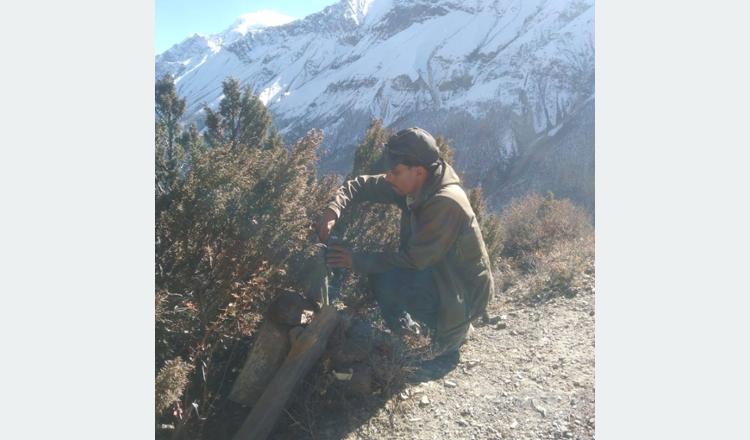
MANANG: A snow leopard survey is underway in Manang to collect data on the endangered species, which is regarded as an indicator of the Himalayan ecosystem.
The National Trust for Nature Conservation (NTNC) and the Annapurna Conservation Area Project (ACAP) are jointly conducting camera trapping with experts to monitor the status, population and associated wildlife of snow leopards in the region.
Dhak Bahadur Bhujel, chief of the Annapurna Conservation Area Project Unit, said the survey aims to assess the condition of the rare and endangered snow leopard within the Annapurna Conservation Area. He said studies conducted in the high Himalayan areas of Narphu, Ngisyang, Khangsar, Tilicho, Gumsang and Bhimthang have confirmed Manang as one of the major potential habitats for the species.
“The snow leopard is an indicator species of the Himalayan ecosystem. If its population is secure, it means the overall ecosystem of the area is in good condition,” Bhujel said. According to him, areas around Ngisyang, Narphu and Tilicho have been identified as key potential habitats. Camera traps have been installed based on evidence such as footprints, scat samples and information from local herders.
Wildlife and environmental experts involved in the survey say snow leopard conservation goes beyond protecting a single species, as it is directly linked to the health of the Himalayan ecosystem, local livelihoods and future tourism.
Bhujel said the study area has been divided into three zones—the Ngisyang Valley, Bhimthang Valley and Narphu Valley—spanning elevations from about 3,200 metres to over 5,200 metres above sea level.
These zones include alpine grasslands, patches of coniferous forest, dry riverbeds, ridgelines and animal trails, all of which are prime habitats for snow leopards and their prey. A total of 129 cameras have been installed, with 57 in the Ngisyang Valley, 29 in the Bhimthang Valley and 43 in the Narphu Valley.
The survey is also being conducted in collaboration with an international researcher studying the Himalayan wolf, with 22 cameras and related data being shared, according to ACAP. “If the snow leopard is safe, it indicates that prey species such as blue sheep, alpine grasslands and the overall Himalayan environment are in a balanced state,” Bhujel said.
The monitoring study, which began on October 14, 2024, covers the Bhimthang Valley and the Annapurna–Manaslu region, identified as key snow leopard habitats in the Snow Leopard Profile Study (Chhetri et al., 2017).
For the study, NTNC and ACAP divided the Manang block into 14 grid cells, each measuring 5×5 square kilometres. Camera traps were randomly installed within each grid to ensure systematic and unbiased data collection. Cameras were placed along animal trails, ridgelines, forested areas, water sources and known or suspected prey zones, away from human settlements and infrastructure.
Data on prey species are also being recorded within each grid to support snow leopard population estimates and ecosystem analysis. Equipment such as cameras, batteries, memory cards, gloves, silica gel, scat collection tubes and data recording forms has been deployed.
Bhujel said preliminary findings estimate the snow leopard population in the area to be around 50, although final figures will be available after the survey is completed. The installed cameras have captured images of various wildlife species, including the Himalayan wolf, red fox, blue sheep, musk deer, yellow-necked marten, Himalayan serow, ghoral and leopard cat, indicating a healthy and balanced mountain ecosystem.
The data collected through camera trapping, scat surveys and predation assessments are expected to help identify human–wildlife conflict hotspots. ACAP says the findings will support measures such as improved livestock management, poaching control, seasonal grazing regulation and community awareness programs to promote coexistence.
These efforts are expected to further strengthen snow leopard conservation and may contribute to an increase in their population. The survey is being conducted with support from the National Red Cross Association (NRCA), Prakash Adhikari of NTNC–ACAP Manang, Conservation Officer Gopal Khanal of the Department of National Parks and Wildlife Conservation, and Om Bahadur Gurung, Gyan Bahadur Gurung, Yam Bahadur Gurung and Bhaktasin Gurung of NTNC–ACAP Manang.






Comment