




KATHMANDU: On August 5, the government decided to make embossed number plates mandatory for vehicles across the country.
The decision was made during a meeting of the thematic committee comprising transport ministers from all seven provinces and local representatives, chaired by Minister for Physical Infrastructure and Transport Devendra Dahal.
Following this decision, the Department of Transport issued a public notice on August 19 stating that embossed number plates would be mandatory for vehicle registration, transfer, and renewal at all provincial transport management offices, effective from September 17, 2025. However, the decision was met with widespread criticism.
Responding to growing public backlash—expressed through media coverage, social media, and transport-related organizations—the Ministry of Transport withdrew its decision on August 26.
In a subsequent statement, the Department of Transport clarified that the installation of embossed number plates would proceed gradually for government, private, and public vehicles.
However, it confirmed that no immediate penalty or enforcement action would be taken starting September 17. The Department also requested that vehicle owners install the plates at their convenience and support the broader digitalization initiative.
It further clarified that necessary infrastructure and manpower had been arranged at the central and provincial levels to facilitate the process, with additional support available to assist service recipients and vehicle owners.
Nepali Congress leader Dr. Minendra Rijal, who has previously headed the Ministries of Culture; Communication; and Defense, has criticized the Congress-UML-led government for operating on an ad hoc basis. In a conversation with Khabarhub, Rijal said the current situation is a result of the government’s lack of strategic direction.
Meanwhile, on February 24, 2025, the government appointed Sharad Ojha as Chairman of the Nepal Insurance Authority, the regulatory body overseeing insurance companies. Ojha’s appointment was controversial from the outset. As the controversy deepened, the Council of Ministers formed an investigation committee on July 14, led by former High Court judge Krishna Giri.
Ojha was suspended when the committee was formed. The government was forced to reverse its decision after the Giri-led committee concluded that Ojha was unqualified for the position and had submitted fake documents to secure the appointment.
He was officially removed from office at a cabinet meeting on the night of August 18 — ending his six-month tenure in dismissal and controversy.
Likewise, the government introduced six ordinances on December 29, 2024 and January 13, 2025, which were later approved. Despite resistance from opposition parties, five of the ordinances presented in the House of Representatives on March 5, 2025 were passed.
However, the government refrained from presenting the land ordinance issued by President Ram Chandra Paudel in the same month, citing ongoing internal discussions.
Facing opposition from the Janata Samajwadi Party (JSP) Nepal and the Loktantrik Samajwadi Party (LSP) Nepal, the government—despite holding a near two-thirds majority with the support of the Nepali Congress and CPN-UML—ultimately backed down. A meeting of ruling coalition parties on March 26 concluded that the land ordinance could not move forward.
On July 1, 2024, the Nepali Congress and UML—the two largest parties in the House of Representatives—reached a seven-point agreement to form a coalition government.
A key point of the agreement was a commitment to constitutional amendment. Yet, more than 14 months later, the government has made no progress on the issue, and no official proposal has been introduced.
Opposition parties have accused the government of using the promise of constitutional amendment as a tactic to hold onto power without genuine intent to implement changes.
Less than two months into Prime Minister KP Sharma Oli’s current tenure, the ruling parties initiated a campaign to remove Deputy Speaker Indira Rana Magar.
The campaign began with discussions at a coalition meeting in Baluwatar on September 9, 2024 , followed by a signature drive in the House of Representatives the next day.
On August 19, 2025, MPs from the Nepali Congress and UML were asked to sign blank sheets of paper supporting Rana Magar’s removal while she was in the U.S. However, Congress leader Dr. Shekhar Koirala opposed the move and refused to sign. As a result, Rana Magar’s position was preserved—for the time being.
Mainali stressed the importance of mature governance. He criticized the current Congress-UML-led coalition for making immature decisions, which he said has weakened the government’s credibility.
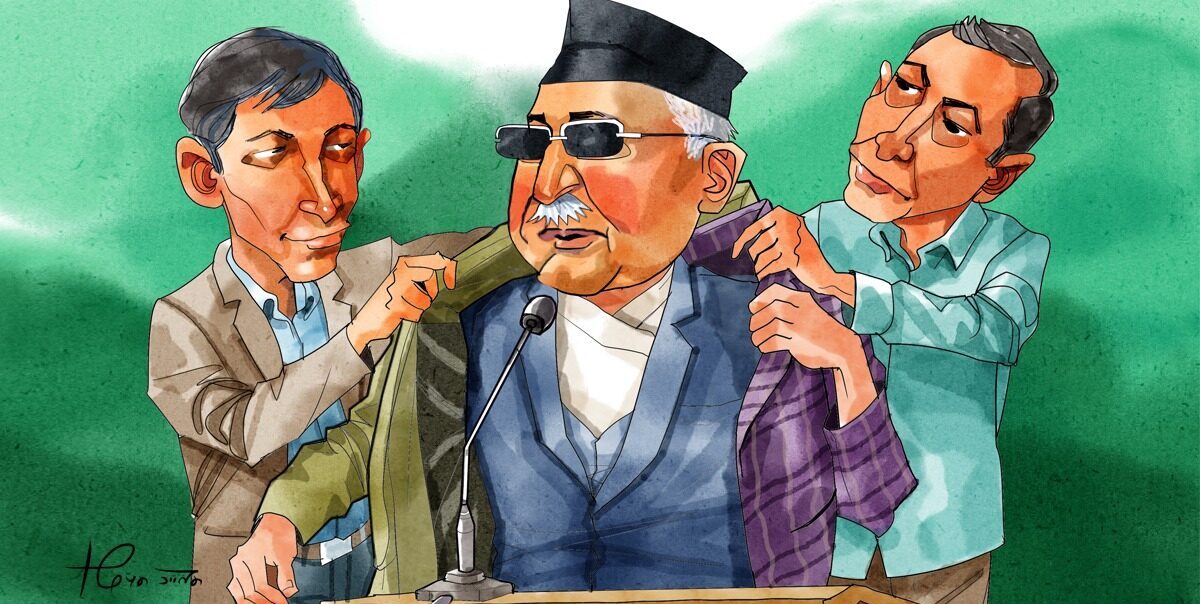
These incidents illustrate a pattern within the Congress-UML coalition government: decisions are made swiftly, but quickly reversed under public or political pressure. The ruling coalition itself appears increasingly frustrated by the government’s tendency to act first and retreat later.
Nepali Congress leader Dr. Minendra Rijal, who has previously headed the Ministries of Culture; Communication; and Defense, has criticized the Congress-UML-led government for operating on an ad hoc basis. In a conversation with Khabarhub, Rijal said the current situation is a result of the government’s lack of strategic direction.
“The government has been run on an ad hoc basis,” Rijal stated. “After the Congress and UML formed the government, it should have set clear guidelines. But this government has become ad hoc.”
Rijal described this ad hocism as the coalition’s biggest managerial flaw. “This is our biggest managerial problem,” he noted.
He further warned that without resolving this issue, both the country and the coalition parties will face serious consequences. “If the managerial problem is not solved, the country will face difficulties, and so will we—the parties in the coalition,” he said.
Former Home Secretary and ex-chairman of the Public Service Commission, Umesh Mainali, echoed similar concerns. He attributed the current instability to the government’s failure to assess the impact of its decisions before implementation.
“Decisions are being made without understanding the consequences or consulting stakeholders,” Mainali told Khabarhub. “Once decisions are made, they face opposition—and then they’re withdrawn. This is not a good sign.”
Mainali stressed the importance of mature governance. He criticized the current Congress-UML-led coalition for making immature decisions, which he said has weakened the government’s credibility.
“There is no maturity in the decisions being made,” he said. “Decisions should be well thought-out and firmly implemented. When decisions themselves are immature, the government’s existence is questioned.”




Comment