




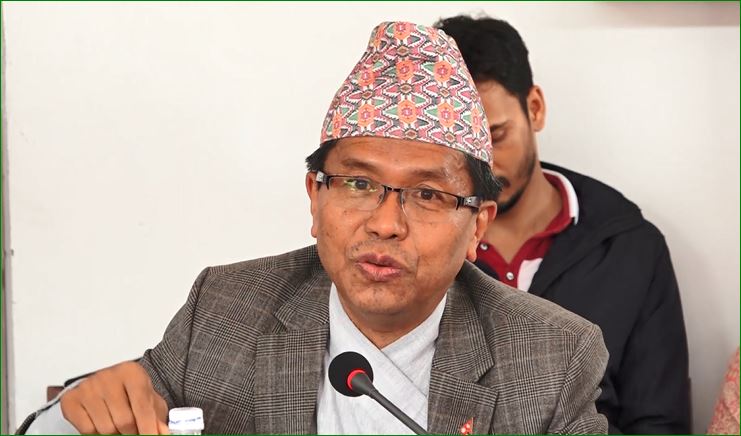
KATHMANDU: The credibility of the Commission for the Investigation of Abuse of Authority (CIAA) has come under serious strain following the publication of the Special Court’s full verdict on the wide-body aircraft procurement scandal.
In a rare move, the court named and directly criticized CIAA Chief Commissioner Prem Kumar Rai, raising serious ethical questions about his continued presence in office.
The court, while sentencing several officials involved in the wide-body procurement case, pointed to what it called “selective prosecution” by the CIAA, suggesting that while Rai, then serving as Secretary at the Ministry of Culture, Tourism and Civil Aviation and chair of the Nepal Airlines board, had played a central role in forming the procurement subcommittee, he faced no legal scrutiny in the case.
Others who merely acted on decisions taken in Rai’s presence were prosecuted, but Rai was not. This inconsistency, the court observed, undermines the principle of equal justice and weakens public trust in the rule of law.
Despite being widely regarded as a clean administrator with a modest lifestyle and no known record of personal corruption, Rai now finds himself at the center of an ethical storm. The question is no longer about personal financial misconduct, but rather about moral responsibility, perceived bias, and conflicts of interest.
As the head of a constitutional anti-corruption body, Rai is expected not only to uphold legal standards, but also the highest levels of public integrity and impartiality.
The controversy surrounding Rai is not limited to this verdict. His appointment itself was the subject of a legal challenge. He was one of 52 constitutional officials appointed through an ordinance issued by the Oli-led government, an ordinance whose constitutionality remains disputed.
A constitutional bench of the Supreme Court recently delivered a fractured verdict on the matter, with only two of the five justices affirming his appointment. Even before the court ruled on his eligibility, Rai had assumed office at the CIAA, choosing not to recuse himself despite the legal uncertainty surrounding his tenure.
Questions have also been raised about Rai’s conduct while leading the CIAA. Critics allege that under his leadership, the commission has taken an unbalanced approach to investigations, pursuing opposition leaders in high-profile cases such as the Patanjali land deal involving former Prime Minister Madhav Kumar Nepal, while appearing to shield figures aligned with the ruling party. Such perceptions of partisanship are corrosive to the public image of an institution that is meant to function as a neutral guardian of accountability.
Adding to the growing unease, activist Yubaraj Saphal has filed a formal complaint against Rai at the CIAA itself, citing both ethical concerns and potential conflicts of interest. There is also discontent in civil society and political circles over Rai’s position, with many suggesting that his presence now compromises the moral authority of the institution he leads.
Nepal’s Constitution is clear in its expectations. Article 238 (6)(g) specifies that officials appointed to the CIAA must possess “high moral character.” The Special Court’s verdict, by explicitly questioning the selective nature of prosecution decisions under Rai’s leadership, directly challenges his compliance with that standard.
In past instances, including the case of former Home Minister Rabi Lamichhane, the Supreme Court has interpreted moral integrity as a standard that must be upheld even in the absence of a formal conviction or legal compulsion.
While Rai’s supporters may point to his past contributions to anti-corruption policy and his reputation for personal honesty, those factors alone cannot insulate him from accountability when the moral standing of the office is under question. In fact, his record of service makes it all the more imperative that he act with dignity and set a precedent for ethical leadership.
A resignation now would not mark a fall from grace, but rather a principled act of responsibility. In a country where officeholders often cling to power until forced out by scandal or litigation, Rai’s voluntary departure would offer a powerful example of moral accountability in public service. It would protect both his own reputation and the credibility of the CIAA, an institution critical to the fight against corruption in Nepal.
If the integrity of public institutions matters, and if the idea of impartial justice is to be preserved, then Prem Kumar Rai must step down. His resignation will not collapse the system, but may just help restore faith in it.




Comment