




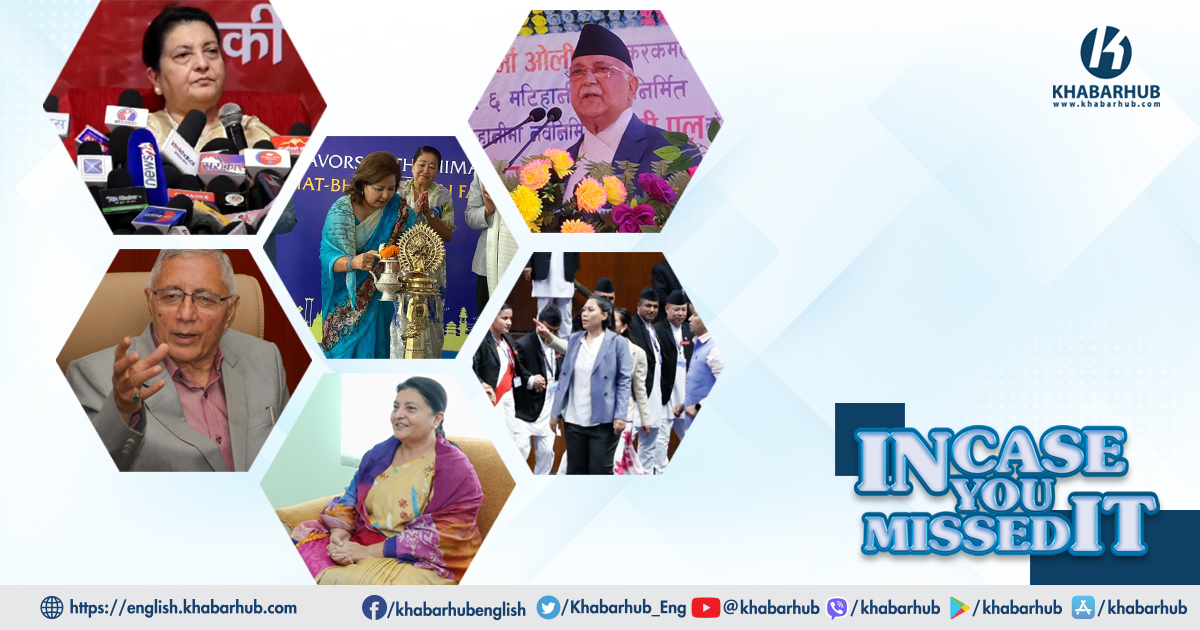
KATHMANDU: Last week in Nepali politics was marked by a powerful convergence of personal ambition, constitutional debate, institutional instability, and factional maneuvering—most notably centered around the dramatic fallout between the CPN-UML and former President Bidya Devi Bhandari.
The political theatre surrounding her blocked reentry into the party spotlighted tensions not only within the UML but also within Nepal’s broader democratic framework, where the line between constitutional decorum and political expediency remains dangerously fluid.
At the heart of the controversy was Bhandari’s defiant press appearance, in which she challenged the party’s decision not to renew her membership. With forceful clarity, she framed her 45-year-long affiliation with the UML as an unerasable legacy and cast herself as a loyal party worker wronged by institutional betrayal.
Her appeal rested heavily on the narrative of political continuity, personal integrity, and commitment to party values. She denied any ambition for power, asserting instead a desire to contribute to the party and nation from a position of democratic service, not authority.
Yet, the UML’s central committee, led by party chair and Prime Minister KP Sharma Oli, took a hardline position. Citing constitutional provisions—particularly Article 61, which mandates the political neutrality of the head of state—the party argued that her return to partisan politics would undermine the sanctity of the presidency and blur the essential boundary between the state and party politics.
The Ministry of Home Affairs also moved ahead with its institutional reform agenda, deploying 45 newly appointed branch officers at the Tribhuvan International Airport immigration office and forming a high-level study panel on immigration reform.
UML spokespersons stressed that someone who once served as the constitutional guardian of national unity and the army’s supreme commander could not return to the political trenches without damaging the credibility of the institution she once led.
However, the party’s invocation of constitutional morality seems selective. Nepal’s Constitution, while emphasizing the President’s non-partisan character during office, remains ambiguous on the post-presidential role. What unfolded last week appeared less about constitutional propriety and more about political calculation.
The fact that Bhandari had long been a trusted ally of Oli and held one of the party’s most senior positions before becoming President complicates the UML’s public posture. Internally, Oli is likely confronting factional resistance, with influential voices in the party wary of Bhandari’s return potentially disrupting established power hierarchies, especially ahead of the UML’s upcoming Statute Convention in September.
The behind-closed-doors meeting between Oli and Bhandari at the UML headquarters in Chyasal further hinted at the duality of party politics—where symbolic gestures coexist with hard strategic decisions. Despite her personal rapport with Oli and prior loyalty, Bhandari found herself stonewalled, her renewed membership unacknowledged, and her political comeback dismissed under the guise of constitutional decorum.
This tension also underlines a deeper problem in Nepali politics: the lack of clarity and consensus on the role of former high office-bearers in party politics. While former presidents, prime ministers, and justices often reenter the political fray globally, Nepal’s young republican system lacks the institutional maturity or legal infrastructure to manage such transitions gracefully.
As such, the Bhandari episode becomes more than a party dispute—it is a constitutional test case that will shape the informal rules of post-office political behavior in the years to come.
Meanwhile, political undercurrents elsewhere continued to shift. The resignation of four ministers in Bagmati Province, following their meeting with Nepali Congress President Sher Bahadur Deuba, suggests a possible reconfiguration of provincial coalitions.
These resignations—whether part of a larger strategy or isolated dissent—highlight the ongoing fragmentation of provincial politics, where alliances are fluid, and party loyalty often secondary to strategic advantage.
Prime Minister KP Sharma Oli, on the other hand, attempted to project decisiveness through governance action. His announcement of 500 deep borings in the drought-stricken Madhes Province served as a populist and urgent response to the region’s deepening water crisis.
By aligning himself with the pressing needs of Madhesi farmers, Oli reinforced his image as a leader in action, especially at a time when his party is facing internal rifts and reputational strain.
On the diplomatic front, Nepal’s engagement with China gained momentum. The signing of multiple MoUs, including a cross-border power transmission feasibility study, human resource development cooperation, and healthcare infrastructure support, reinforced Kathmandu’s growing dependency on Beijing for development financing and capacity building.
These agreements, while beneficial in the short term, also raise long-term strategic concerns regarding sovereignty, economic leverage, and geopolitical alignment in an increasingly polarized global environment.
Domestically, the week was also significant for a renewed push against corruption and institutional mismanagement. The arrest of investor Dipendra Agrawal in a high-profile fraud case, and the CIAA’s summoning of former minister Rajkumar Gupta for a voice test in a bribery scandal, underscored rising pressure for accountability.
While such actions are necessary and welcomed by the public, selective enforcement and the lack of systemic reform continue to cast doubts on the sincerity and depth of Nepal’s anti-corruption drive.
The Ministry of Home Affairs also moved ahead with its institutional reform agenda, deploying 45 newly appointed branch officers at the Tribhuvan International Airport immigration office and forming a high-level study panel on immigration reform.
In sum, last week’s political developments paint a picture of a democracy in flux. Bidya Devi Bhandari’s contested political reentry, KP Sharma Oli’s calculated response, a series of institutional reforms, diplomatic engagements, and protests all point to a state navigating a delicate and often contradictory path between legality and loyalty, between populist rhetoric and constitutional restraint.
These moves suggest a willingness to address bureaucratic dysfunctions, though real impact will depend on the implementation of structural changes rather than temporary personnel reshuffles.
Finally, the repeated disruption of parliamentary proceedings by the Rastriya Swatantra Party (RSP) and Rastriya Prajatantra Party (RPP) reflected growing legislative gridlock. Their demand for a high-level probe into the visit visa scandal, which they claim has been mishandled by the executive, illustrates the mounting frustration among smaller and opposition parties over issues of governance and transparency.
Their boycott of proceedings signals not just a parliamentary tactic but a deeper crisis of confidence in institutional mechanisms of oversight.
In sum, last week’s political developments paint a picture of a democracy in flux. Bidya Devi Bhandari’s contested political reentry, KP Sharma Oli’s calculated response, a series of institutional reforms, diplomatic engagements, and protests all point to a state navigating a delicate and often contradictory path between legality and loyalty, between populist rhetoric and constitutional restraint.
The weeks ahead will likely determine whether Nepal’s political actors can rise above tactical brinkmanship to uphold democratic norms—or whether power, once again, will trump principle.




Comment