




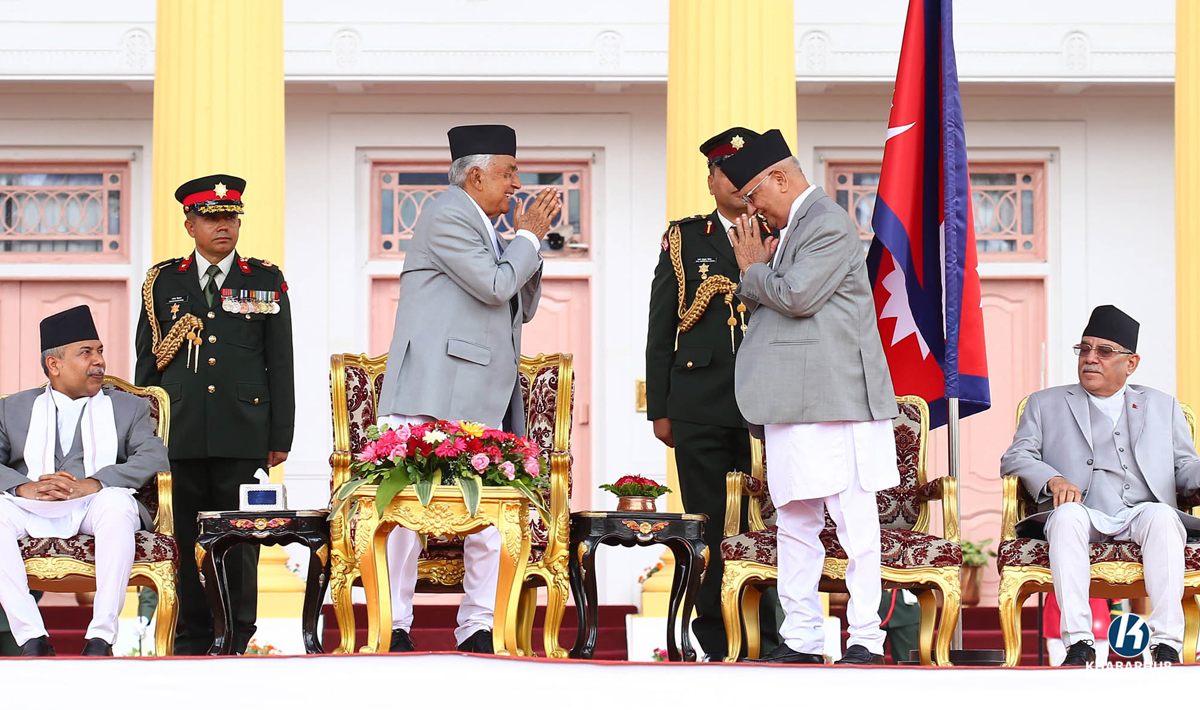
KATHMANDU: A controversial bill seeking to amend the Constitutional Council Act has triggered a major institutional clash in Nepal, drawing sharp lines between Prime Minister KP Sharma Oli and President Ram Chandra Paudel.
The conflict, which began within Parliament, has now extended all the way to the President’s Office, signaling deepening friction within the country’s constitutional framework.
The bill, which was endorsed by both the House of Representatives and the National Assembly, was sent to the President for final certification on July 15. However, President Paudel returned it unsigned, citing that the proposed changes undermined the spirit and intent of the Constitution and democratic norms.
His decision has forced the government to reconsider the legislation, which cannot now be resubmitted in the same form without risking further political backlash.
At the heart of the dispute lies an attempt by the Oli government to amend Section 6 of the 2009 Constitutional Council Act. This section governs how meetings of the Council are conducted, including quorum requirements and procedures for decision-making.
The amendment sought to relax these standards, allowing decisions to be made even if only three out of the five members of the Council were present. The President, in his written explanation to Parliament, described this provision as potentially dangerous, suggesting it could enable arbitrary decision-making and reduce accountability in appointments to vital constitutional bodies.
President Paudel, a senior figure in the ruling Nepali Congress party, appears to have been influenced by growing unease within his own party over the bill. Although the Nepali Congress helped pass the bill in Parliament, internal voices had raised concerns that the amendments could undermine the democratic foundation of the Council’s operations.
Legal experts and opposition parties also expressed strong objections, warning that the bill could set a dangerous precedent by consolidating power within the executive.
The President’s refusal to certify the bill has not only created a rift between Sheetal Niwas and Singha Durbar but also exposed the vulnerabilities and contradictions within the ruling coalition. Prime Minister Oli, who had expected the President to promptly sign off on the bill, now faces internal dissent and renewed criticism from opposition parties and legal scholars.
Analysts say the government miscalculated the President’s stance, assuming that his political past with the Nepali Congress would guarantee compliance.
The bill’s origins date back to 2020 when then Prime Minister Oli, facing internal rebellion within the Nepal Communist Party, dissolved Parliament and introduced an ordinance with similar provisions. That ordinance allowed decisions in the Constitutional Council with only three members present and was immediately approved by then-President Bidya Devi Bhandari.
Using the ordinance, Oli appointed over 50 individuals to key constitutional bodies without undergoing the standard parliamentary hearings. Critics at the time labeled the move an abuse of power, and although the Supreme Court later overturned the dissolution of Parliament, it did not invalidate the appointments, a decision that remains controversial.
President Paudel’s move to return the bill marks a departure from the past, where the President’s role was largely seen as ceremonial in such matters. His detailed response raises fundamental concerns about the balance of power in a parliamentary democracy and emphasizes the need for inclusive, participatory, and transparent decision-making in constitutional appointments.
In the aftermath of the President’s decision, the government faces a dilemma. It cannot send the same bill back without making revisions, as doing so would not only risk another rejection but also raise questions about its respect for the Constitution and democratic processes.
The Nepali Congress is itself divided, having supported the bill in Parliament but now grappling with criticism from within its ranks. Meanwhile, the opposition remains disorganized, failing to mount a unified response to the government’s maneuvering.
Constitutional experts argue that the President’s decision was necessary to protect the integrity of the system. Dr. Bhimarjun Acharya, a prominent constitutional scholar, said that the bill was flawed from the outset and Parliament acted irresponsibly by passing it.
He warned that sending the bill back in the same form would be a mistake and urged lawmakers to revisit the proposal with a commitment to constitutional values.
The controversy also brings the judiciary under scrutiny. A recent Supreme Court verdict upheld the appointments made under the original ordinance, further complicating the political environment. Critics argue that the court failed in its duty to safeguard the Constitution, and the decision has contributed to a growing perception of institutional erosion.
The current deadlock highlights the broader challenge facing Nepal’s democracy — a lack of accountability and clarity in the relationship between key constitutional bodies. The fallout from this bill has cast a shadow over the government, the legislature, and the judiciary, revealing systemic weaknesses that could have long-term consequences.
As the government deliberates its next move, it faces increasing pressure to respect the President’s concerns and rework the bill in line with constitutional principles. Anything less would risk deepening the crisis and undermining the credibility of Nepal’s democratic institutions at a critical juncture in its political evolution.





Comment