




KATHMANDU: The government led by Sushila Karki, which was mandated to hold elections in March 5, 2026, after resolving the political crisis created by the Gen-Z “uprising” September 8 and 9, has come under increasing controversy in recent days.
Tensions between this government, formed in the wake of the Gen-Z movement, and representatives of the Gen-Z uprising appear to be steadily growing.
The CPN-UML, one of the largest parties in the country, has continued to demand the restoration of the dissolved parliament, arguing that elections will not take place under the current circumstances.
The clash between CPN-UML cadres and the Gen-Z group in Simara, Bara has further heightened political suspicion. Critics argue that the government has failed to effectively lead the country through the transition. Recent incidents involving attempts to obstruct leaders’ basic rights to travel, move freely, and express their views have added to doubts about the overall election environment.
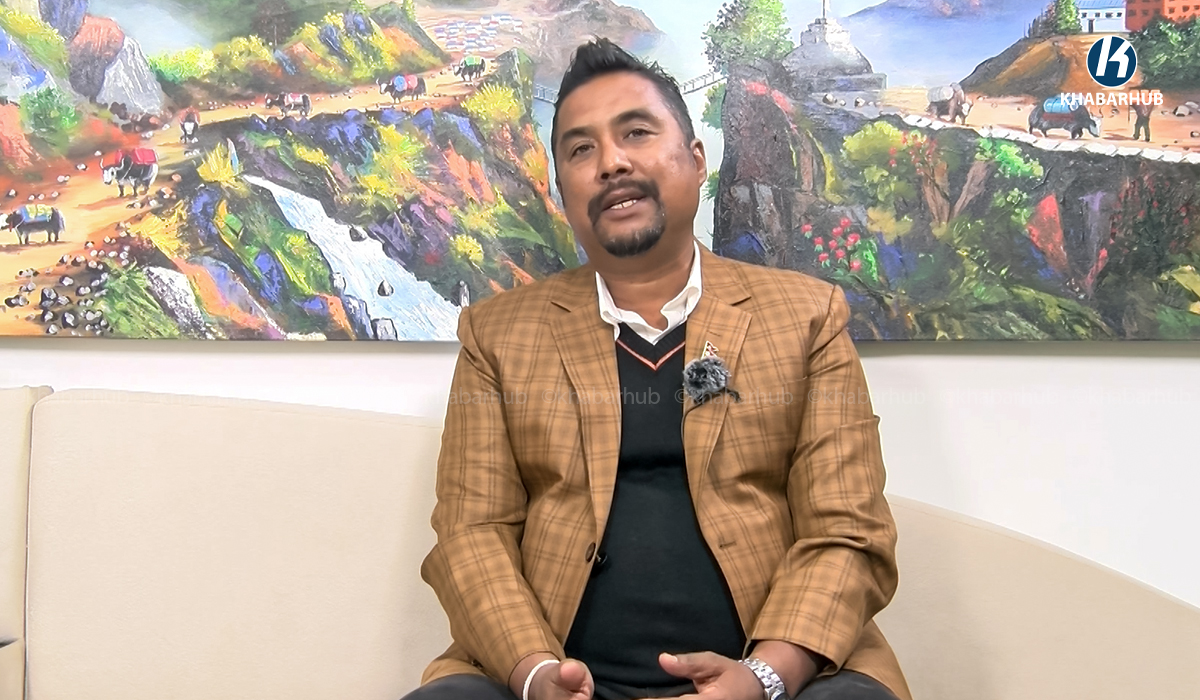
Before the Gen-Z uprising, the Rastriya Mukti Party Nepal was conducting a nationwide liberation campaign under the leadership of Suman Sayami. However, the campaign has slowed down in the aftermath of the Gen-Z upheaval. As the country enters a period of uncertainty following the events of September 9, we spoke with Sayami about the current political situation. Sayami himself is dissatisfied with the working style of the interim government led by Sushila Karki, stating that the government has failed to address the Gen-Z agenda. Below is an edited excerpt from his interview with Khabarhub on this subject:
Before the Gen-Z movement, you were running a national-level campaign. But did the upheaval of September 8 and 9 discourage you?
After the Gen-Z movement, the country’s objective situation has changed significantly. The date for the House of Representatives election has been set for March 5, 2026, and we are preparing for it. We will go to the election—there is no alternative to elections in a democracy.
Our party is not in a weakened state; we are actively campaigning. We have formed the entire National Council to exercise authority there. We consider political parties only as a medium or tool. Continuing in the old style will not achieve anything. That is why we are now working on economic, social, political, and other plans through the Newa: Nation Council.
First, we had to bring the country out of the old ideas that polarized it. We cannot move forward with the ideas of capitalism and Marxism. These ideologies have caused problems and conflicts worldwide. We are not seeing sustainable societies emerging from them.
That is why we are developing the concept of a pluralistic nation-state and community socialism based on patriotism. The Gen-Z movement, by changing the overall situation, has compelled us to rethink and adjust our strategy.
In your opinion, what is the mandate of the Gen-Z movement?
Due to widespread dissatisfaction, a kind of rebellious spirit arose among the Gen-Z —something that was bound to happen. It also had positive effects. The movement clarified the need for generational transition and increased responsibility. It also emphasized the importance of giving space to the youth.
The movement made us aware that corruption can affect up to three generations—this was an important realization. However, the destruction and the loss of many young lives during the incident of September 9 is deeply tragic.
Another positive outcome is that political awareness among the youth has increased. There is now a visible understanding that our problems can—and must—be solved politically. But recent developments are worrying. The burning of houses resembles the beginnings of a civil war. The interim government led by Sushila Karki does not appear capable of handling this situation.
What is the status of the Gen-Z mandate in the current political balance of power?
The demands of Gen-Z are not being fulfilled at present. While the parliament has been dissolved, there are discussions about amending the constitution, holding direct elections for the executive, and taking action against perpetrators of violence. Meanwhile, the current government seems trapped in uncertainty and confusion.
It is trapped strategically, administratively, and politically. I do not believe that the election scheduled for March 5, 2026 will actually take place. Therefore, we need new thinking.
We must bring everyone into a conversation based on all-party principles, respecting coexistence. In fact, more than just all-party dialogue, we need a platform where all parties, civil society, party representatives, and Gen-Z representatives sit together and discuss. However, I see the current government’s situation as extremely critical.
According to you, is this government not operating according to the Gen-Z mandate?
No. It seems unable to provide clear policy direction or administrative guidance. The incident in Simara, Bara has shown that conflict could erupt again. The way Sushila Karki is running the government now cannot continue.
Is the distance between Gen-Z representatives and the government increasing?
Yes, the distance is growing. Gen-Z representatives have already begun saying that this government is not functioning properly. Those who are in government appear like temporary caretakers. They received a mandate, yet they are preoccupied with irrelevant matters. They are unable to deliver results.
The main reason is the lack of coordination—with political parties, with civil society, with stakeholders. The constitution needs amendment. The recent movement itself resulted in changes, but constitutional amendments require broad agreement. Administrative actions alone will not create legitimacy; following only the mandate risks conflict. Therefore, an all-party discussion is essential.
Leadership is also an issue—leadership with capacity. From the perspective of people in the valley, we have not yet received such leadership. This time, if we can bring forward leadership from the indigenous population of the valley, we believe meaningful change is possible.
The role played by former Chief Justice Kalyan Shrestha is an example. If a person like him were brought forward through an all-party consensus, this crisis could be resolved.
Corruption must be punished. No work has been done in accordance with the constitution; no actions have been people-centered or nation-centered. At present, the problem lies more in leadership than in the system—though the system can be amended.
At that time, the President said he had used a “trick” to find a political solution. Doesn’t this raise doubts that the government was formed specifically to fulfill the mandate of the Gen-Z movement?
The Gen-Z movement emerged out of a vacuum in leadership and ideas—mistakes were made on all sides. Had everyone agreed to amend the constitution without dissolving parliament, the issue might have been resolved then. However, this government is only an interim one. It does not appear to have any mandate beyond holding elections.
So naturally, there are suspicions. Prime Minister Sushila Karki said she would work according to the spirit of Gen-Z, but she has not been able to do so. Gen-Z, dissatisfied with the old political structure, is searching for a new kind of system—an alternative.
This means the solution now lies only through elections. But it is still uncertain whether elections will happen, and even if they do, whether their results will be accepted. For this reason, I believe all-party discussions would be the best approach. It is not wise to keep the country in this state of confusion and instability.
The main political party, UML, has already said there will be no elections. Some leaders and analysts share this doubt as well. Is it unclear whether elections will actually take place?
The incident in Simara, Bara has created an impression that the country is on the verge of conflict. Geopolitical factors are also at play. If conflict deepens, there is always the possibility of external intervention. A weak state invites intervention. We must resolve this before it escalates.
We must not arrive at the conclusion that elections will not happen. Elections are necessary—there is no alternative in a democracy.
The constitution can be amended after securing a two-thirds majority through elections, but it is also essential to prepare a clear TOR now. This is why all-party discussions are needed. However, I see a lack of leadership capable of taking such initiative.
You speak of all-party discussions. Why haven’t you been able to make this a key agenda and push it forward?
We must also take initiative now. Leadership must come from all sectors—it cannot be done by any one group alone. We must also search for capable leadership. Sushila Karki is failing. Her failures have contributed to the conflict. She must reflect on this.
We have already begun discussing the issue. If there is no clear path to elections, he may eventually have to hand over power.
Has the situation already reached a point where she should step down, or will she leave only after the situation worsens?
I believe the situation requiring her departure has already emerged. Her current statements and actions indicate this.
If he moves forward with wise discretion, the country can be saved. If not, it will plunge into conflict—and that would lead to disaster. UML has already demonstrated its strength, and Gen-Z is talking about retaliating.
There is also a provision for constitutional review. Earlier, when the government was formed, amendments were discussed. Why couldn’t supporters of constitutional amendment come together to create a positive environment?
Political and ideological issues are involved. We cooperate with those who share our vision. Right now, the country is stuck in uncertainty because of the top leaders of the three major parties. Gen-Z also demands their removal.
Nepali Congress and UML talked about amending the constitution when they formed the government. But there was betrayal. They raised the issue only to conceal corruption. They have even been accused of fraud.
Now, the only way out is elections. But even when elections take place, the three main parties come together, while other people- and nation-centric parties are left aside. Our party is not yet fully formed. All Gen-Z members are opening their own parties. This fragmentation will lead nowhere. Real change is impossible without unity. We are preparing in a new way—for the liberation of all people and the country.




Comment