




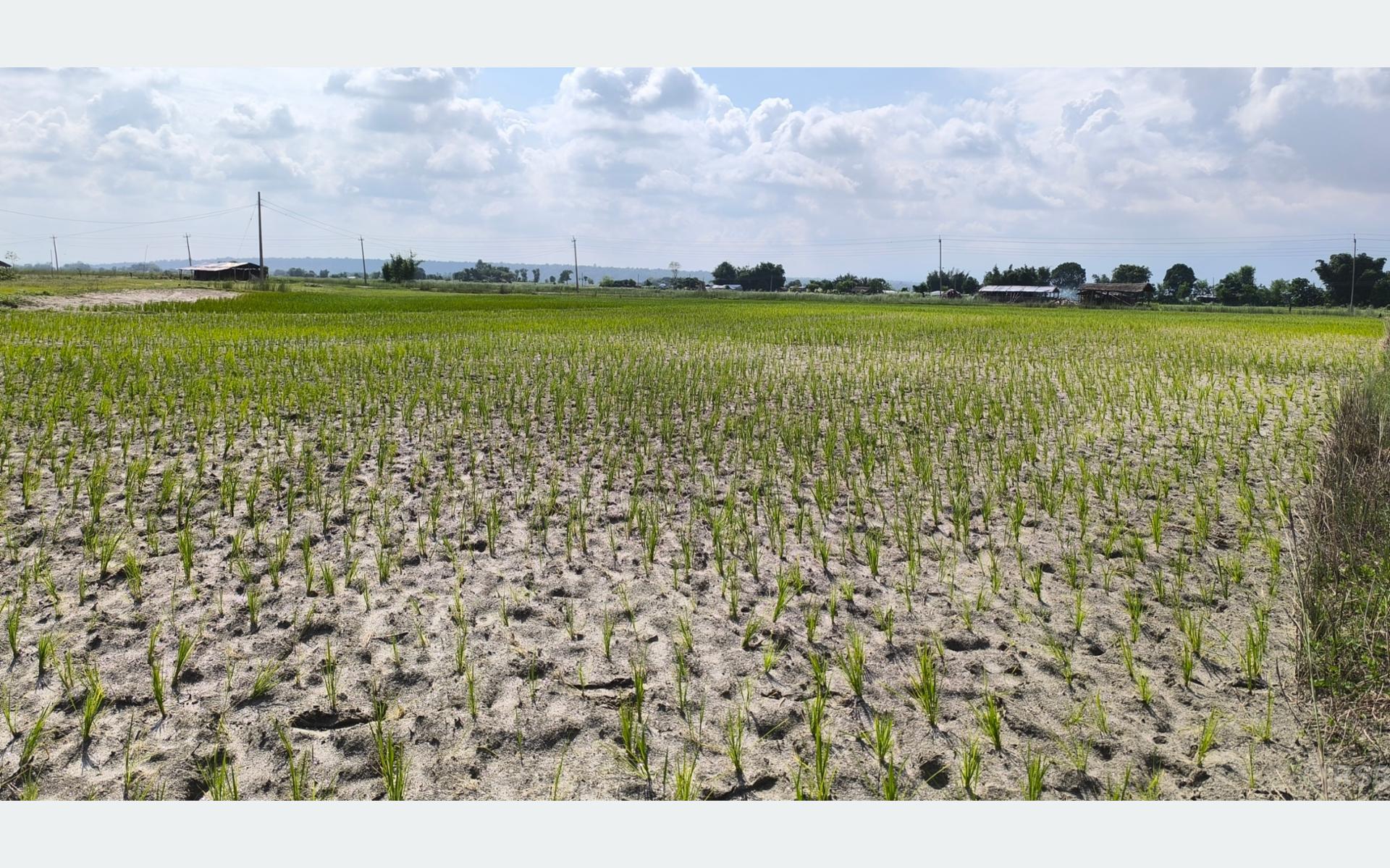
KATHMANDU: Paddy planting has been severely affected in Madhes Province and other key grain-producing regions of Nepal due to this year’s unfavorable monsoon.
On the recommendation of the Madhes Province government, the Federal Government has declared the province a disaster-prone area for three months.
Stakeholders have expressed growing concerns over a potential decline in paddy production. According to the Ministry of Land Management, Agriculture and Cooperatives of Madhes Province, only 47 percent of the paddy planting has been completed so far.
In comparison, the Department of Agriculture under the Ministry of Agriculture and Livestock Development reports that about 80.6 percent of planting was completed in Madhes at the same time last year.
The total area under paddy cultivation in Madhes is 372,645 hectares. Nationwide, the Department states that 72.14 percent of paddy planting had been completed as of July 20, compared to 84.6 percent last year.
Dr. Saroj Chaudhary, spokesperson for the Madhes Province Ministry of Land Management, Agriculture and Cooperatives, said that due to lack of rainfall, rice seeds are drying out, and already planted rice crops are suffering from drought stress because of insufficient irrigation.
“Currently, fields in Madhes appear dry, with less than half a percent of planting done due to rain shortages,” he said. “We are working to mitigate the effects of the drought.”
Dr. Mathura Yadav, coordinator of the National Rice Research Program, warned that if adequate rainfall does not arrive by the 20th to 22nd of Shrawan, paddy production could decrease by 15 to 20 percent.
“Timely planting and regular irrigation after sowing are essential for good yields,” she said. “Unfortunately, irrigation in many areas depends on rainfall, which has been insufficient when most needed. Considering the current situation in Madhes, paddy production is likely to fall, and without rain soon, the decline could worsen.”
Crop expert Dr. Dilliram Sharma added that Madhes, as Nepal’s main rice-producing region, faces serious risks from drought. “Rice seeds are drying up, and if planting is delayed or done unevenly, seed scatter will increase and yields will fall. Planting alone is not enough; proper irrigation is crucial,” he said.
“Similar challenges may arise in the future, so research into drought-resistant crops and alternative planting options is necessary.”
Data from the Climatology Division under the Department of Hydrology and Meteorology shows that the country typically receives an average of 1,400 millimeters of rainfall during the monsoon, but only about 500 millimeters—34.9 percent of the expected amount—has fallen so far.
Rainfall measurement centers in Janakpur, Simara, Biratnagar, Pokhara, and other locations report below-average precipitation. Janakpur, for instance, has received just 20 percent of its average monsoon rainfall of 1,100 millimeters, according to the Climatology Analysis Branch.
The Department of Water Resources and Irrigation states that irrigation infrastructure has been developed to serve roughly 1.5 million hectares of the approximately 2.53 million hectares of irrigable land in Nepal. However, only about one-third of this land has year-round irrigation facilities.




Comment