




There are moments in history when the world pauses to reflect—not just on where it stands, but where it is headed. Today feels like one of those moments. The global economy, long driven by an unshakable faith in growth and markets, is showing clear signs of strain. The promise that prosperity would eventually reach everyone if we just kept the wheels turning no longer holds. Crises seem to arrive more often, last longer, and leave deeper scars—especially in places already struggling to catch up.
Amid this uncertainty, a quiet but powerful realization is taking root: we need a new way forward. A new economic model—one that values fairness as much as efficiency, resilience as much as returns, and shared wellbeing as the true measure of success. Not just a course correction, but a reimagining of what we mean by progress.
This is not about tearing down what exists. It’s about building something better, together—an economy grounded in equity, resilience, and shared prosperity.
The old model is no longer enough. For decades, economic policymaking around the world was guided by a familiar playbook: liberalize trade, attract foreign capital, privatize services, and focus on GDP growth. In many places, this brought some gains—new infrastructure, expanded middle classes, and higher incomes. But it also left behind deep imbalances.
Inequality soared. Natural resources were overexploited. Public services were weakened in the name of efficiency. And when crises hit—whether the 2008 financial collapse, the COVID-19 pandemic, or climate disasters—the impact was felt most by those with the fewest buffers.
This is not a revolution of ideology or confrontation. It is a gentle but firm revolution of values—one that recognizes the limits of what we’ve done and imagines what we might still achieve.
The old model, it turns out, was built for speed, not for shock; for returns, not for resilience. And now, its limits are painfully clear. So, what would a better economic model look like? What if, instead of treating people and the planet as afterthoughts, we put them at the heart of our choices? What if we began from the belief that everyone deserves a fair chance, that economies should work for communities, and that growth means little if it’s not shared?
Let’s imagine an economy built on three simple but powerful ideas:
First is equity. Create opportunities that are truly inclusive. We’ve grown used to talking about “inclusive growth,” but often in abstract terms. Equity goes deeper. It means ensuring that where you are born, your gender, race, or social status doesn’t determine your future. It means public services that reach everyone, jobs that pay a living wage, and tax systems that don’t reward the wealthiest at the expense of the rest.
It also means listening to those who’ve been kept on the sidelines—small farmers, informal workers, youth, and women—and shaping policies that reflect their realities. True equity is not just about redistribution; it’s about recognition and respect.
Second is resilience. Build economies that can withstand and adapt to change. If the past few years have taught us anything, it’s that we need stronger foundations. From fragile supply chains to overburdened health systems, our economies were not built to weather today’s storms.
Resilience means planning for disruption—not hoping it won’t come. It’s about investing in health, education, and food systems that can adapt and endure. It’s about supporting local production and regional cooperation so countries aren’t left stranded during global shocks. And it’s about rethinking debt and financial systems so that vulnerable countries aren’t punished for circumstances beyond their control.
Above all, resilience is about dignity—the ability of individuals, families, and nations to face uncertainty without fear of falling through the cracks.
Third is shared prosperity. Redefine what we mean by success. We’ve long measured success by how fast economies grow. But what if we also asked: who benefits from that growth? Does it lead to better health, more secure livelihoods, cleaner air, or stronger communities?
Shared prosperity means shifting our focus from raw output to real outcomes. It means investing in sectors like care work, renewable energy, and education—areas that generate meaningful jobs and lasting value. It also means valuing contributions that don’t always show up in economic statistics—like unpaid caregiving, volunteerism, and community building.
Growth should be a means, not an end. A better economy grows in ways that lift everyone.
Around the world, particularly across the Global South, these conversations are already underway. In fact, some of the most innovative responses to today’s challenges are emerging from developing countries—where necessity often fuels creativity.
From digital public infrastructure in India to community-based health systems in Rwanda and renewable energy innovations in Kenya and Chile, there’s no shortage of ideas. What’s needed now is space to lead and shape the rules—not just follow them.
For too long, global economic governance has been dominated by a few, with the rest expected to adapt. That must change. The Global South, with its demographic weight, natural wealth, and growing economic influence, is uniquely positioned to champion this new vision. It can speak not just for itself, but for a broader humanity hungry for fairness and balance.
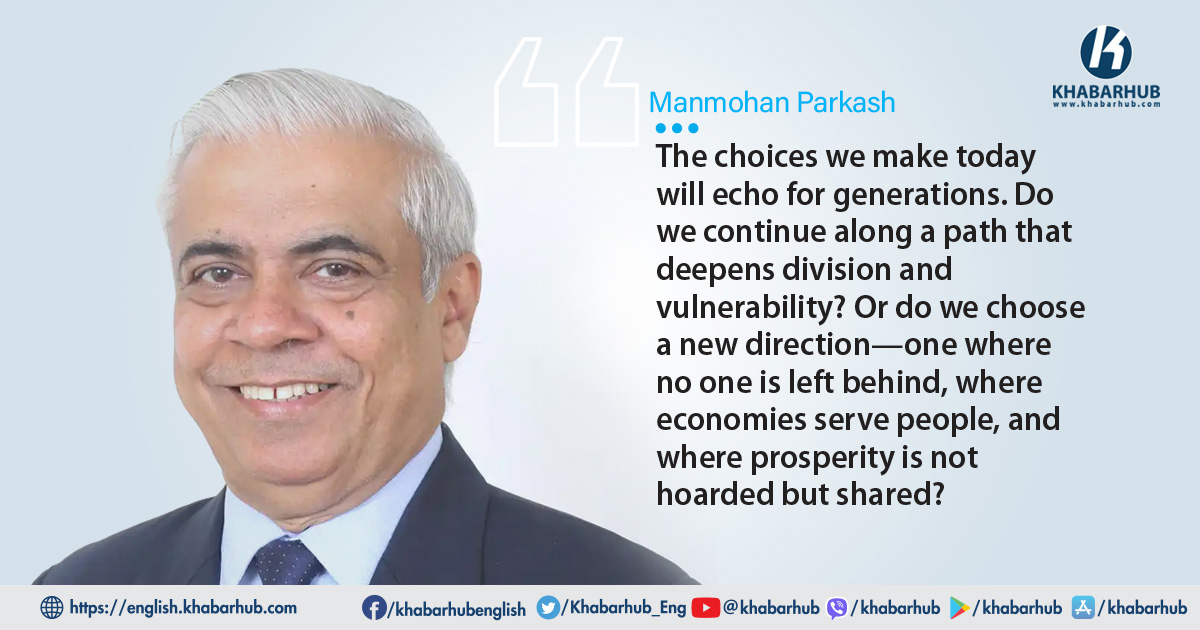
The choices we make today will echo for generations. Do we continue along a path that deepens division and vulnerability? Or do we choose a new direction—one where no one is left behind, where economies serve people, and where prosperity is not hoarded but shared?
So, what needs to change to transition this from vision to reality? Imagining a new paradigm is only the first step. Making it real requires courage—from governments willing to invest differently, from international institutions ready to reform, and from citizens and businesses willing to support a broader vision of value.
Some practical steps include reforming global financial institutions to reflect today’s realities and give developing countries a stronger voice; investing in local economies and regional cooperation instead of dependency on distant markets; prioritizing climate resilience and social protection in every economic plan; and measuring progress through well-being, sustainability, and inclusion—not just GDP.
These are common-sense updates to a system that has become too brittle, too unequal, and too narrow in its goals.
This is not a revolution of ideology or confrontation. It is a gentle but firm revolution of values—one that recognizes the limits of what we’ve done and imagines what we might still achieve.
An economy built on equity, resilience, and shared prosperity is already in motion—in community-led development, in calls for debt justice, in growing movements for climate action and fairer trade. What’s needed is the political will, moral clarity, and collective imagination to scale it.
The choices we make today will echo for generations. Do we continue along a path that deepens division and vulnerability? Or do we choose a new direction—one where no one is left behind, where economies serve people, and where prosperity is not hoarded but shared?
The answer lies in returning to simple truths: that all people deserve dignity, that resilience begins with care, and that real progress is measured by how well we live.
(Former Senior Advisor, Office of the President and Deputy Director General, South Asia, Asian Development Bank. Global thought leader on economic policy, infrastructure, and development finance, with a focus on inclusive growth and reimagining global institutions. Views are personal.)




Comment