




KATHMANDU: The ruling CPN-UML has decided that former President Bidya Devi Bhandari, who previously served as head of state and Supreme Commander of the Nepali Army, should not return to active party politics.
According to Rajendra Gautam, head of the UML’s publicity department, the Central Committee meeting concluded late Tuesday night with the decision that someone who has held the symbolic and constitutional role of the head of state should not assume a partisan political position.
“A former president is a symbol of national unity and guardian of the country,” Gautam said. “Such a figure becoming a party leader or cadre goes against established constitutional norms and values.”
The meeting also removed the party’s age limit of 70 years and the two-term cap for the party chairperson, effectively clearing the way for KP Sharma Oli to continue as party leader. The decision will be formalized during the upcoming statute convention scheduled for early September.
Gautam stated that the party reached a consensus that individuals who have served as head of state should rise above political systems and avoid partisan engagement to prevent public skepticism. However, he maintained that UML would continue to respect former President Bhandari.
Chair KP Sharma Oli formally declared in the meeting that Bhandari should now be recognized as a “respected former president” rather than “comrade Bidya Bhandari.”
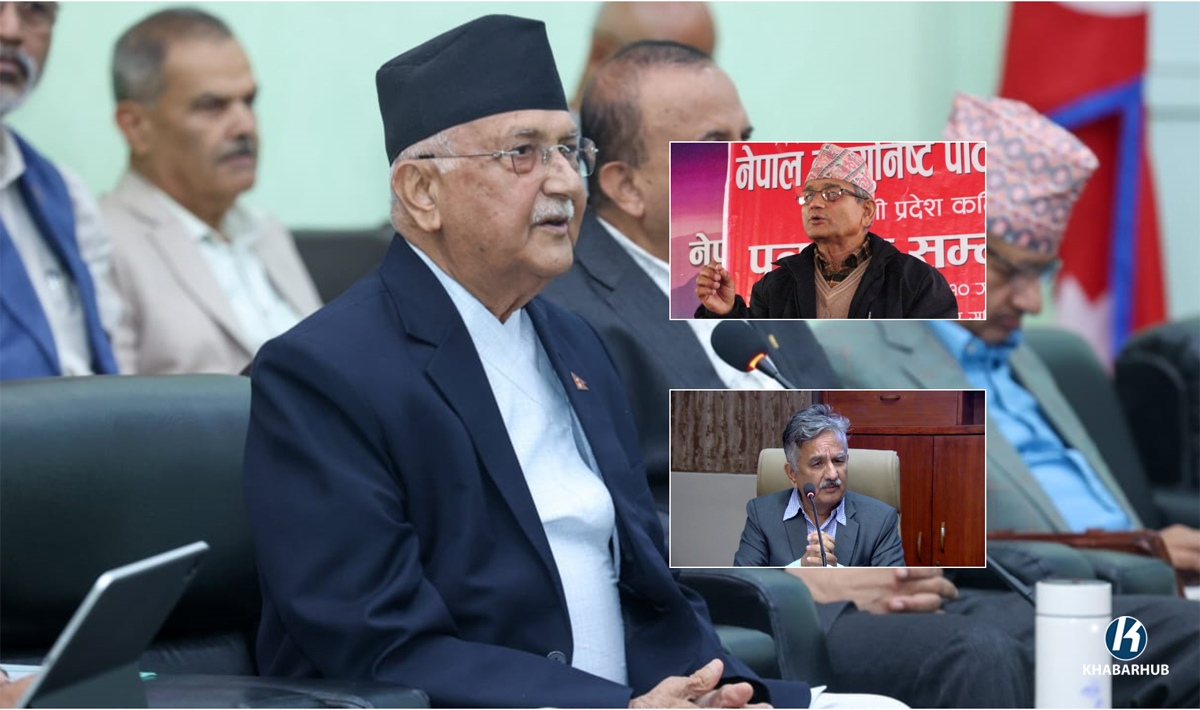
Despite this, several senior leaders strongly opposed the decision. Vice Chairs Surendra Pandey and Yubaraj Gyawali, along with Standing Committee member Karna Bahadur Thapa, voiced their disagreement with Oli’s stance.
The Central Committee meeting became tense when the party moved to invalidate Bhandari’s membership, which she had renewed in April 2024, and bar her from returning to politics. Pandey, Gyawali, and Thapa raised their hands to speak, but leaders close to Oli, including Khagaraj Adhikari, attempted to block them.
The hall grew chaotic as dissent grew. Vice Chair Ishwar Pokharel, who had earlier clashed with Oli during a Secretariat meeting, remained silent. However, Surendra Pandey challenged Oli directly and urged reconsideration of the decision.
Pandey warned Oli against running the party in a Stalinist fashion, drawing parallels to past authoritarian leadership. “When Stalin’s boots echoed, party members trembled. Are you trying to make UML the same?” Pandey asked sharply.
Recalling UML’s 6th General Convention in Nepalgunj in 1998, Pandey warned against repeating mistakes made when party members Yogesh Bhattarai and Rup Narayan Shrestha were expelled, only to be reinstated later. “Forced decisions may have to be reversed. Please do not lead the party into another crisis,” he cautioned.
Oli responded angrily, dismissing Pandey’s concerns and asking, “Why were they expelled, again?” Pandey persisted, emphasizing the dangers of silencing opposition within the party.
The situation escalated as pro-Oli members began shouting down dissenters. Despite the uproar, Pandey continued his criticism, accusing Oli of orchestrating support and silencing critics. “You are not allowing space for free expression inside the party,” Pandey said, likening Oli’s approach to a “scripted show.”
Vice Chair Yubaraj Gyawali also voiced concern, calling the decision to revoke Bhandari’s membership a dangerous step that could push the party toward division. He emotionally pleaded with Oli to reconsider: “This could have a lasting impact on the party. Please don’t go through with this decision.”
Despite repeated appeals, Oli remained firm. “He showed no signs of backing down,” said Gyawali, who concluded his statement by calling Oli’s move “heartbreaking.”
During the meeting, UML General Secretary Shankar Pokharel reportedly instructed provincial in-charges to unite behind Oli and direct central committee members from their respective provinces to speak in his favor. Central committee members said some were even promised future meetings with Oli in exchange for their support.




Comment