




KATHMANDU: Even the national anthem defines Nepal’s borders as stretching “from Mechi to Mahakali.” For most citizens, this geography represents the nation’s territorial limits. Yet across the Mahakali River lie two Nepali settlements—Dodhara and Chandani—connected to the rest of the country only by the Dodhara–Chandani suspension bridge.
What kind of mindset do the Nepalis living beyond this bridge carry? What does life look like on the far edge of the border? Dodhara–Chandani is not just a pair of villages—it is the lived story of Nepalis at the frontier. Though geographically part of Nepal, this town, situated alongside the Indian states of Uttarakhand and Uttar Pradesh, is deeply interwoven with India’s marketplaces and daily rhythms.
For residents on the opposite side of the Mahakali, the anthem may say “Nepal from Mechi to Mahakali,” but they often feel like Nepalis beyond Mahakali. There is no formal border infrastructure here, and no functional access to Nepal’s markets. Everything—big or small—for daily life must be obtained from India.
The reality of Dodhara–Chandani extends far beyond a geographical boundary; it is a continuing struggle for identity and survival—where citizenship is Nepali on paper, but everyday life relies on the Indian economy.
Below is an edited excerpt from an interview with Kishor Kumar Limbu, the Mayor of Dodhara–Chandani Municipality, discussing life, challenges, and aspirations on Nepal’s frontier:
What is your experience working as a people’s representative across the Mahakali?
Being a people’s representative in a border area comes with significant challenges. Our municipality is situated near the Mahakali Bridge, which connects Nepal to India, and borders two Indian states—Uttarakhand and Uttar Pradesh. Unfortunately, there is no formal border here, so our residents heavily rely on the Indian market. Indian goods are cheaper, while Nepali products are more expensive, which has contributed to the rise of smuggling.
Daily necessities—such as sugar, tea leaves, utensils, and other household items—are mostly purchased from India. Weak border surveillance allows free movement: Indian citizens enter Nepal easily, and our people can cross into India without restriction. There is no systematic record of who comes, what they bring, or why. This situation has raised security risks. While police administration exists, improvements have been limited.
What are the main needs of the people here?
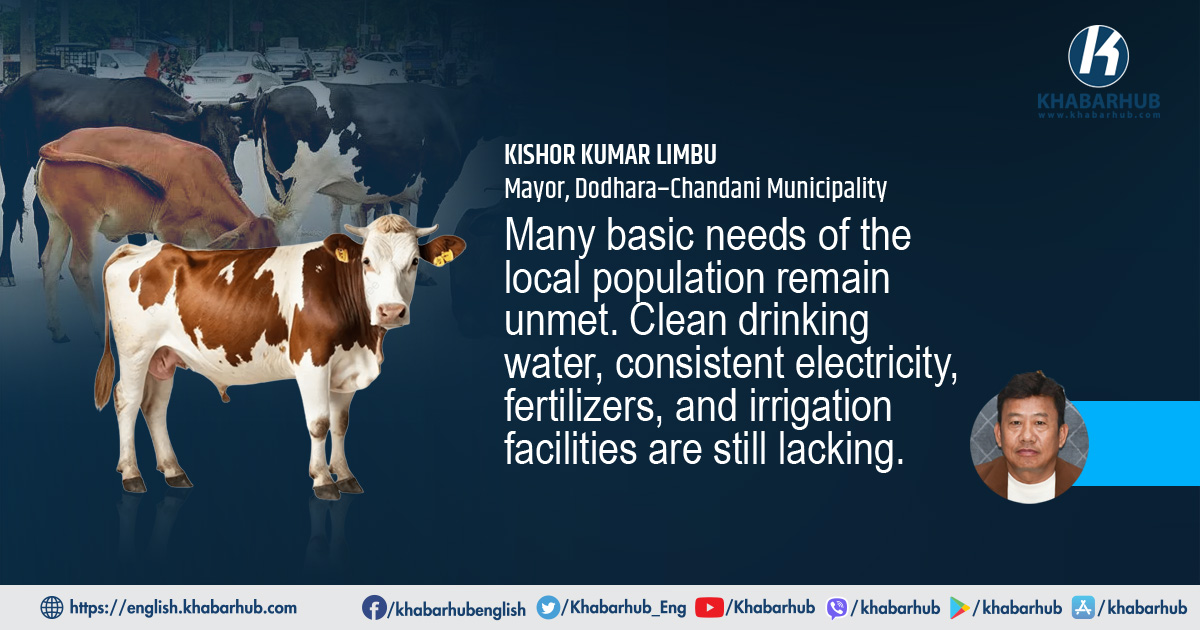
Many basic needs of the local population remain unmet. Clean drinking water, consistent electricity, fertilizers, and irrigation facilities are still lacking.
Residents often buy vehicles, such as cars and motorcycles, from India because the Indian market is more accessible and affordable than Nepali markets. This reliance on India extends to most daily necessities.
What are the opportunities and challenges for border residents?
Life on the border is extremely difficult. One of the major challenges is the threat from wild animals coming from Indian forests. Elephants, in particular, enter villages, destroy homes and crops, and cause damage to people and property. Animals move freely across the India-Nepal border, creating additional problems.
When there is a shortage of grass or food in India, wild animals cross into Nepal. It is often unclear which authority to approach for help. Stray animals are also brought from India and released in Nepal, affecting local agriculture. Despite these challenges, continuous efforts are being made to maintain stability and improve the lives of border residents.
Most far-western citizens go to India for work. What about residents of Dodhara–Chandani?
Our residents also travel to India for employment due to limited job opportunities locally. Many have gone abroad as well. Indian cities like Delhi and Bangalore are the main destinations. Since educational opportunities are scarce, most youth move to India primarily for work rather than for higher education.
Some educated youth have secured employment as teachers in schools or local institutions, but such opportunities remain very limited. As a result, most families in our city have at least one member working in India or abroad.
What initiatives have you taken for the future of youth and students?
Education and health have been given special priority. A new hospital has been established, staffed with four MBBS doctors. New campuses and school buildings have been constructed to improve education, with a regular monitoring system implemented in every school.
The curriculum has been adapted to meet local needs, and teaching has already begun. One school has been designated as a ‘model school.’ To enhance education quality, board exams are now conducted from class 5, and online classes have been introduced for classes 10 and 12. Bachelor-level courses are now available locally in Dodhara–Chandani.
In terms of infrastructure, about 80 percent of the roads are now paved. However, many students still discontinue their studies after class 12, and we are continually working to address this challenge.
Dodhara–Chandani is not only part of Nepal’s geography but also a land of emotions and struggles. Residents live with hope amid difficulties, preserving their Nepali identity across the border. Although we are included in the national anthem, political recognition has often been lacking. Yet, we remain proud to carry the name of Nepal, because we are Nepalis living beyond the border.




Comment