




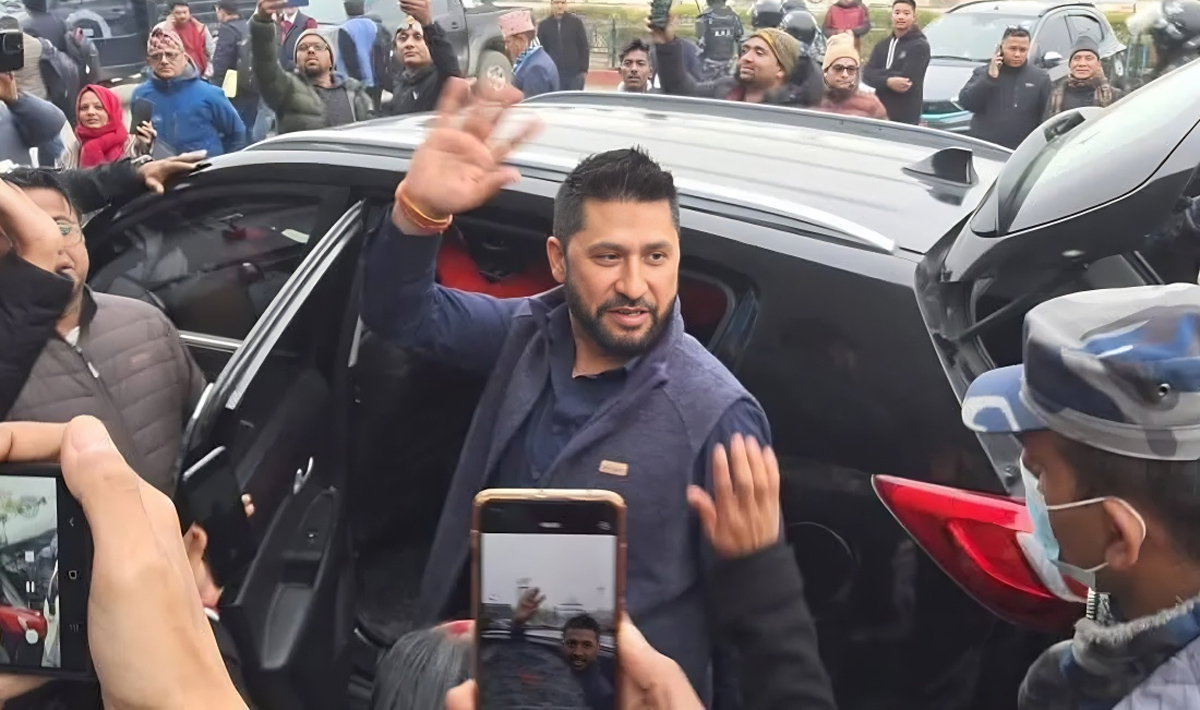
KATHMANDU: For the past four and a half months, Rastriya Swatantra Party (RSP) chair and former Deputy Prime Minister Rabi Lamichhane has been behind bars in connection with the Supreme Savings and Credit Cooperative fraud case based in Butwal, Rupandehi.
Transferred from Bhairahawa prison to Nakkhu prison in Lalitpur, Lamichhane continues to dominate political debate in parliament and on the streets. Even Maoist chair Pushpa Kamal Dahal visited him in jail. Yet, little to no attention has been paid to the plight of thousands of depositors tied to the cooperative scandal that landed Lamichhane behind bars.
Lamichhane, along with business partner GB Rai and others, faces charges of systematically embezzling cooperative funds. While he managed to secure bail in cases linked to other cooperatives in Pokhara and Kathmandu, the Rupandehi District Court sent him to jail in the Supreme Cooperative case.
On March 7, he was remanded to Bhairahawa prison on charges of embezzling more than Rs 213 million, including interest. Later, on August 15, the Home Ministry transferred him to Lalitpur’s Nakkhu prison.
Police investigations revealed that the Supreme Cooperative case involved large-scale misappropriation. On January 12, the Rupandehi District Government Attorney’s Office filed supplementary charges, stating that Rs 13.1 billion deposited by 10,391 depositors had been misused. But what is the current state of the cooperative itself? Have depositors received any relief after Lamichhane was jailed?
According to Baburam Panthi, Senior Officer at the Office of Cooperative Registrar in Lumbini Province, the problem remains exactly as it was. The cooperative has not held an Annual General Meeting since 2022, leaving it without a functioning board of directors.
Most of its leadership is either absconding or in jail, and the main office has remained shuttered. Although complaints are being forwarded to the police, deposit refunds cannot move ahead because multiple cases remain under consideration in different courts. A proper savings return mechanism has not even been formed.
A parliamentary probe committee formed in May 2024 to investigate the crisis later submitted a detailed report that revealed alarming details about the misuse of funds. The committee found that the cooperative had distributed more than Rs 985 million in loans, of which Lamichhane and eighteen other large borrowers had taken nearly three-quarters of the total. Most of the loans were issued without adequate collateral, making recovery almost impossible.
The report concluded that GB Rai and his associates deliberately exploited dormant cooperatives, luring ordinary people with promises of high returns and systematically siphoning off deposits.
The cooperative itself has a troubled history. It was originally established in 2000 as Maitreya Savings and Credit Cooperative but was taken over in 2015 by Rai’s group, which rebranded it as Supreme Cooperative. With expansion into Bhairahawa and Kapilvastu, its network grew, but so did allegations of mismanagement.
Despite being declared problematic years ago, no effective rescue plan has been implemented. A provincial law that would allow the creation of a depositor protection mechanism has yet to be updated, leaving more than 10,000 depositors stranded.
Financial records show severe irregularities, including low liquidity, massive lending to companies, repeated loans to the same members, and poor asset-liability management, all of which worsened depositor vulnerability.
While Lamichhane remains in jail, the real victims, the ordinary depositors, are still without justice. With billions of rupees misused, no functioning board in place, and no refund mechanism established, the Supreme Cooperative scandal continues to expose deep cracks in Nepal’s cooperative sector.




Comment