




For Nepal, a small state located between two rising powers, diplomacy has never been optional—it has been existential. Wedged between India to the south, east, and west and China to the north, Nepal’s geography is both its greatest asset and its greatest vulnerability, as the Himalayan nation is geographically constrained yet strategically significant.
How Kathmandu manages these two asymmetric relationships determines not only its external posture but also its domestic stability—and is neither optional nor simple. To navigate this complex terrain, Kathmandu must adopt a framework of equidistant, equicentric, and equivalent diplomacy—a strategy that balances engagement, centers national interest, and ensures comparable treatment in interactions, providing a pragmatic framework for the 21st century.
From Geography to Strategy
India and China are not distant neighbors; they shape Nepal’s economy, security, and political environment. India accounts for nearly 70 percent of Nepal’s trade and is its primary source of energy, investment, and transit access. China is a rising partner in infrastructure, trade, and strategic engagement, exemplified by the Belt and Road Initiative (BRI) framework agreement signed in 2017.
Both neighbors view Nepal through strategic lenses: India sees it as part of its immediate security arc, while China perceives it as a node in Himalayan connectivity and regional influence.
Diplomatic norms—such as respecting commitments, avoiding secretive arrangements, and acknowledging each side’s concerns—should be consistently applied. Equivalent diplomacy not only reduces misperceptions but also signals to both neighbors that Nepal treats them fairly, which strengthens trust and strategic stability.
Nepal, for its part, cannot afford either dependence or confrontation. History demonstrates the need for balance. Nepal’s diversification of arms procurement in the late 1980s led to a 15-month trade and transit impasse with India, while the 2015–16 blockade—whether triggered by local protests or viewed as Indian coercion—reinforced public sentiment and highlighted the dangers of overdependence. In both cases, Nepal’s strategic space was narrowed by asymmetric reliance.
Equidistant Diplomacy: Maintaining Balance
Equidistant diplomacy does not mean equidistant geography; it is about balance in principle and perception. With India, Nepal cannot deny the depth of cultural, historical, and economic links: nearly 70 percent of its trade is with India, millions of Nepalis and Indians live and work across the open border, and India remains the largest buyer of Nepali hydropower.
With China, the relationship is intimate but symbolically powerful: Chinese investments in infrastructure, the 2017 BRI framework agreement, and the prospect of Himalayan connectivity offer Nepal leverage and options. It is impossible for Nepal to be “physically balanced” between its two neighbors. Instead, it means equal principle in diplomatic engagement.
Equidistance ensures that neither neighbor feels marginalized or excessively dominant. Kathmandu must pursue cooperative but transparent relations with both, ensuring that one relationship does not undermine the other. Nepal can pursue energy trade, transit arrangements, and cultural ties with India, while simultaneously advancing infrastructure, trade, and investment engagement with China.
Both relationships should be pursued on merit, with Nepal’s sovereignty and long-term interests as the guiding principle. By maintaining this balance, Kathmandu reduces the risk of overdependence and reinforces its diplomatic credibility.
Equicentric Diplomacy: Placing National Interest at the Core
If equidistance is about balance, equicentric diplomacy is about focus. It means placing Nepal’s own national interest at the center of all relationships. Nepal should not see itself merely as a “buffer” or a “bridge” for India and China. It should see itself as a sovereign actor that uses its position to maximize its own stability, prosperity, and credibility.
Equicentric behavior requires continuity and consistency. Foreign policy cannot be allowed to swing wildly with changes in government or partisan agendas. When Nepal amended its constitution in 2020 to incorporate a new map, domestic consensus was achieved—but it constrained Kathmandu’s flexibility in dialogue and also limited diplomatic maneuverability with India.
Similarly, while BRI promises of northern connectivity raised hopes of new highways and a railway to Kerung, projects stalled due to financing and feasibility concerns. For Kathmandu, equicentric diplomacy means pursuing projects—whether Indian, Chinese, or multilateral—that genuinely serve Nepal’s long-term development, not just short-term political narratives.
Equivalent Diplomacy: Ensuring Comparable Treatment
Equivalent diplomacy complements equidistance and equicentricity by ensuring comparable standards of engagement, respect, and reciprocity with both India and China. Nepal must avoid perceptions of favoritism, patronage, or opportunistic tilts. Equivalent behavior entails that agreements, communications, and strategic interactions are calibrated to reflect parity in principle—even if not in volume.
For instance, when negotiating energy imports with India or infrastructure projects with China, Nepal should apply similar procedural standards: transparency, mutual consultation, and binding timelines.
Nepal’s geography need not be a liability. Equidistant, equicentric, and equivalent diplomacy allows Kathmandu to position itself as a connector and not merely a buffer—a way to turn geography from a vulnerability into an opportunity. By balancing engagement, centering national interest, and ensuring comparable treatment in dealings with both India and China, Nepal can preserve sovereignty, attract investment, and maintain strategic space rather than being trapped. Nepal can become a connector—but only if it anchors its diplomacy in national interest rather than partisan point-scoring.
Diplomatic norms—such as respecting commitments, avoiding secretive arrangements, and acknowledging each side’s concerns—should be consistently applied. Equivalent diplomacy not only reduces misperceptions but also signals to both neighbors that Nepal treats them fairly, which strengthens trust and strategic stability.
Managing Differences That Have Strategic Bearings with India and China
The real challenge is not to politicize differences but to manage them in ways that do not destabilize Nepal’s diplomacy. With India, differences arise over trade imbalances, hydropower pricing, border sensitivities, and perceptions of political interference. With China, differences lie in trade deficits, financing terms of infrastructure projects, and the limits of connectivity across the Himalayas.
Managing these differences requires three approaches: One, Institutionalized Dialogue: Nepal must keep structured channels open with both Delhi and Beijing, ensuring that differences are addressed at technical and diplomatic levels before they escalate into political crises.
Two, Issue-based Compartmentalization: Trade disputes with India should not derail cooperation in hydropower; debt negotiations with China should not undermine cultural exchanges. By compartmentalizing issues, Nepal can prevent one dispute from poisoning the entire relationship.
Lastly, Transparent Diplomacy: Kathmandu must avoid secrecy in its dealings—whether on BRI projects with China or security understandings with India. Transparency builds confidence with both neighbors and reduces the risk of misperception.
The most sensitive test of equidistant, equicentric, and equivalent diplomacy lies in managing disputes like the Nepal–India border issue. The Kalapani–Lipulekh–Limpiyadhura triangle remains unresolved, rooted in differing interpretations of the Kali River under the 1816 Sugauli Treaty. Politicization has turned a technical dispute into a nationalist flashpoint.
Equidistant diplomacy here means Nepal addressing the dispute firmly with India while resisting the temptation to invite China into the issue. Equicentric diplomacy means framing the dispute as a matter of Nepal’s sovereignty and stability, not as ammunition in a geopolitical contest. Equivalent diplomacy here means engagement, respect, and reciprocity with both India and China.
The border issue can move from being a nationalist rallying cry to a manageable diplomatic agenda item.
By applying equidistant, equicentric, and equivalent principles, Nepal can transform differences from potential flashpoints into manageable diplomatic agendas. Through these three approaches, Nepal can demonstrate that differences, while inevitable, are manageable—and that Kathmandu’s diplomacy is driven by stability rather than opportunism.
China as a Strategic Variable
China’s growing footprint adds complexity and opportunity. China’s exports to Nepal in 2023–24 reached Rs 298.77 billion, expanding significantly as 14 of 21 border trade points were opened in May 2024. Nepal’s exports to China, though still limited at NPR 2.48 billion, have grown by 3%.
In a region where mistrust and asymmetry often dominate, Nepal’s challenge—and its opportunity—lies in practicing diplomacy that is balanced, centered, and consistent. Equidistant, equicentric, and equivalent diplomacy is not just theory; it is Nepal’s practical pathway to sustainable engagement with its two great neighbors.
The Kerung–Kathmandu railway remains an aspirational project; though politically appealing, it faces daunting financial and engineering hurdles. Chinese engagement, including political outreach in Nepal’s domestic politics, has generated Indian concern.
However, China also plays a catalytic role. The possibility of northern access has pushed India to modernize its transit treaty with Nepal in 2023 and expand rail and port access in 2025.
The fear of losing hydropower projects to Chinese financing has accelerated India’s commitment to importing 10,000 MW from Nepal over the next decade. Beijing’s presence provides leverage, encouraging Kathmandu to negotiate with New Delhi from a position of relative strength, as well as encouraging India to be more responsive.
If managed equidistantly, equicentrically, and equivalently, China’s role becomes a stabilizing variable rather than a destabilizing one.
Turning Geography into Opportunity
Nepal’s geography need not be a liability. Equidistant, equicentric, and equivalent diplomacy allows Kathmandu to position itself as a connector and not merely a buffer—a way to turn geography from a vulnerability into an opportunity. By balancing engagement, centering national interest, and ensuring comparable treatment in dealings with both India and China, Nepal can preserve sovereignty, attract investment, and maintain strategic space rather than being trapped. Nepal can become a connector—but only if it anchors its diplomacy in national interest rather than partisan point-scoring.
Success requires strengthening Nepal’s diplomatic institutions, ensuring foreign policy continuity across governments, insulating bilateral issues from domestic partisan politics, and depoliticizing sensitive disputes. It also requires Nepal to clearly communicate that while it values both India and China, its ultimate loyalty is to its own sovereignty and prosperity. In this framework, geography becomes a strategic advantage rather than a constraint.
Conclusion
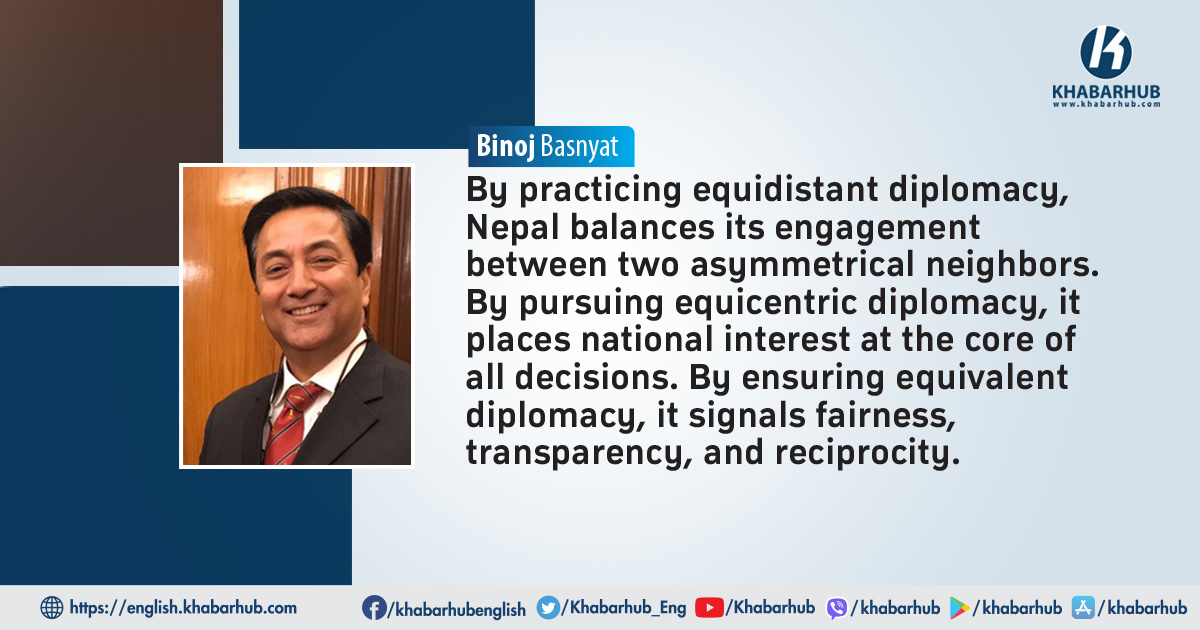
Politics in Nepal–India–China relations is unavoidable; politicization is not. By practicing equidistant diplomacy, Nepal balances its engagement between two asymmetrical neighbors. By pursuing equicentric diplomacy, it places national interest at the core of all decisions. By ensuring equivalent diplomacy, it signals fairness, transparency, and reciprocity.
Together, these principles provide a robust framework for navigating South Asia’s complex dynamics. Differences with India and China are inevitable, but when managed under these three guiding principles, they do not destabilize relations. Instead, they become opportunities for Nepal to assert sovereignty, enhance credibility, and turn its strategic geography into an enduring advantage.
In a region where mistrust and asymmetry often dominate, Nepal’s challenge—and its opportunity—lies in practicing diplomacy that is balanced, centered, and consistent. Equidistant, equicentric, and equivalent diplomacy is not just theory; it is Nepal’s practical pathway to sustainable engagement with its two great neighbors.
(Basnyat, a Major General (Retd) of the Nepali Army, is a strategic analyst and is associated with Rangsit University, Thailand)
(Views expressed in this opinion are the writer’s and do not necessarily reflect the editorial stance of Khabarhub — Editor)






Comment