




KATHMANDU: Last week in Nepali politics was remarkable not for its surprises, but for how unsurprising serious misconduct has become. Minister Rajkumar Gupta’s resignation amid a damning bribery scandal would, in a healthier political climate, signal a moment of reckoning. Instead, it feels routine — a predictable beat in the symphony of political cynicism that has come to define Nepali governance in recent years.
Gupta, a sitting UML lawmaker and federal minister, stepped down after an audio recording revealed he had allegedly accepted Rs 7.8 million in bribes to influence the transfer and appointment of land revenue officials — including obstructing the transfer of a Kaski land officer and lobbying for the appointment of UML cadre Khem Bahadur Pun. The scandal quickly triggered a CIAA investigation and loud calls for accountability across the political spectrum.
Yet Gupta’s resignation came not through a decisive move by Prime Minister KP Sharma Oli, but via Facebook — a controlled, damage-limiting announcement in which he claimed innocence, spoke of “conspiracies,” and portrayed himself as a victim of “advanced technology.” This familiar refrain — a blend of denial, deflection, and victimhood — has become the standard script for embattled leaders, not just in Gupta’s case, but in past scandals involving Gokul Baskota and others.
More disturbing than the content of the recording is the lack of outrage. Observers have noted that unless public pressure sustains, the Gupta case could quietly join the graveyard of forgotten scandals, with neither parliamentary sanctions nor party disciplinary actions enforced. The incident does not signal systemic reform — only another crack in an already crumbling edifice.
Government paralyzed, Parliament discredited
This political inertia is mirrored in the ongoing deadlock in Parliament. More than 50 consecutive days have passed with major opposition parties — including RSP and RPP — obstructing proceedings over the visit visa scandal involving the Home Ministry and the arrest of Immigration Chief Tirtharaj Bhattarai. Yet, no resignations have occurred, and no independent probe has been formed.
Prime Minister Oli’s refusal to act on Home Minister Ramesh Lekhak’s position, despite escalating demands and repeated parliamentary disruptions, reflects a disturbing trend: governing through apathy. His coalition appears more interested in weathering the storm than addressing the underlying crisis.
RPP Chair Rajendra Lingden called this phase “the darkest period in Nepal’s parliamentary history.” That may sound hyperbolic, but given that the House has been rendered largely ceremonial—while accountability is skirted and scandals multiply—it may not be far off the mark. The ruling parties’ refusal to acknowledge or act on public anger risks further hollowing out an already weak legislature.
Coalition without a cause
Ironically, all this chaos coincides with the one-year anniversary of the NC-UML coalition government—a partnership that promised a new direction through constitutional amendments, political stability, and governance reform. Yet in practice, even the first step of forming a task force for constitutional revision has not materialized. Neither party seems prepared to translate the rhetoric of reform into action.
In this context, Maoist Centre Chairperson Pushpa Kamal Dahal (Prachanda) has re-entered the political spotlight, offering to help secure the necessary two-thirds majority to amend the constitution — if the government commits to progressive changes. His demands are pointed: reforming the system of governance, addressing federal demarcation, and institutionalizing inclusion and social justice.
But this move raises another question: Is the offer genuine, or a calculated maneuver to reclaim lost relevance? After all, Dahal himself has led the government multiple times and failed to push similar reforms. Still, his challenge to the UML-NC alliance—“Does the government have the courage?”—is a legitimate one. So far, the answer appears to be no.
UML’s internal shift
Within the UML, internal restructuring signals another layer of concern. The party’s decision to remove age and term limits from its leadership eligibility rules has opened the door for KP Sharma Oli to retain control indefinitely. This centralization of power may solidify short-term party unity, but it undermines democratic norms and blocks generational change.
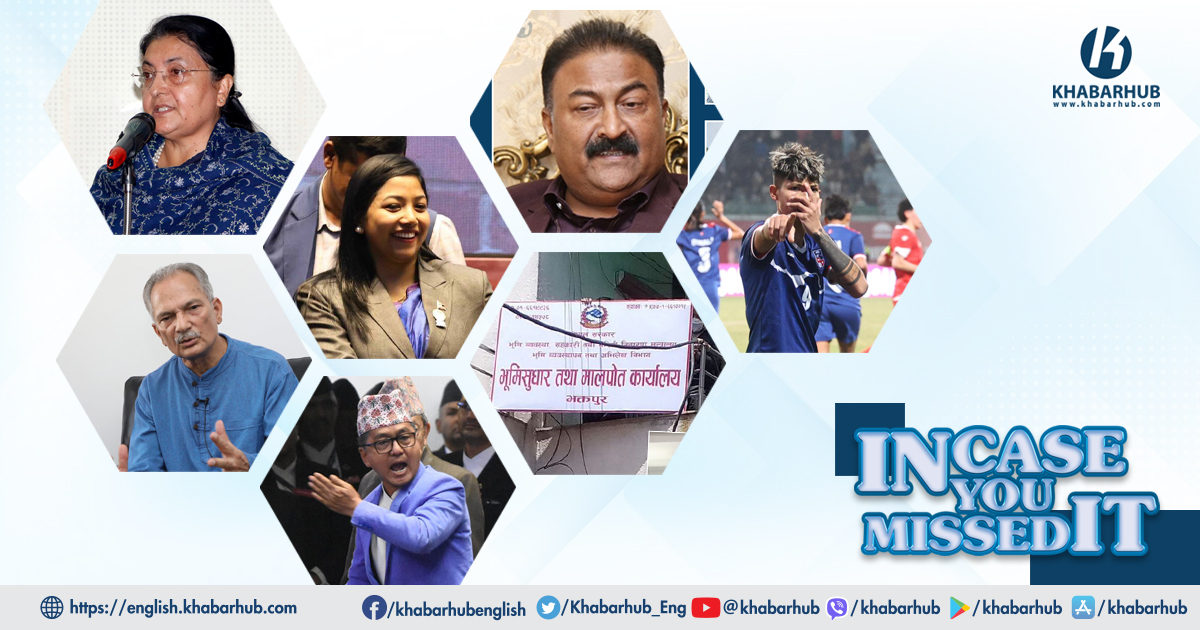
More telling is the decision to bar former President Bidya Devi Bhandari from participating in the UML’s upcoming statute convention, despite her rejoining the party. While the party claims procedural justifications, it is hard to ignore the political subtext: Bhandari’s recent activism and her lingering association with Oli-era controversies — including two attempted dissolutions of Parliament — make her a complicated figure. Even now, she defends her role in those events by claiming she merely followed cabinet decisions, yet the Supreme Court’s reversals suggest otherwise.
Her exclusion speaks volumes about the UML’s internal dynamics — a party increasingly focused on control over debate, loyalty over legacy.
Corruption: Not an exception, but the system
Perhaps the clearest symbol of the state’s fragility is the CIAA’s arrest of Bhaktapur Land Revenue Chief Kumar Acharya with Rs 2.45 million in bribes—just days after Gupta’s scandal broke. Bribery, it appears, is not the periphery of governance, but its beating heart. As long as political protection shelters corrupt officials, and scandals are treated as storms to be weathered rather than cleansed, public trust will continue to erode.
Former Prime Minister Baburam Bhattarai captured this mood in a blunt social media post, accusing the three main parties — UML, NC, and Maoist Centre — of failing to address Nepal’s structural problems. “It is evident that even when the supreme leader of the third major party heads the government, he has failed to make a dent,” Bhattarai wrote. His remarks reflect the growing desperation for an alternative force capable of offering more than recycled slogans.
Glimmers of reform in Local Governments
While the federal government flounders, some local bodies have shown moral clarity. In Krishnapur, Kanchanpur, authorities ordered the demolition of chhaugoths (menstrual huts) following the death of a woman from a snake bite — a reminder of how law and compassion can coexist at the grassroots, even as they falter nationally.
Likewise, Kathmandu Metropolitan City’s Rs 25.76 billion budget reflects long-term priorities like infrastructure and social development. But KMC’s chronic inefficiency raises doubts about execution. A good budget alone cannot drive reform; implementation and accountability must follow.
Conclusion: Nepal’s politics is at an inflection point
Taken together, last week’s events don’t just reflect crisis—they reflect a system running on political exhaustion. Scandals erupt, ministers resign, the public protests, opposition disrupts—and yet, nothing structurally changes. That is the real scandal.
Minister Gupta’s resignation, while dramatic, is not transformative. The removal of age and term limits in UML, while strategic, is not visionary. Prachanda’s offer of support, while bold, is not new. And Bhattarai’s warnings, while accurate, offer no blueprint yet.
Nepal’s politics stands at a dangerous crossroads: either it reinvents itself through courage and reform, or it continues the slow slide into irrelevance, where public anger turns into apathy. In the end, history will judge this generation of leaders not by how many scandals they survived, but by how many chances they squandered.




Comment