




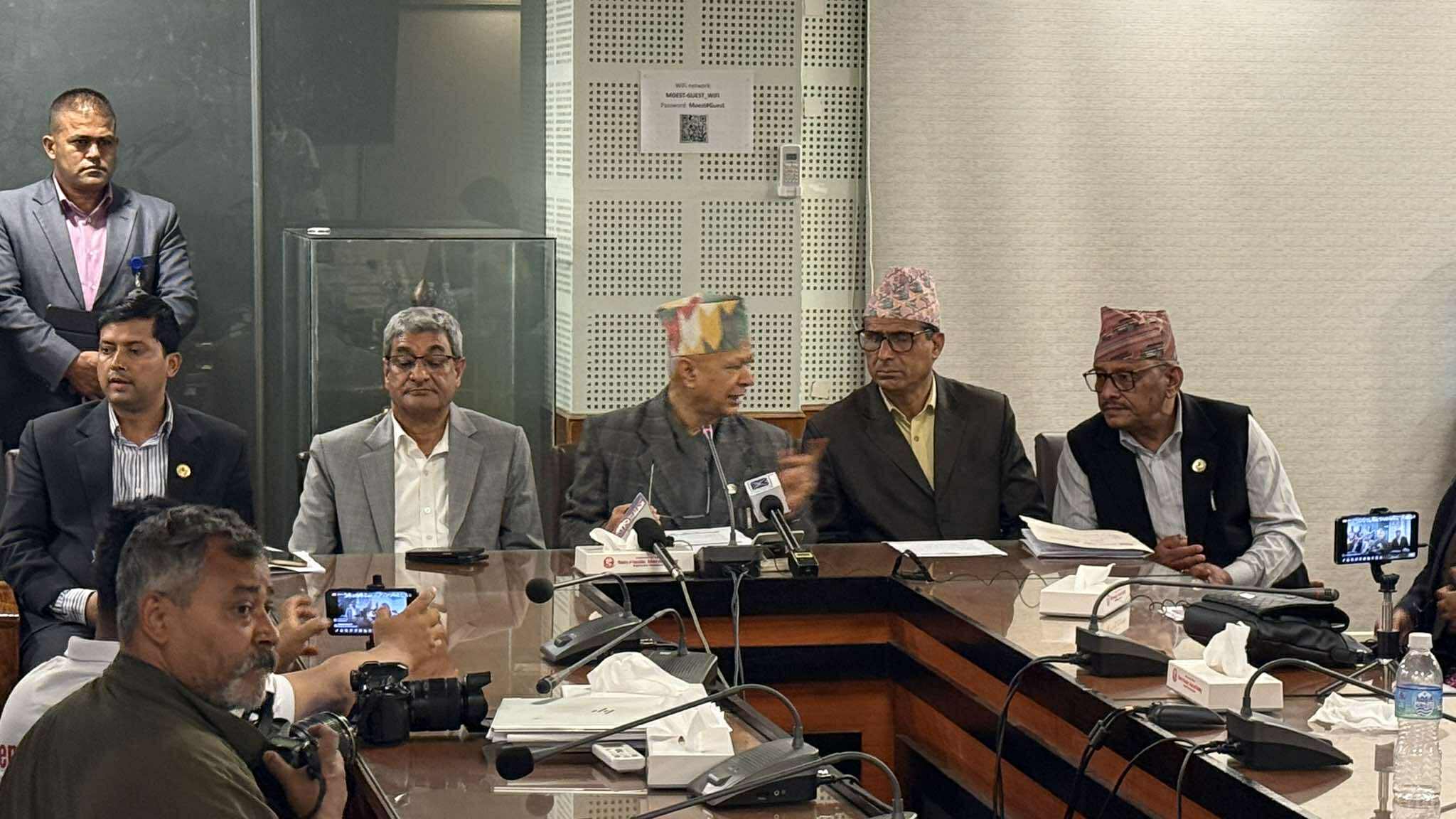
KATHMANDU: The subcommittee formed under the Education, Health and Information Technology Committee of the House of Representatives has come under scrutiny for remaining silent on the issue of regulating privately funded schools in the proposed School Education Bill.
The subcommittee, coordinated by CPN-UML lawmaker Chhabilal Bishwakarma, submitted its report to the main committee on Sunday. However, the report does not address the government’s proposal to bring privately funded schools under educational trusts.
The original School Education Bill 2080, registered in Parliament, proposed that privately funded schools be established and operated under educational trusts.
It allowed for institutional schools currently registered under the Companies Act to transition into educational trusts and offered tax exemptions for those converting into public educational trusts.
The bill also permitted social, religious, and welfare organizations to run non-profit schools under the trust model.
Despite the significance of this provision, the subcommittee’s report omits any reference to it. However, members of the subcommittee reject the claim that they have ignored the issue.
Loktantrik Samajwadi Party (LSP) MP and subcommittee member Ram Prakash Chaudhary stated that the matter would be resolved by the full committee.
“The subcommittee is not silent on this. It has been stated that the full committee will decide,” Chaudhary told Khabarbah. “Private schools cannot be shut down overnight, and it hasn’t been decided whether they will be transitioned into trusts over 15 or 20 years.”
Chaudhary emphasized that any agreement reached in the subcommittee must be approved by the full Education, Health and Information Technology Committee and is still subject to change.
“The agreement we reached will go to the full committee. If revisions are needed, they will be made. Ultimately, the decision will be based on a majority vote,” he added.
Historically, the seventh amendment to the Education Act in 2058 BS mandated that private schools either register under the Companies Act or transition into educational trusts. Before that, private schools were registered with the District Education Office like public schools.
The subcommittee has also proposed a mandatory scholarship provision for privately funded schools. Section 150 of the bill states: “Privately funded schools shall provide scholarships as specified by prevailing education laws in the form of full scholarships.”
The subcommittee, given a 35-day deadline, took nearly two months to submit its report. In addition to Bishwakarma, members included Dig Bahadur Limbu, Devendra Poudel, Mahendra Kumar Ray, Ram Prakash Chaudhary, Rekha Sharma, Bina Jaiswal, Binita Kumari Singh, and Sarita Bhusal.
While the subcommittee avoided addressing the transformation of private schools into trusts, it did propose new regulations that could increase state oversight of private institutions.
Regulating foreign-inspired names
One notable proposal is the regulation of school names. Many private schools in Nepal have adopted names inspired by foreign countries, individuals, or places. Despite repeated calls to promote Nepali identity through school names, these calls have largely been ignored.
Under the proposed amendment to Section 12 of the bill—titled “Transfer, merger, reduction of class or level, closure or change of name of school”—schools will now be required to change names that do not reflect Nepali identity if the bill is passed.
In sum, while the subcommittee has sidestepped a critical structural reform of private school governance, it has introduced measures that hint at greater regulatory control—though critics argue they fall short of addressing the core issue of privatization in education.
Naming guidelines for schools
Sub-section 4 of the proposed School Education Bill states: “When naming or changing the name of a school, it should reflect a natural or cultural place, person, or monument of Nepal.
However, the name of a school named after a historical figure, monument, or national natural heritage shall not be changed.”
Further, Sub-section 5 of Section 12 adds: “If any school operating at the time of the commencement of this Act bears a name that reflects a foreign person, institution, place, or any foreign element, it must be renamed to reflect Nepali identity within three years from the commencement date of this Act.”
Fee tTransparency requirement
The subcommittee’s report has introduced a provision requiring privately funded schools to set their fees within the framework determined by local authorities, in line with national standards for school operations and fee determination.
As stated in the report: “Any school that was operating with valid permission at the time this Act comes into effect and does not meet the national standards prescribed herein must achieve full compliance within five years from the date of commencement of this Act.”
Sub-sections 2 and 3 of Section 15 specify: “Privately funded schools may charge fees within the categories and limits set by the local level, subject to national standards.
Additionally, such schools must publicly disclose their fee structure at least two months before the start of each academic session.”
Mandatory full scholarships
The subcommittee has also proposed a mandatory scholarship provision for privately funded schools. Section 150 of the bill states: “Privately funded schools shall provide scholarships as specified by prevailing education laws in the form of full scholarships.”
For clarity, the bill defines a “full scholarship” as covering all tuition and examination fees, textbooks and educational materials, uniforms, transportation, residential facilities (if available), and any additional fees or services provided by the school.
Minimum national standards for school infrastructure
The subcommittee has recommended that all schools must meet defined national standards, including the requirement that the land used for the school either be owned by the school or legally allocated with occupancy rights.
The report outlines the following mandatory infrastructure requirements: child-friendly, environment-friendly, and disability-friendly school buildings; well-ventilated and well-lit classrooms; appropriate furniture; separate toilets for boys, girls, and students with disabilities; science laboratories; libraries; computer labs; subject-specific and classroom teachers; and learning-focused teaching materials.
In addition, the bill requires all schools to provide basic health care and counseling services, drinking water, places of worship, playgrounds, and supporting infrastructure. These are to be incorporated under sub-sections 1 and 2 of Section 5 of the bill.
Schools operating under current laws must comply with the new national standards within five years of the School Education Act’s enactment.
As stated in the report: “Any school that was operating with valid permission at the time this Act comes into effect and does not meet the national standards prescribed herein must achieve full compliance within five years from the date of commencement of this Act.”





Comment