




Nepal stands at one of the most delicate junctures in its modern political history. The Generation Z uprising, fueled by frustration against corruption, political stagnation, and generational inequality, has forced the country’s political elite to confront long-ignored realities. The interim government formed after the uprising now faces the monumental task of restoring national credibility, state unity, and strategic purpose.
While the initiation of a trilateral dialogue among political parties, Generation Z representatives, and the government is a commendable first step, it is only the beginning of a far more demanding journey. Those approaches are classical (planning), adaptive (experimenting), visionary (creating), shaping (co-creating), and renewal (surviving).
The deeper question remains—can consensus keep Nepal united in a divided country and a cleaved region? Strategy relies on three interconnected pillars that form the backbone of a successful, adaptive political strategy: strategy planning, strategy execution, and strategy evaluation.
The answer lies in one decisive initiative: a “Kathmandu Declaration”—a national consensus charter that unites political forces, youth movements, civil society, and the security establishment under a shared national vision.
Such a declaration, properly negotiated and institutionalized, could become the foundation for Nepal’s next political evolution: a reformed political system and governance model that reflects the will of the people while ensuring long-term stability in a country that contributes to a region where geopolitical rivalry and competition are seeking space.
The Case for Consensus
Half a decade of multiparty practices was twisted into a tactical pause that was disrupted by the Maoists’ armed rebellion for a proletarian system in opposition to the democratic opening. The last two decades—marked by the Comprehensive Peace Agreement (CPA) of 2006 and the declarations of a secular, federal republic in 2015, achieved through a representative Constituent Assembly—have been marked by high-pitched expectations but dwindling aftereffects.
The Generation Z uprising has shaken Nepal’s political order, but it has also opened an unprecedented window for reform and strategic stability. The interim government’s trilateral dialogue should now evolve into a national compact—a Kathmandu Declaration endorsed by all stakeholders.
The Constitution remains a historic monumental achievement but falls short of strategic peace. Despite the transformative intent, structural loopholes have exposed state inefficiency: overlapping jurisdictions, political patronage, financial inefficiencies, gaps in governance, duplication of authority, and policy paralysis.
Unpacking the Constitution with amendments to address these gaps would not undermine the Assembly’s legacy; rather, it would fulfill it. Reform is not rejection—it is refinement.
Revisiting the Governance Model
Nepal must now have the courage to reimagine its political system and governance model to serve citizens, not just political interests and their clients and adherents. The debate should not be about restoring the past but improving the present through a model that ensures stability with accountability.
Nepal, like Singapore in the 1960s, stands at a decisive turning point. The Generation Z uprising reflects an awakened consciousness—a refusal to accept mediocrity, corruption, and political paralysis. Lee’s message resonates profoundly: leadership must inspire a collective will to rise beyond divisions, not simply administer the status quo. Nepal today needs precisely that kind of leadership—visionary yet pragmatic, inspirational yet disciplined.
In this context, Lee Kuan Yew’s timeless reminder in From Third World to First (2000) rings true for Nepal’s current predicament:
“The task of a leader is to raise his people’s level of consciousness, to get them to see that they can be more than they have been, to stir their imagination and make them want to do better.”
The sea-locked Japanese model of constitutional monarchy and two-layer democracy offers valuable insights. Japan’s system preserves national unity through a symbolic monarchy and the unity of the people while ensuring political pluralism through parliamentary democracy at both national and local levels.
The Emperor embodies continuity and non-partisanship, while executive authority rests fully with elected representatives.
For Nepal, a landlocked country, this model can inspire a hybrid governance structure—one that strengthens unity while streamlining federal complexity. A ceremonial head of state, above politics, could provide symbolic continuity and moral oversight, while a two-tier democracy (central and local) could replace the costly and fragmented three-tier federal structure.
This would reduce bureaucratic overlap, ensure fiscal prudence, and enhance national cohesion without compromising democratic representation.
Reforming the Constitution, redefining governance, and rebuilding trust are not administrative exercises but moral awakenings. Such a conversation must be rooted in consensus, not confrontation, and be inclusive, not exclusive. The “Kathmandu Declaration” could become that awakening—a shared national commitment to do better, either through political consensus or through the people’s mandate.
Lessons from Others: The Case of Tunisia and Chile
Two contemporary case studies illustrate how national consensus can redefine political trajectories: Tunisia’s National Dialogue Quartet (2013) and Chile’s Constitutional Convention (2021).
After Tunisia’s Arab Spring revolution, the country faced severe political polarization between secular and Islamist forces, pushing it toward collapse. In 2013, four key institutions—the labor union, the employers’ union, the lawyers’ association, and human rights groups—formed the National Dialogue Quartet.
They mediated between rival political blocs, produced a consensus roadmap, and drafted a new constitution. Tunisia avoided civil war and received the 2015 Nobel Peace Prize for demonstrating that dialogue can save democracy.
Similarly, Chile, following the 2019 youth-led protests against inequality, established a democratic process to draft a new constitution. Although the first draft failed in a referendum, the process itself rekindled public participation and compelled political elites to reformulate a new social contract through broader inclusion.
Nepal can learn from both experiences. Tunisia’s dialogue model highlights institutional mediation and collective ownership, while Chile’s constitutional process underscores youth inclusion and reform legitimacy. Both affirm one truth: political renewal through consensus is not only possible but essential when societies reach the breaking point.
Strategic Alignment for National Renewal
As Mark Haynes Daniell notes in A New Approach to Strategy, strategy is not a single plan but “an evolving architecture of purpose, priorities, and partnerships that must align political will, institutional capacity, and societal trust.”
For Nepal, this definition captures the essence of its national predicament. Political transitions have produced structures but not synergy; institutions exist, yet operate in isolation. A truly strategic Nepal must align its political objectives with administrative capability and national identity. This requires what Daniell calls a “strategic consensus”—a shared understanding of where the nation must go and why.
The Kathmandu Declaration could embody this alignment, transforming fragmented governance into coherent purpose. By integrating political reform, economic discipline, and social cohesion into a single strategic narrative, Nepal can move from reactive politics to proactive statecraft—anchoring democracy in strategy, not slogans.
Kathmandu Declaration: The Blueprint
A Kathmandu Declaration should be Nepal’s equivalent of these transformative compacts—a national covenant built through inclusive participation. Its structure could include:
One, National Dialogue Commission (NDC): Composed of representatives from major political parties, Generation Z leaders, civil society, academia, business, and security institutions. The NDC would act as a neutral platform for structured negotiation and public engagement.
Two, Agenda for Political Reform: The Declaration should explicitly mandate constitutional amendments to refine governance. The re-examination of Nepal’s federal system, through the lens of efficiency and unity, could adapt lessons from Japan’s two-layer democracy. A streamlined model can preserve local autonomy while reinforcing national coherence.
Third, Integrity Pact and Anti-Corruption Charter: All signatories must commit to transparency, asset disclosure, efficient governance, and a code of conduct enforceable by law. The Declaration can create a National Integrity Council with constitutional status, ensuring no future government undermines the anti-corruption drive.
Fourth, Economic Consensus for Stability: Nepal’s fragile economy—dependent on remittances and imports—needs a collective development roadmap. The Declaration could prioritize domestic production, regional connectivity, and incentives for youth entrepreneurship to anchor economic resilience.
Lastly, Security and Civil-Military Partnership: The Nepali Army, as a unifying institution, should facilitate—not dominate—the process, ensuring the rule of law and protecting national interests during transition. A national consensus on defense policy, border management, and peacekeeping can reaffirm the Army’s professional and apolitical role.
From Political Rivalry to Strategic Cooperation
Nepal’s political culture has long been defined by competition for power rather than cooperation for progress. The Kathmandu Declaration should flip that paradigm. It must embody collective patriotism—a recognition that no single party, leader, or generation can carry the national project alone.
The Kathmandu Declaration, rooted in dialogue and driven by national purpose, can thus become Nepal’s 21st-century foundation and a strategic peace—where the energy of youth meets the wisdom of experience, and where consensus becomes the cornerstone of strategic stability.
The interim government, therefore, should not merely manage elections; it must mediate transformation. It has the legitimacy to convene and the neutrality to facilitate. Generation Z, with its moral energy and social media mobilization, can serve as the conscience of the process. The political parties, meanwhile, must rediscover statesmanship—placing national interest above partisan gain.
Conclusion: A New Beginning
The Generation Z uprising has shaken Nepal’s political order, but it has also opened an unprecedented window for reform and strategic stability. The interim government’s trilateral dialogue should now evolve into a national compact—a Kathmandu Declaration endorsed by all stakeholders.
This Declaration would not be another symbolic document or a tactical pause, but the framework for Nepal’s renewal—a blueprint for political consensus, economic resilience, and strategic stability.
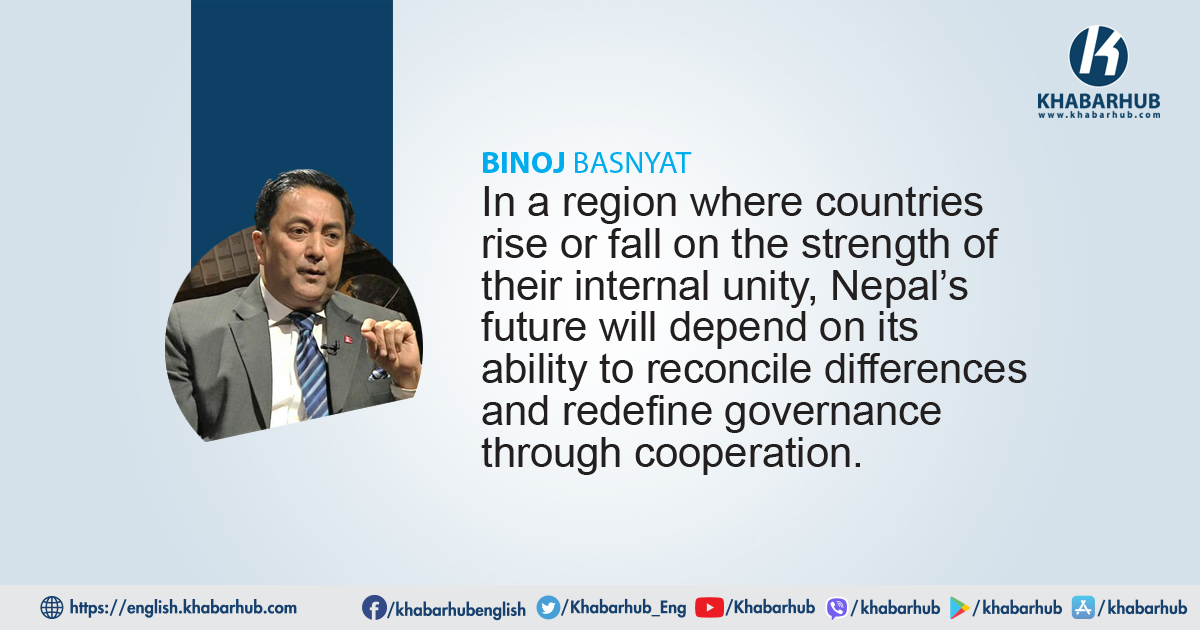
In a region where countries rise or fall on the strength of their internal unity, Nepal’s future will depend on its ability to reconcile differences and redefine governance through cooperation. Japan’s experience suggests that stability need not come at the cost of democracy—it can emerge from consensus, constitutional clarity, and a national identity that transcends political divides.
By aligning the 2015 Constitution’s legacy with adaptive reforms—drawing inspiration from Japan’s constitutional parameters and two-layer democracy—Nepal can bridge the divide between heritage and modernity, and move from political rivalry and competition toward a culture of cooperation and national purpose.
A structural or governance-oriented quote by Lee Kuan Yew, from From Third World to First, states: “The acid test of any government is whether it improves the standard of living of its people.” This quote could underscore the Kathmandu Declaration’s spirit: political reform and consensus are not ends in themselves—they are means to deliver better governance, opportunity, and dignity to the people.
The Kathmandu Declaration, rooted in dialogue and driven by national purpose, can thus become Nepal’s 21st-century foundation and a strategic peace—where the energy of youth meets the wisdom of experience, and where consensus becomes the cornerstone of strategic stability.
(Basnyat is Maj. General (Retd.) and a strategic affairs analyst based in Kathmandu. He writes on South Asian geopolitics, national security, and the intersection of governance, diplomacy, and stability.)





Comment