




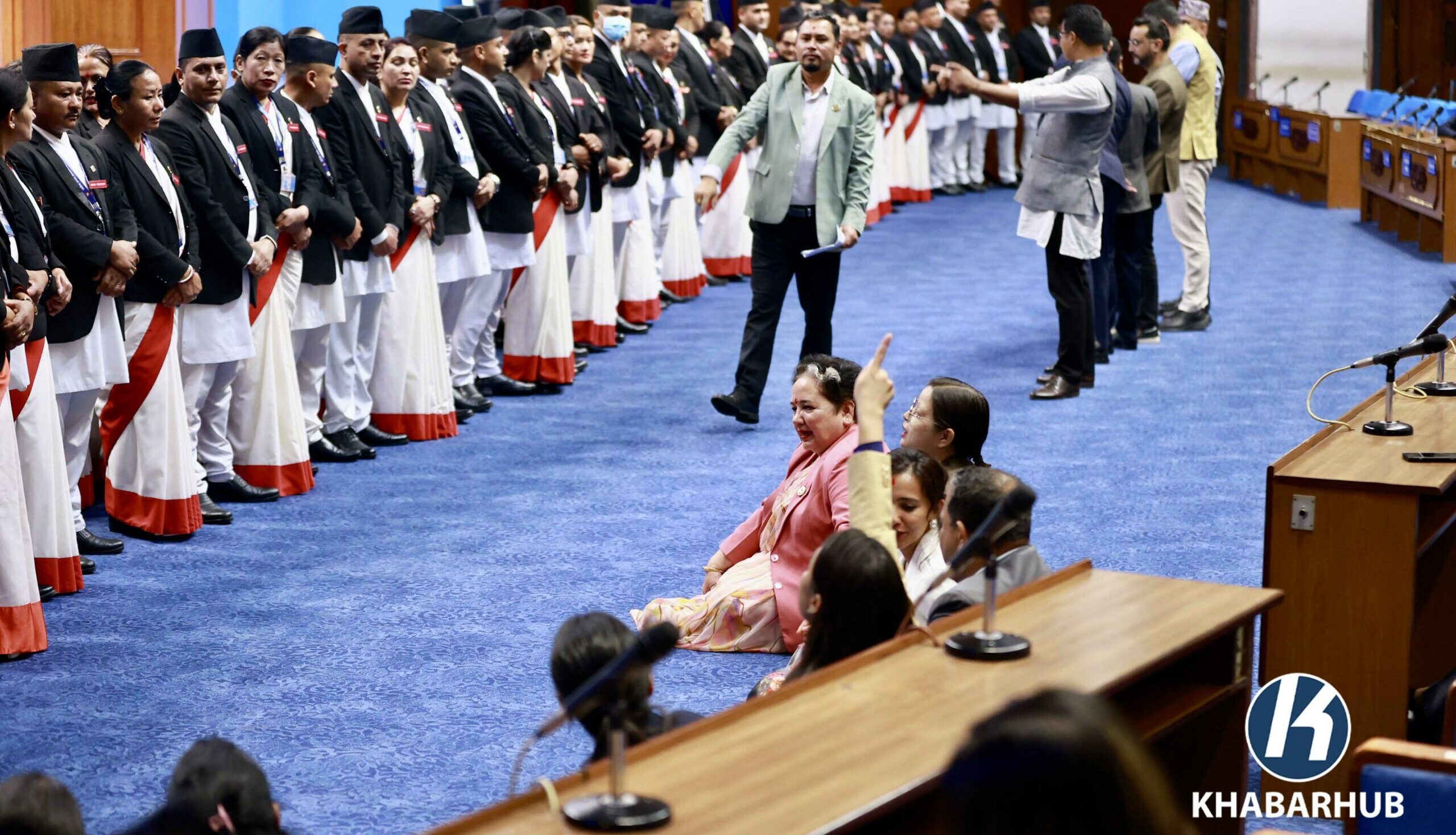
KATHMANDU: The Rastriya Swatantra Party (RSP), a new political force that entered Nepal’s Federal Parliament following the 2022 general election, has been obstructing proceedings in the House of Representatives (HoR), demanding the resignation of Home Minister Ramesh Lekhak.
The RSP, now the fourth largest party in parliament, has been protesting since May 27, calling for the formation of a judicial or parliamentary inquiry committee to investigate the visit visa scandal allegedly linked to Minister Lekhak.
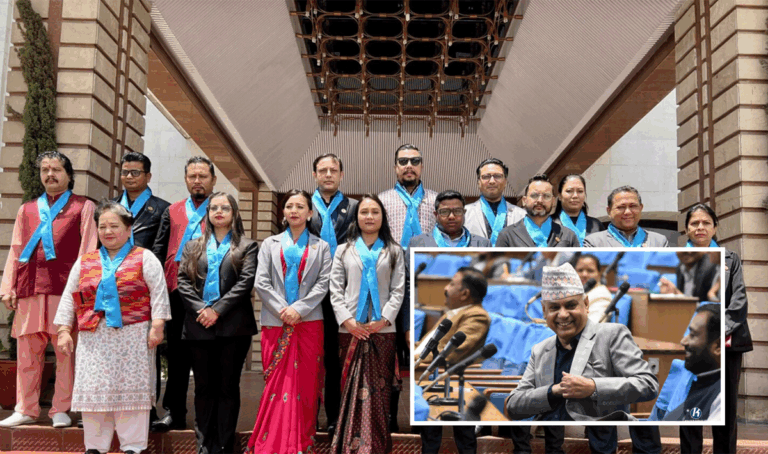
Demonstrating a different approach from Nepal’s traditional parties, RSP lawmakers arrived at Tuesday’s House meeting wearing blue ribbons resembling mufflers around their necks.
Sharing a group photo taken at the main entrance of the parliament building on social media, MP Dr. Toshima Karki stated that the blue ribbon was a symbol of “opposition to human trafficking and smuggling,” expressing “solidarity with victims” and a “commitment to a safer society.”
Similarly, RSP’s acting spokesperson, MP Manish Jha, posted on Twitter that the blue ribbon symbolizes a global campaign against human trafficking. “Today, all RSP MPs have opposed human trafficking by wearing blue ribbons in the Federal Parliament,” he wrote.
However, the ruling Nepali Congress objected to RSP lawmakers wearing blue ribbons in the chamber. When Speaker Devraj Ghimire gave the floor to RSP MP Dr. Chanda Karki, Nepali Congress immediately raised a point of order.
Chief Whip Shyam Kumar Ghimire argued that the attire violated parliamentary decorum and demanded that the RSP lawmakers be removed from the House for wearing what he deemed inappropriate accessories.
Quoting Chapter 6, Section 30 of the House of Representatives Rules (2075 BS), which allows the Speaker to warn and take action against members displaying indecent behavior, Ghimire said, “There are clear provisions regarding decent attire in the House. Do the scarves worn by some MPs today fall under ‘decent attire’? If tomorrow someone enters in half-pants or casual wear, will that uphold the dignity of the parliament?”
In earlier sessions, RSP MPs remained silent when opposition members spoke but interrupted ruling party members by surrounding the well of the House and shouting slogans.
At times, they even sat on the floor of the well, allegedly to rest—actions that drew criticism on social media. CPN-UML MP Surya Bahadur Thapa Chhetri went so far as to liken RSP lawmakers to “broiler chickens” for their conduct.
Commenting on the RSP’s approach to the visit visa issue, Maoist Centre Deputy General Secretary and MP Barshaman Pun suggested that the RSP lacks experience in parliamentary procedures.
Speaking during the discussion on the annual revenue and expenditure estimate on June 15, he advised RSP lawmakers to learn from the older parties.
“This new party is inexperienced and may not yet understand certain parliamentary struggles,” said Pun. “I urge the RSP to draw lessons from the past and from the parties in the House. The issue they raised regarding the visa scandal has already been addressed to some extent.”
Pun added, “I request the fourth-largest party, the RSP, to recognize that while they’ve made their point, the budget is a recurring and crucial matter. They should now focus on contributing their views on this topic.”
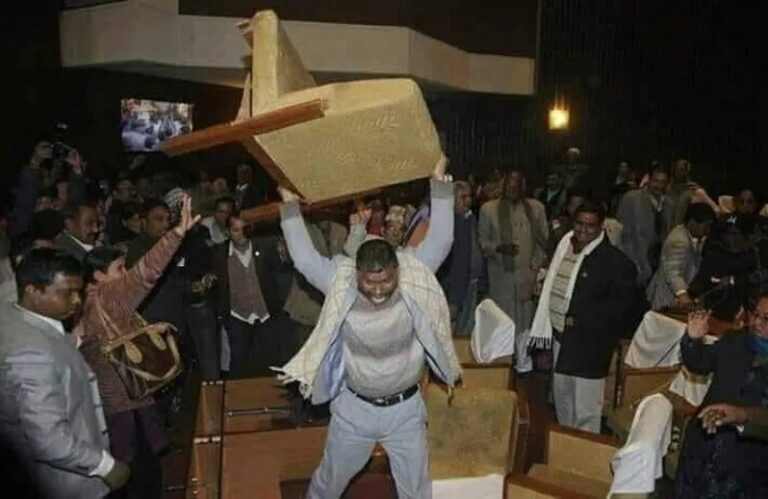
In response, RSP supporters took to social media, posting photos of past House vandalism committed by Maoist lawmakers during earlier political turmoil, asking pointedly: “What can we learn from the Maoists who broke chairs?”
The Maoist Center (then Unified CPN-Maoist) has a well-documented history of creating turmoil within Nepal’s legislature.
One of the most notorious incidents occurred at midnight on February 3, 2015, during a meeting of the Constituent Assembly. Chaos erupted as Maoist lawmakers resorted to vandalism—breaking chairs and microphones—which led to significant property damage. Images of the melee still resurface on social media, evoking memories of that tumultuous night.
Even after the session had been formally adjourned, Maoist lawmakers climbed on furniture and continued to vandalize the chamber.
Present inside the Assembly during the incident were two prominent leaders—former Prime Ministers Pushpa Kamal Dahal ‘Prachanda’ and Dr. Baburam Bhattarai—who had both previously led the government.
Earlier, on January 17, 2011, Maoist lawmakers had also obstructed the budget presentation by snatching the budget briefcase from then Finance Minister Surendra Pandey and tearing the fiscal document.
The then Speaker, Subash Chandra Nembang, was forced to adjourn the session amid rising tensions. The confrontation escalated to the point where some MPs’ clothes were torn in a scuffle between Maoist and UML members. The budget had to be issued the next day through an ordinance.
Is the UML Any Different?
The CPN-UML, now part of the ruling coalition, has also engaged in prolonged obstruction of parliamentary proceedings. Notably, the UML disrupted the House for nine consecutive months starting from September 8, 2021, after learning that former Prime Minister Madhav Kumar Nepal was planning to split the party and register a new faction with the Election Commission.
The UML’s anger stemmed from Speaker Agni Prasad Sapkota’s refusal to officially recognize a letter from party chair KP Sharma Oli, submitted on August 17, which sought action against 14 UML lawmakers, including Nepal.
The Unified Socialist Party was formally registered on August 25, and Speaker Sapkota subsequently declared that no further action would be taken regarding the letter. In protest, the UML disrupted parliament from September 6 onward for the next nine months.
During this period, chaotic scenes unfolded in the House, including UML lawmakers climbing onto the Speaker’s rostrum and pushing other MPs aside. Historically, the UML also obstructed 58 parliamentary sessions during the government led by Girija Prasad Koirala.
Additionally, UML National Assembly member Golche Sarki once slapped the then Local Development Minister Ram Chandra Paudel (now President of Nepal) during a National Assembly meeting in July 1993. Sarki was suspended for 15 days for the incident.
Nepali Congress: No Exception
The Nepali Congress, currently leading the government, also has a record of parliamentary obstruction. The party blocked 22 sessions in protest of an alleged cooperative fraud case involving RSP President Rabi Lamichhane, demanding his resignation as Home Minister and the formation of a probe committee.
“Congress disrupted the House for two months to investigate the cooperative scandal, halting all proceedings. We only obstructed on the 27 and 28 [of May],” noted RSP acting spokesperson Manish Jha in a post on June 10.
“We participated peacefully on the day of the budget (Jestha 15). Disruptions occurred again on June 3, 4, 5, 6, 8 and 9. But we are not trying to outdo the CPN-UML or Nepali Congress in disrupting the House.”
Nepali Congress had also blocked parliament in June 2019, demanding the withdrawal of the Guthi Bill, and later disrupted sessions again after the Commission for the Investigation of Abuse of Authority filed a case against then-deputy leader Bijay Kumar Gachhadar, alleging political bias.
RSP Under Scrutiny
The Rastriya Swatantra Party (RSP), a relatively new entrant in federal politics, has been obstructing parliamentary proceedings, demanding a parliamentary or judicial investigation into the visit visa scandal and the resignation of Home Minister Ramesh Lekhak.
From May 27 to Tuesday, the RSP has disrupted 16 sessions of the House of Representatives. Initially, the Maoist Center supported the protests until June 12, but since then, the RSP has stood alone in continuing to raise the issue.
Although the Maoist Center, Nepal’s third-largest party, appeared aligned with the RSP earlier, it later struck a two-point agreement with the ruling alliance to help break the deadlock, effectively distancing itself from the issue.
Meanwhile, the Rastriya Prajatantra Party (RPP) also supports the RSP’s demand but has not coordinated efforts. While the RSP continues to boycott the House, the RPP has taken to besieging the well.
Now, the question arises: How long will the RSP continue its obstruction?
RSP Vows to Continue Parliamentary Obstruction Over Visit Visa Scandal
RSP Chief Whip Santosh Pariyar has reaffirmed the party’s stance on continuing its disruption of Parliament until its demands regarding the visit visa scandal are addressed. “The agitation will continue until our demands are met,” he told Khabarhub.
What MPs Should Keep in Mind
The law clearly outlines the dignity, decorum, and behavioral standards expected of Members of Parliament (MPs). Chapter 4 of the House of Representatives Rules and Chapter 4 of the National Assembly Rules detail the conduct MPs must maintain during parliamentary sessions.
General Decorum for MPs During Sessions:
(a) All members must stand to show respect when the Speaker enters the chamber.
(b) Respect must be accorded to the Speaker’s chair, and the Speaker must be allowed to take their seat without interruption.
(c) MPs may only leave the chamber once the session has been adjourned and the Speaker has exited.
(d) MPs may speak only when granted permission by the Speaker.
(e) When speaking, MPs must stand at the designated place and address the Speaker, unless directed otherwise.
(f) MPs must remain seated and listen attentively when the Speaker is speaking.
(g) No MP should walk between the Speaker’s chair and a member who is speaking.
(h) MPs must not sit or stand with their back to the Speaker.
(i) No behavior that disrupts or undermines the dignity of the session or causes disorder is allowed while another MP is speaking.
(j) MPs are not allowed to read unrelated materials, such as books or newspapers, during the session.
(k) Mobile phones must be kept on silent, and phone conversations or recordings are strictly prohibited in the chamber.
Rules for Parliamentary Speech and Debate:
(a) MPs must rise to seek recognition from the Speaker and speak only when called upon or given a signal.
(b) The conduct of the Speaker may not be criticized, except when specifically debating a motion regarding their behavior.
(c) MPs must not raise topics prohibited under Article 105 of the Constitution.
(d) The use of indecent, obscene, offensive, discriminatory, or unparliamentary language—including words that insult individuals or groups based on race, religion, language, gender, or any other category—is strictly forbidden.
(e) MPs must not abuse their right to speak with the intent to obstruct parliamentary proceedings.
These rules serve as a reminder that all MPs—whether from new or established parties—are bound by the same standards of conduct to ensure the smooth functioning and integrity of Nepal’s legislative process.



Comment