




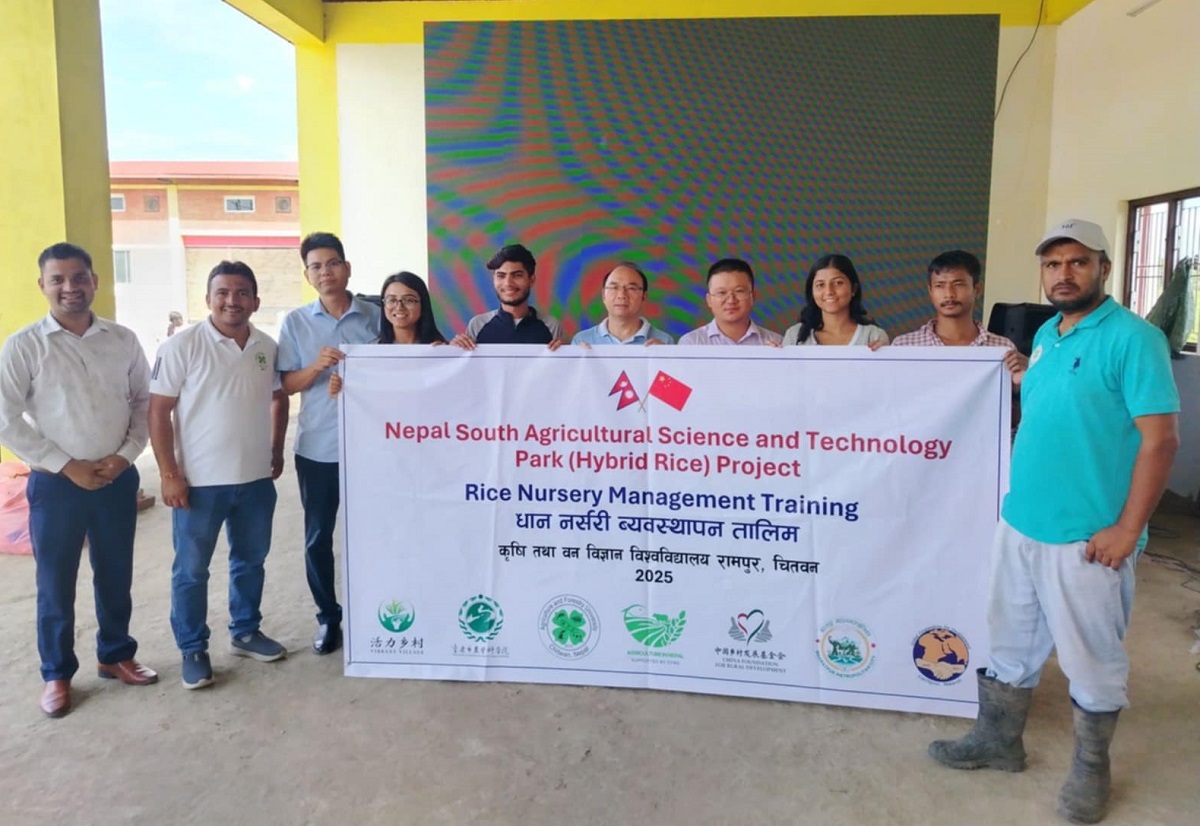
CHITWAN: Over 100 rice farmers from Nepal’s Chitwan region participated in a specialized training program on hybrid rice cultivation techniques at the China-Nepal Southern Agricultural Science and Technology Park.
The event, organized by the China Foundation for Rural Development, in collaboration with Nepal’s Agriculture and Forestry University (AFU) and Global cooperation for development (GCD) and supported by the Chongqing Academy of Agricultural Sciences, aimed to enhance rice productivity and farmer incomes through advanced agricultural practices.
Rice is Nepal’s staple crop, covering 29% of farmland and feeding nearly 70% of the population. However, the country’s average yield of 2.5 tons per hectare lags far behind China’s 6 tons per hectare, primarily due to outdated farming techniques and inefficient fertilizer use.
Speaking at the opening ceremony, AFU Vice-Chancellor Sharma emphasized the training’s significance: “Chitwan is Nepal’s rice bowl, but we need modern techniques to maximize yields. This collaboration with China will help our farmers adopt smarter practices, ensuring food security and higher incomes.”
The one-day workshop focused on practical solutions tailored to Nepal’s farming conditions:
Prof. Wang Qian (Chongqing Academy of Agricultural Sciences) introduced high-yield hybrid rice varieties suited for Chitwan’s climate and demonstrated seedling tray nurseries and mechanical transplanting.
Dr. Raju Kheral (AFU) tackled excessive fertilizer use by teaching soil testing and precision fertilization, helping farmers optimize nutrient application.
Farmers engaged actively, raising concerns about lodging prevention, yield comparisons, and soil testing tools. Each participant received a Nepali-language handbook on efficient rice cultivation for future reference.
Ram Gurung, a local farmer with a decade of experience, shared his optimism: “Traditional methods kept my yields low. Now, with China’s hybrid rice and scientific techniques, I aim for a 20% increase next season.”
This training follows the August 11 launch of hybrid rice trial transplanting in Chitwan, where the first 100-mu (6.7-hectare) pilot fields are expected to yield 5 tons per mu—double the output of local varieties. Future initiatives will expand to potato cultivation and agricultural machinery to further boost Nepal’s farming sector.
Li Hua, Director of the China-South Asia Poverty Reduction Center, highlighted the long-term vision: “We’re not just providing seeds—we’re equipping farmers with knowledge. Field experts will follow up with on-site guidance to ensure success.”
This training marks a new phase in China-Nepal agricultural cooperation, combining technology transfer with localized support to strengthen Nepal’s food security and rural development.






Comment