




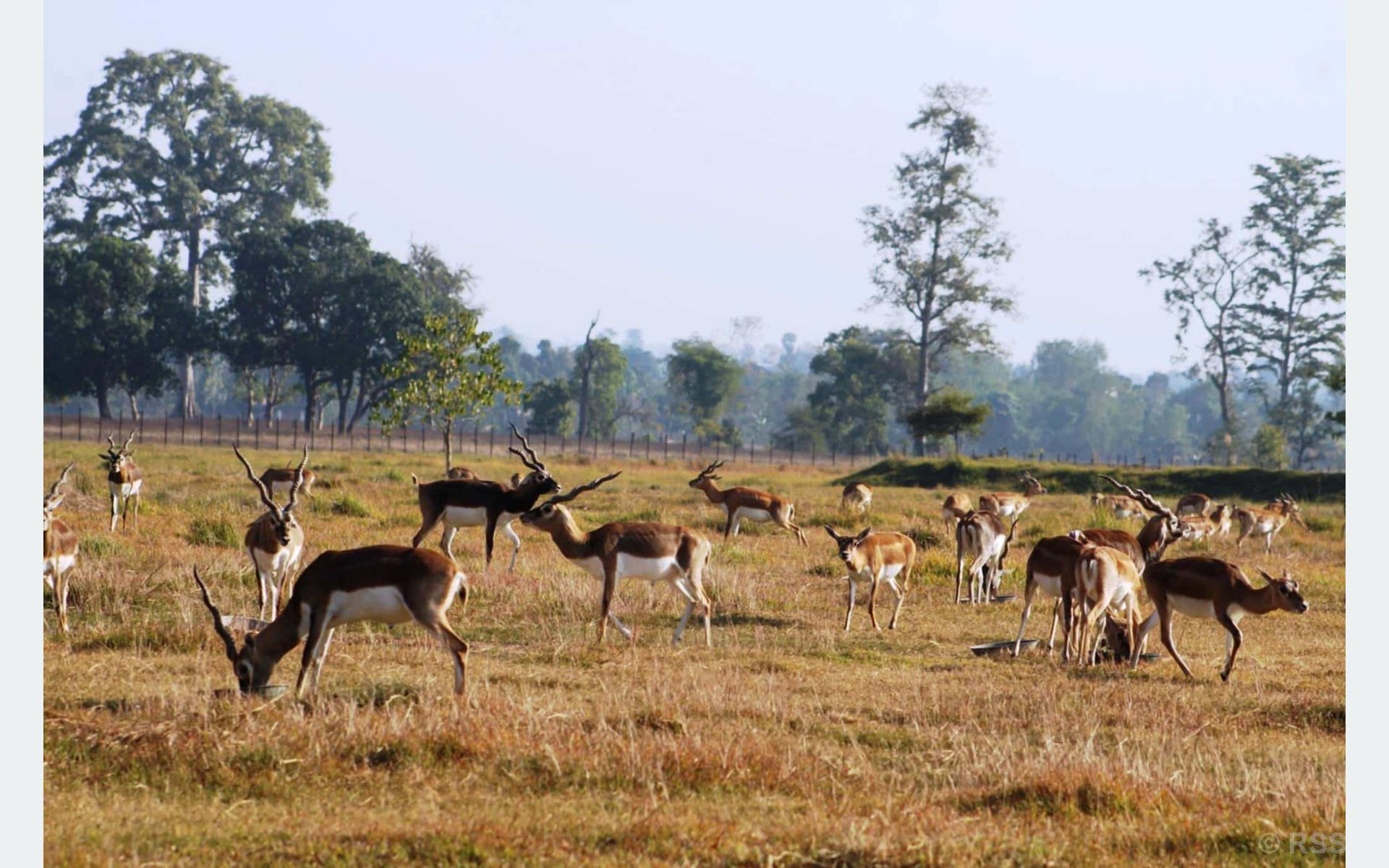
KANCHANPUR: The population of rare blackbucks in Shuklaphanta National Park continues to grow steadily.
Since the species’ restoration efforts began a decade ago, their numbers have risen to 310, comprising 117 males, 143 females, and 50 calves. Among the males, 93 are adults and 24 semi-adults, while females include 99 adults and 44 semi-adults.
The blackbucks are protected within a fenced area of 58.8 hectares in Hirapur Phata inside the park. The fencing began with just 7.5 hectares in 2012 and has gradually expanded over the years: 4.5 hectares in 2013, 5 hectares in 2015, 17 hectares in 2017, and 7.8 hectares in 2019.
Purushottam Wagle, the park’s information officer, explained that managing the increasing blackbuck population has become challenging.
Studies are currently underway to explore relocating blackbucks either to other parts of the park or to different protected areas. “We have held discussions with the ministry and department on managing the growing population,” he said.
A feasibility study is being conducted on releasing blackbucks into natural habitats such as Burnikheda. Additionally, a proposal to rehabilitate them in Chitwan National Park has been submitted.
According to park records, the blackbuck population has grown significantly over the past decade: from 31 in 2013 to 36 in 2014, 35 in 2015, 44 in 2016, 59 in 2017, 66 in 2018, 88 in 2019, 115 in 2020, 141 in 2021, 204 in 2022, 261 in 2023, and 287 in 2024.
The conservation program in Shuklaphanta began with the transfer of blackbucks from Nepalgunj and Lalitpur Central Zoos in Bhadra 2069 BS, followed by a second transfer from Khairapur in Bardiya in Baisakh 2072 BS. A total of 42 blackbucks were brought in the first phase and 14 in the second.
To maintain the health and nutrition of the blackbucks, they are fed once daily with a mix of feed including bran, maize, and gram. Veterinarian Abhash Shrestha noted that due to occasional parasitic infections such as worms, medicine is regularly mixed into their feed.
Under the National Parks and Wildlife Conservation Act, 2029, blackbucks are classified as protected wildlife. These antelopes are also found in Nepalgunj, Mrigasthali in Kathmandu, Khairapur in Bardiya, and Hirapur Phata in Shuklaphanta.
Adult males are black and prefer grassy plains, while females are brown. Both sexes are brown until reaching maturity. Blackbucks give birth approximately every six months.
The number of domestic tourists visiting the blackbuck conservation area is increasing, as many come to observe these rare animals in their natural habitat.






Comment