




Six months after Balendra Shah assumed office as Prime Minister, Nepal is at an unusual point in its political history. The September 2025 Gen Z uprising disrupted the established political order; the March 2026 election produced a powerful mandate for the Rastriya Swatantra Party (RSP); and a new generation entered national politics with expectations that the government should be more accountable, competent and responsive to both overt and covert strategic challenges.
But six months is neither long enough to judge a government by the full consequences of its policies nor short enough to excuse the absence of direction.
The more useful question, therefore, is not whether the Balen-led administration has transformed Nepal in six months. It clearly has not, but it has laid the foundation—and no government could reasonably do so in such a short period. The question is more strategic: What should Nepalese expect to see by the time this government completes its first year, and what vulnerabilities must the government manage if the promise of political change is to become durable national transformation?
The answer should go beyond roads, buildings, appointments or individual administrative decisions. The first year should establish whether Nepal is becoming more governable, more institutionally credible, more socially cohesive, more economically resilient and more strategically autonomous, while ensuring that corruption is dismantled and those responsible are brought to justice.
The lesson is straightforward: National security begins before the police arrive. It begins with the capacity to prevent social tensions from developing into communal confrontations.
The government has inherited a country demanding rapid change but operating through institutions that were built for a different political era. Its greatest opportunity is also its greatest vulnerability: a large electoral mandate can accelerate reform, but if reform becomes excessively personalized, politically confrontational or institutionally disruptive, the very stability required to sustain change could be weakened.
The next six months should therefore be treated as a period of consolidation, institutionalization and strategic preparation.
Five Tests of Change: From Administrative Reform to Institutional Transformation
The public expectation is unlikely to be that every structural problem will have been solved within twelve months. What citizens should reasonably expect is evidence that the state is moving in a different direction through a reformed approach.
Five visible changes would matter. First, the government should become more predictable. Decisions should increasingly be based on rules, timelines and measurable objectives rather than political discretion.
Second, public services should become more responsive. Citizens should encounter fewer administrative obstacles, greater use of digital systems and clearer accountability for delays and failures.
Third, corruption should become more difficult—not merely more publicly condemned. The government needs institutional mechanisms for procurement transparency, asset declarations, conflict-of-interest management and accountability that do not depend on the personality of the prime minister.
Fourth, merit should begin to replace patronage. Recruitment, promotion and transfers within the civil service, police and other public institutions should increasingly reflect competence and performance rather than political affiliation.
Fifth, the government should begin demonstrating that reform can survive beyond the government itself.
That last point is critical. The purpose of a political revolution is not to produce a permanently dominant political party. It is to produce institutions that make political change less disruptive in the future.
The first-year test should therefore be whether the Balen administration is institutionalizing reform rather than merely administering it.
The Government Must Convert Its Mandate into an Institutional Settlement
The RSP entered government as an outsider to Nepal’s traditional political establishment. That gives it political space to challenge established practices, but it also creates a responsibility to build institutional legitimacy.
The government’s proposed constitutional reform process illustrates the challenge. A task force formed by the administration has reportedly proposed changes affecting a very large portion of the Constitution, while major opposition parties have questioned both the scope and the process. The government has said that broad consensus would be necessary and that the exercise is preparatory rather than an attempt to impose unilateral change.
This issue will become one of the defining tests of the first year.
Constitutional reform cannot become a contest between the new majority and the old establishment. Nor should opposition to the government’s proposals automatically be treated as resistance to reform.
Nepal needs a process through which reform acquires ownership beyond the ruling party.
The government should therefore use the next six months to identify areas where broad consensus exists—administrative duplication, federal-provincial-local jurisdiction, public-sector efficiency, electoral accountability and institutional clarity—and build consensus there first.
Where fundamental constitutional questions remain contested, the government should create space for national debate rather than rushing towards confrontation.
The strategic objective should be to change enough to correct institutional weaknesses while building sufficient consensus to ensure that reform itself does not become the next source of instability.
The Resistance of the Old Order: Manage It, Do Not Underestimate It
The traditional political parties have lost electoral dominance, but they have not disappeared.
They retain organizational networks, experienced leadership, ideological constituencies and connections across Nepal’s political and social landscape. Opposition parties have already challenged aspects of the government’s reform agenda, particularly constitutional reform and its determination to address systemic corruption and misconduct.
The Balen administration should therefore avoid two opposite mistakes. The first would be to underestimate the capacity of established parties to resist or adapt.
The second would be to treat every opposition action as an attempt to destabilize the country.
Democratic opposition is necessary. The government’s challenge is to distinguish legitimate political competition from institutional obstruction and destabilization.
The best answer is not confrontation but performance. If the government delivers better public services, improves institutions, creates employment and maintains constitutional discipline, the political space for obstruction naturally narrows.
Conversely, if reform becomes personalized, opaque or excessively confrontational, traditional parties will find opportunities to portray the current government as another form of political establishment.
The paradox is therefore clear: To defeat the old political culture, the new government must avoid reproducing its methods.
The Social Vulnerability: Prevent Politics from Becoming Identity
One of the most important risks facing Nepal is not necessarily political opposition but social polarization.
Recent communal violence in the Tarai demonstrated how a relatively localized dispute can acquire a much wider religious and political dimension. Security agencies had previously warned about rising communal polarization and the potential for social media misinformation to accelerate tensions.
This should be treated as an early warning for the government. Nepal’s religious diversity is not a problem. Hindu, Buddhist, Muslim, Christian, Kirat and other communities are part of Nepal’s social fabric. The vulnerability arises when political entrepreneurs, extremist elements, misinformation networks or external influences turn identity into a source of confrontation.
The government should therefore establish a national social-cohesion mechanism capable of identifying emerging tensions before they become security crises.
This should involve local administrations, political parties, religious leaders, community representatives, security agencies, civil society, digital platforms and fact-checking institutions.
The state should also develop an early-warning system for inflammatory misinformation and AI-generated content.
The objective should not be to censor legitimate expression. It should be to prevent deliberate incitement, fabricated information and coordinated manipulation from turning local disputes into national crises.
By the first anniversary, Nepalese will reasonably want to see more than administrative reform. They will want evidence that the government has a credible economic strategy.
The lesson is straightforward: National security begins before the police arrive. It begins with the capacity to prevent social tensions from developing into communal confrontations.
Open Borders, Migration and the Governance of Sovereignty
Nepal’s open border with India is a permanent geographical reality and an important economic and social asset. It cannot simply be securitized without damaging legitimate movement and the deep interdependence between the two societies.
But openness requires institutional capacity. The government should therefore use its first year to develop a comprehensive migration and border-governance strategy.
The objective should be to know more accurately who enters Nepal, who leaves, who resides here, and which movements are associated with legitimate tourism, employment, commerce or family connections.
The state must strengthen its capacity to combat trafficking, smuggling, document fraud, transnational crime and other illicit activities without treating ordinary migrants as security threats.
This is particularly important because Nepal is simultaneously a country of immigration, transit and mass outward migration.
The strategic principle should be: Open borders should not mean weak borders; stronger governance should not mean closed borders.
Digital identity systems, immigration databases, customs integration, intelligence sharing and better coordination between federal and local authorities can allow Nepal to preserve openness while improving sovereignty.
Terrorism and Cross-Border Security: From Exposure to Preparedness
Nepal’s national security vulnerabilities also include domestic political violence and potential exposure to cross-border terrorism and terrorist financing. The Asia/Pacific Group’s 2023 mutual evaluation found that Nepal’s domestic terrorism threat had declined significantly, although small-scale incidents involving improvised explosive devices and small arms had occurred.
It also identified two terrorist-financing cases involving funds transferred from regional jurisdictions through Nepal for planned activities outside the country. The assessment highlighted limitations in understanding terrorist-financing risks, conducting financial investigations and enforcing asset-confiscation orders.
Nepal’s continued inclusion on the Financial Action Task Force’s (FATF) increased-monitoring list in June 2026 further underscores the need to strengthen the effectiveness of its financial safeguards. These findings do not establish that Nepal currently faces widespread international terrorism; they demonstrate why a low-incidence environment must not be confused with an absence of vulnerability.
The recent flood disaster should therefore become a turning point—from post-disaster relief to anticipatory national resilience. Nepal has already announced plans to drain several high-risk glacial lakes and strengthen flood forecasting, illustrating the direction such a preventive approach could take.
The strategic response should combine professional intelligence coordination, risk-based border screening, aviation security, financial intelligence, effective prosecution and cooperation with neighbouring countries. Nepal must move from reacting to incidents to identifying and disrupting threats before they develop into national security crises.
Economic Performance: From Remittance Dependence to Productive Capacity
By the first anniversary, Nepalese will reasonably want to see more than administrative reform. They will want evidence that the government has a credible economic strategy.
The question should not simply be whether GDP has increased. It should be whether Nepal is becoming more productive.
Hydropower, tourism, information technology, agriculture, manufacturing, logistics and digital services need to be treated as strategic sectors rather than disconnected economic programmes.
The government should establish measurable first-year benchmarks for hydropower generation and electricity exports; tourism arrivals and tourism infrastructure; foreign investment; digital services; industrial production; employment; export diversification; and infrastructure delivery.
Remittances will remain important. But a country cannot build long-term strategic autonomy by depending primarily on the export of its own labour.
The strategic transition should be:
From labour export to productive employment;
From consumption to production;
From import dependence to export capacity;
From development assistance to investment-led growth.
This is where economic policy becomes national security.
A stronger economy gives Nepal greater freedom in foreign policy because it reduces the pressure to accept external choices simply because it needs external resources.
Disaster Resilience: The First Year Cannot End Without a National Resilience Architecture
The recent catastrophic floods have made this issue impossible to postpone. The disaster has destroyed homes and critical infrastructure and exposed the difficulty of reaching vulnerable communities quickly. The scale of the losses has demonstrated that disaster management is no longer simply a humanitarian responsibility; it is a test of state capacity.
For Nepal, this is especially significant because the country’s climate vulnerability is structural.
The government should therefore use the first year to establish a permanent National Resilience Architecture.
It should include national early-warning systems, glacier and glacial-lake monitoring, hydrological forecasting, resilient bridges and roads, emergency communications, pre-positioned logistics, local disaster-response capacity, clear security-force roles, climate-risk mapping and protection of critical infrastructure.
The principle should be: Anticipate before reacting. Coordinate before improvising. Prepare locally, act nationally.
The government should also integrate disaster resilience into development planning.
There is little strategic value in building a road, bridge or hydropower project today if its vulnerability to tomorrow’s climate risks has not been assessed.
But government is slower than politics. Institutions take time to reform. Infrastructure takes years to build. Courts cannot be bypassed. Civil-service systems cannot be transformed overnight. Foreign policy requires continuity. Economic restructuring requires investment cycles.
The recent flood disaster should therefore become a turning point—from post-disaster relief to anticipatory national resilience. Nepal has already announced plans to drain several high-risk glacial lakes and strengthen flood forecasting, illustrating the direction such a preventive approach could take.
Foreign Policy: Turn the Mandate into Strategic Autonomy
By its first anniversary, the Balen administration should also demonstrate a clear external strategy.
Nepal cannot afford a foreign policy based on reacting to pressure from larger powers.
Its strategic environment requires diversification.
India remains indispensable because of geography, trade, transit, energy, investment and people-to-people ties.
China remains a strategic imperative because of geography, connectivity, trade diversification and the wider transformation of the Himalayan region.
The US and other major and middle powers can contribute technology, investment, education, development cooperation and international partnerships.
The objective should not be equal distance from all. It should be equal confidence in dealing with all.
Nepal should neither become part of great-power confrontation nor allow its development choices to become instruments of strategic competition.
The principle should be: Diversify partnerships, avoid dependency, protect sovereignty and convert geography into strategic choice.
This is the transition from Nepal as a buffer to Nepal as a strategic bridge.
Breaking the Impunity Cycle: Executive Push, Judicial Pushback, and Legislative Alternatives
The establishment of Nepal’s Property Inquiry Commission in April 2026 clearly illustrates how radical political intent to combat corruption can spark fierce resistance from entrenched legal and constitutional frameworks.
The commission’s primary intention was to break a decades-long cycle of political impunity by proactively auditing the unexplained wealth of top-tier officials dating back to 2006—effectively bypassing the permanent anti-corruption body (the CIAA), which is legally barred from reviewing cabinet-level policy decisions.
However, this aggressive executive push met immediate institutional resistance in July 2026, when the Supreme Court halted its operations over jurisdictional disputes, forcing a constitutional standoff.
To find a viable way forward, the government must move away from creating temporary, legally vulnerable parallel commissions. Instead, a more sustainable strategy involves legislative reform to structurally amend the CIAA Act—specifically, repealing Section 4(b) to eliminate the “policy decision” loophole that currently shields corrupt elites. By empowering the existing, constitutionally mandated CIAA with broader investigative authority and greater autonomy, Nepal can build a legally robust, permanent mechanism capable of holding high-level officials accountable without triggering paralyzing constitutional crises.
The Biggest Vulnerability: Expectations May Outrun State Capacity
There is another danger the government should not underestimate: the expectation gap.
The Gen Z movement raised high expectations for ending corruption, ensuring efficient governance and creating more national opportunities. The election transformed this political movement into a mandate, further strengthening the belief that an entirely different style of government was possible.
The first year cannot complete Nepal’s transformation. It must demonstrate that transformation has become possible, establish the institutional foundations to sustain it, and build the platform for the next five years. The question is not whether Balen changed Nepal in one year, but whether he has begun building a Nepal capable of changing itself.
But government is slower than politics. Institutions take time to reform. Infrastructure takes years to build. Courts cannot be bypassed. Civil-service systems cannot be transformed overnight. Foreign policy requires continuity. Economic restructuring requires investment cycles.
If expectations rise faster than delivery, disappointment can become politically destabilizing.
The government therefore needs a public performance compact.
It should tell citizens what will be completed within one year, what will be initiated within one year, what will require three to five years, and what cannot realistically be achieved by the government alone.
This is not merely a communication strategy. It is strategic expectation management. A government that promises transformation without explaining its institutional constraints risks recreating the same cycle of public disappointment that produced the political rupture in the first place.
Conclusion: The First Year Should Build the Platform for the Next Four
Six months into the Balen administration, the central issue is not whether Nepal has already been transformed. It has not. The question is whether the government can use the remaining six months before its first anniversary to establish the foundations of lasting transformation.
The political mandate provides an opportunity; it does not guarantee success.
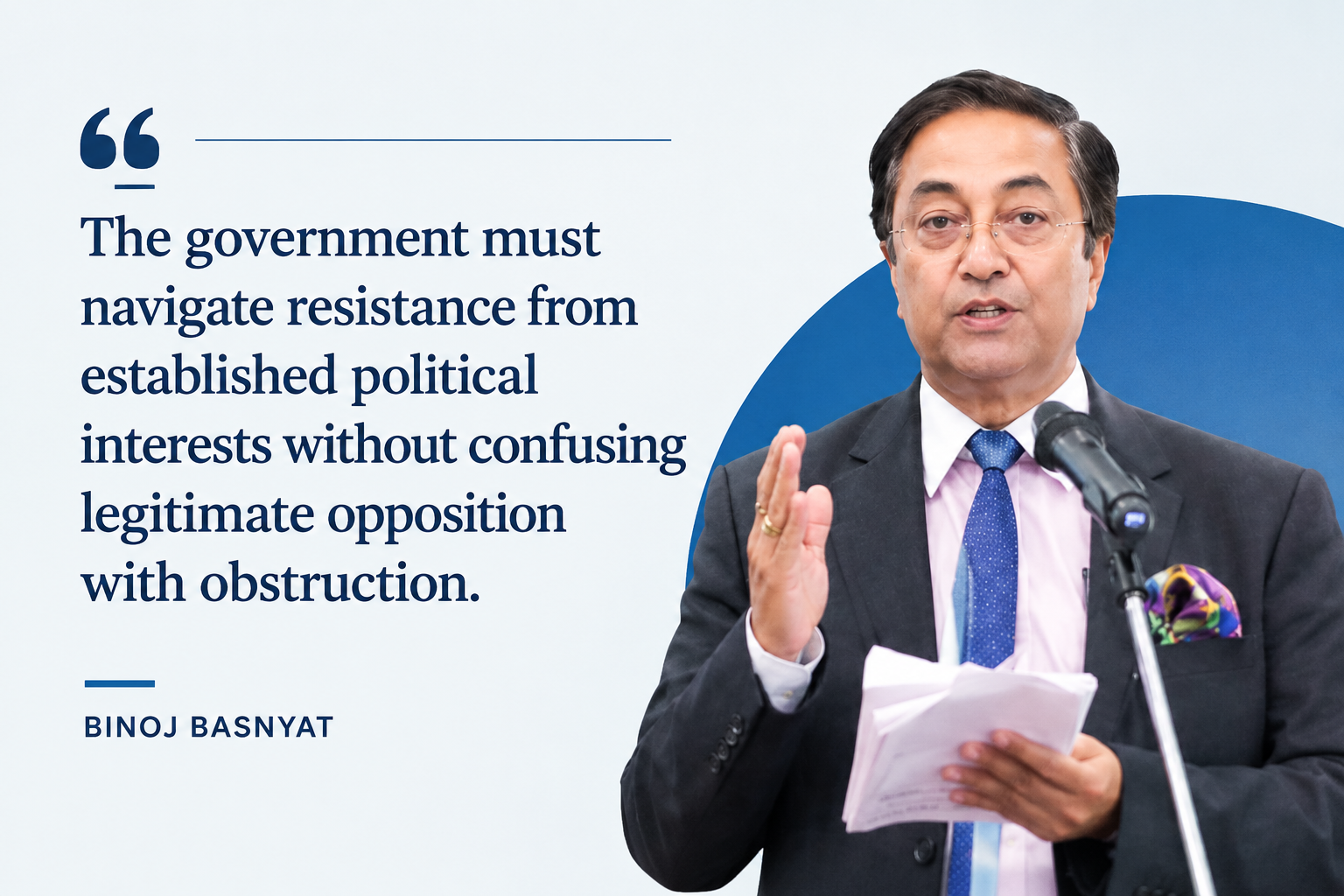
The government must navigate resistance from established political interests without confusing legitimate opposition with obstruction. It must address social vulnerabilities without allowing identity politics to fuel communal polarization, manage migration and border challenges without undermining legitimate openness, and convert remittances and natural resources into productive national capacity.
It must anticipate climate-induced disasters rather than repeatedly react to them, while turning Nepal’s position between major powers into a strategic choice rather than a strategic vulnerability.
Nepal should be:
More governable—with clearer accountability and faster public services.
More institutional—with reforms embedded in rules rather than personalities.
More meritocratic—with professional public institutions.
More cohesive—with stronger mechanisms against communal polarization.
More secure—with better border, migration and transnational-crime governance.
More resilient—with disaster preparedness built into national planning.
More productive—with stronger foundations for hydropower, tourism, technology and industry.
More connected—through infrastructure that expands economic opportunity.
More strategically autonomous—maintaining strong relationships with India, China, the US and other partners without becoming strategically dependent on any one of them.
And above all, Nepal should be more confident in itself.
Above all, the first year must demonstrate that corruption is no longer protected by political connections or institutional impunity. Corrupt networks must be dismantled through impartial investigations, credible prosecutions and due process. Accountability must apply equally, without political retaliation or selective justice. The objective is not to punish political opponents, but to restore the principle that public office carries responsibility and that no individual stands above the law.
The first year should therefore be understood as a bridge between political rupture and national resurgence. The Gen Z uprising created the demand for change; the election provided the mandate. The remaining task is to convert that mandate into institutional capacity, public confidence and demonstrable structural reform.
The administration should be judged not by the number of roads built, buildings inaugurated, appointments made or administrative decisions announced, but by whether Nepal is becoming more governable, more institutionally credible, more socially cohesive, more economically resilient and more strategically autonomous.
The deeper tests are whether institutions are becoming more independent, citizens more confident, the economy more productive, justice more equal and the state better equipped to anticipate and manage its vulnerabilities.
The ultimate question is not how different the Balen administration looks from its predecessors, but whether it is building a state capable of governing effectively, protecting its citizens, creating opportunities, enforcing accountability and exercising greater strategic choice in the world.
The first year cannot complete Nepal’s transformation. It must demonstrate that transformation has become possible, establish the institutional foundations to sustain it, and build the platform for the next five years. The question is not whether Balen changed Nepal in one year, but whether he has begun building a Nepal capable of changing itself.
(Basnyat is a retired Major General of the Nepali Army and a strategic affairs analyst focusing on international relations, geopolitics, national security and evolving regional power dynamics. His writings examine the strategic forces shaping regional security, statecraft, foreign policy and the changing geopolitical order.)




Comment