




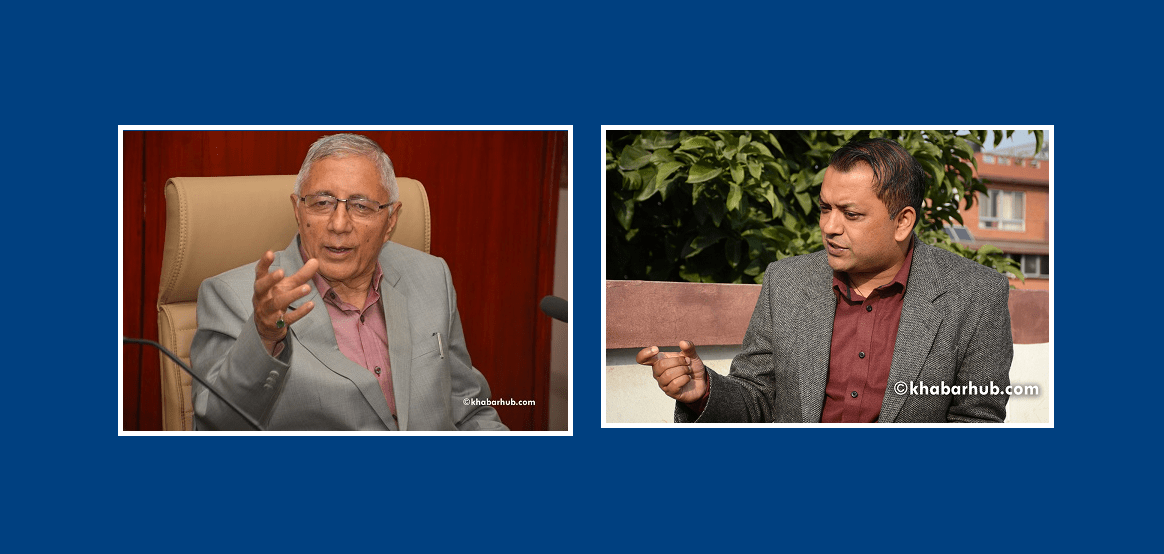
KATHMANDU: The debate over leadership transition within the Nepali Congress (NC) has officially begun, though the party has yet to finalize its active membership list.
With this delay, it is now evident that the 15th General Convention will not be held on schedule. Still, internal discussions and meetings are underway, focused on power dynamics, leadership transfer, and the party’s future roadmap.
Several senior leaders who once played influential roles have re-emerged, following signals from party President Sher Bahadur Deuba hinting at a possible leadership transfer. Those aspiring for leadership—especially some veteran figures—have become visibly active.
Amid these developments, seven former office bearers aligned with Deuba, now referred to as the ‘Seven Brothers’ — Bimalendra Nidhi, Krishna Prasad Sitaula, Prakash Man Singh, Shashank Koirala, Bijay Kumar Gachhadar, Gopal Man Shrestha, and Dr. Prakash Sharan Mahat — are positioning themselves as power brokers in the leadership transition.
They appear intent on shaping the future of the party in line with their individual factions and influence. Dr. Koirala, who contested against Deuba in the 14th General Convention, is preparing to run again. General Secretary Gagan Thapa is also likely to enter the presidential race.
Thapa’s growing independence from Shekhar Koirala and his escalating campaign preparations have stirred notable movement within the party. Leaders from various factions, including some from the establishment, have begun courting Thapa, anticipating future political realignments.
Fortunately, the situation is still in a manageable stage. There is still time to make a choice—between preserving outdated personal power structures or revitalizing the party and the democratic republic. The next general convention must not be a routine event—it must become a convention of generational transfer and renewal.
The Nepali Congress today resembles a federation of multiple factions and subgroups—each with its own interests, ambitions, and power strategies. While this structure has contributed to occasional instability, it also reflects a unique internal balancing mechanism within the party.
The Deuba-led faction is widely referred to as the establishment, while the opposing side, led by Shekhar Koirala and Gagan Thapa, is often described as the reformist stream. Both camps are busy formulating alternative strategies ahead of the General Convention.
Within the establishment itself, there are multiple active subgroups. Leaders like Nidhi, Sitaula, Singh, Shashank, Gachhadar, Shrestha, and Mahat have been holding regular consultations.
However, individually, they lack the influence or organizational base to stake a strong claim to party leadership. Instead, they are seen relying on Deuba’s political strength to remain relevant, hoping he will support one of them as his successor.
Their recent surge in activity reflects anxiety about their future roles in the party. Many believe that without Deuba’s backing, they risk being sidelined in the upcoming General Convention. This fear has led them to rally around Deuba, urging him to anoint one of them as the next leader.
Their inability to build a strong, independent support base has made them increasingly dependent on Deuba’s political capital. The group of seven appears to be exerting pressure on the president—not just through dialogue, but through coordinated visits to his private residence in Budhanilkantha, clearly aimed at influencing succession decisions.
What has intensified this urgency is the perceived threat posed by the younger generation, particularly General Secretary Gagan Thapa. His growing popularity among party cadres, outspoken stance on leadership change, and support from leaders like General Secretary Bishwa Prakash Sharma and youth leader Pradeep Poudel have unsettled the traditional leadership.
The “Seven Brothers” see a generational shift—possibly under Thapa’s leadership—as a direct challenge to the existing power structure. As a result, their recent maneuvers appear aimed at containing his influence and preserving the status quo.
Their actions, though framed as efforts for internal consensus, seem designed to interfere with what many see as an inevitable generational transition.
Known as a shrewd and experienced political player, Nepali Congress President Sher Bahadur Deuba has remained publicly silent amid recent intense meetings and behind-the-scenes lobbying. He has not responded to the activities of the so-called “Seven Brothers,” who are maneuvering to have one of them chosen as his successor. Yet, for those familiar with his six-decade-long political career, it’s clear: Deuba’s silence is not inaction.
A master of timing, power balance, and political calculation, Deuba has a deep understanding of internal party dynamics. During his early political years, he skillfully worked with Ganeshman Singh and Krishna Prasad Bhattarai—key figures often in opposition to then-party president Girija Prasad Koirala—while also being part of Koirala’s inner circle. His ability to observe, measure, and calculate political moves remains unmatched in the party.
The upcoming general convention must be the moment when leadership is handed over to the younger generation. Doing so is not a sign of disrespect to veteran leaders. Rather, it opens the door for them to play guiding roles as respected advisors. The momentum for youth representation is now unstoppable.
Today, the Nepali Congress finds itself at a crossroads. It urgently needs leadership that understands and connects with the new generation—one that not only listens to young voices but is also capable of empowering them.
The core message the “Seven Brothers” must grasp is that a generational transition is not a threat, but a necessity. If young leaders are given guiding roles—as seen in India’s Bharatiya Janata Party (BJP), where senior figures have become mentors—the results could be mutually beneficial for the party and for Nepal’s democratic future.
In today’s fast-paced digital era, led by the “Gen G” generation—those raised on technology and rapid change—the traditional leadership model feels increasingly outdated. This generation reacts quickly, seeks transformation, and values innovation.
If the Nepali Congress delays the transfer of leadership, it risks becoming an organization remembered only by its name, flag, and election symbol.
Fortunately, the situation is still in a manageable stage. There is still time to make a choice—between preserving outdated personal power structures or revitalizing the party and the democratic republic. The next general convention must not be a routine event—it must become a convention of generational transfer and renewal.
The rise of leaders like Gagan Thapa and Bishwaprakash Sharma was not orchestrated by blessings from above. They did not ascend the ranks on a red carpet.
Instead, they earned their place through grassroots struggle and activism, shedding blood in the fight against autocracy. Their emergence is a continuation of the legacy of founding leader Bishweshwar Prasad Koirala, not a departure from it.
Today, the party needs a battle of ideas, not a power struggle over the keys to the Sanepa office. The public, and especially Congress supporters, are looking for leaders who can modernize the party—leaders who understand that politics in the 21st century must embrace technology, youth, and reform.
The upcoming general convention must be the moment when leadership is handed over to the younger generation. Doing so is not a sign of disrespect to veteran leaders. Rather, it opens the door for them to play guiding roles as respected advisors. The momentum for youth representation is now unstoppable.
If the leadership does not voluntarily transition, the “Gagan Thapas” of this generation are ready to take it forward through democratic means.





Comment