





KATHMANDU: Economic Digest offers a concise yet comprehensive overview of significant business happenings in Nepal, presented in easily digestible summaries.
Nepal Rastra Bank’s monetary policy for fiscal year 2025/26 signals a significant shift toward economic stimulus through reduced interest rates, relaxed credit provisions, and broader financial inclusion. Despite concerns over capital flight, NRB has lowered key policy rates and expanded loan limits—particularly in housing and share-backed lending—while introducing flexible working capital norms for agriculture and communications.
The policy also addresses regulatory modernization by integrating national ID systems, revising the CD ratio, and aligning with global liquidity standards. Complementing monetary measures, fiscal developments across provinces show improved budget execution, while local initiatives—such as Kathmandu’s budget finalization and IPO access for migrant workers—reflect a broader effort to stimulate domestic investment and financial participation.
Nepal Rastra Bank unveils monetary policy for fiscal year 2025/26
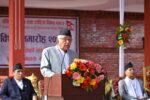
Nepal Rastra Bank (NRB) has introduced its 59th monetary policy for fiscal year 2082/83. The policy was announced by Governor Dr. Biswo Nath Poudel during a public event on Friday. While the central bank was founded in 2013 B.S., the practice of issuing monetary policies began in 2023 B.S., with formal announcements by governors starting in fiscal year 2059/60. The proposed policy had been presented to the NRB Board of Directors on Thursday evening, ahead of its public release.
Gold price setting resumes after week-long pause, drops by Rs 300 per tola
After halting operations for a week, the Federation of Nepal Gold and Silver Dealers’ Association resumed daily gold and silver price setting. Following an agreement with the government, the federation ended its protests and restarted pricing as of Friday. Gold is now priced at NPR 191,800 per tola, down by NPR 300 compared to July 3.
NRB raises share-collateral loan ceiling to Rs 250 million
As per the new monetary policy, the central bank has increased the single borrower limit for loans backed by shares. The cap has been raised from Rs 150 million to Rs 250 million per person. This change allows individuals to access larger credit amounts against share collateral.
NEPSE index climbs 27.84 points this week, turnover hits Rs 40.29 billion
The Nepal Stock Exchange (NEPSE) index rose by 27.84 points over the past week, closing at 2,731.80. The index registered gains on three out of five trading days. It had closed at 2,703.96 the previous week. Total market turnover reached Rs 40.29 billion, an increase from Rs 38.80 billion the week before.
Home loan limits and loan-to-value ratio increased
Nepal Rastra Bank has eased home loan policies in the new monetary policy. The maximum amount an individual can borrow to purchase a house has been raised from NPR 20 million to NPR 30 million. The loan-to-value (LTV) ratio for home and land purchases has also been increased from 50 percent to 70 percent, making it easier for individuals to secure financing.
NRB targets removal from FATF grey list through enhanced AML measures
In a bid to get Nepal off the Financial Action Task Force (FATF) grey list, Nepal Rastra Bank has introduced stricter measures for monitoring, investigating, and prosecuting suspicious financial activities. The monetary policy for 2025/26 stresses the urgent implementation of actions outlined in the FATF-mandated plan. It also highlights the importance of strong inter-agency coordination to meet the necessary compliance standards for exiting the grey list.
Finance committee moves to stop new stock exchange license, seeks NEPSE reform
The Parliamentary Finance Committee is set to instruct the Securities Board of Nepal to halt the process of licensing a new stock exchange. It is also pushing for restructuring the existing NEPSE. This follows recent discussions between the committee, NEPSE, and the Securities Board. Although the committee had previously revoked a ban on new stock exchange licenses, it is now reconsidering that stance.
NRB adopts flexible monetary policy with lower interest rates to revive economy
Nepal Rastra Bank has implemented a more flexible monetary policy aimed at boosting the sluggish economy. The central bank has lowered several key rates: the standing liquidity facility (bank rate) has been reduced to 6 percent (down by 0.5 percentage points), the policy rate is now 4.5 percent (down from 5 percent), and the standing deposit collection rate has been cut to 2.75 percent (from 3 percent).
NRB to revise working capital loan guidelines
In the new monetary policy, NRB announced plans to further review the working capital loan framework. Governor Dr. Biswo Nath Poudel stated that the revised guidelines will consider the business type and repayment cycles of sectors such as agriculture, small and cottage industries, education, health, media, and communications.
NRB to support loans for NARC-endorsed agricultural crops
The monetary policy includes a new initiative to boost agricultural productivity by easing loan access for crops recommended by the Nepal Agricultural Research Council (NARC). Banks and financial institutions will be encouraged to provide financing for these priority crops as part of the government’s agricultural promotion strategy.
Despite capital flight concerns, NRB signals more interest rate cuts
Even amid concerns that further interest rate reductions could trigger capital flight, Governor Dr. Biswo Nath Poudel has moved ahead with policies indicating continued cuts. The monetary targets have been designed so that the weighted average interbank rate may remain lower than the policy rate—similar to the current fiscal year. To reinforce this direction, the central bank has also reduced all interest rates within the corridor.
Banks allowed to count non-banking regulatory reserve as supplementary capital for two years
Nepal Rastra Bank will now allow banks to use regulatory reserves derived from non-banking assets as part of their supplementary capital for up to two years. This move, introduced in the new monetary policy by Governor Dr. Poudel, aims to strengthen banks’ capital structures.
NRB to review CD ratio and implement global liquidity standards
Nepal Rastra Bank plans to revisit the current Credit-to-Deposit (CD) ratio framework. Additionally, it will introduce international liquidity risk management standards, including the Liquidity Coverage Ratio (LCR) and Net Stable Funding Ratio (NSFR), to align with global practices and strengthen financial stability.
Budget and monetary policy set differing inflation targets for next fiscal year
For the upcoming fiscal year, the government’s budget and the central bank’s monetary policy have set slightly different inflation targets. Finance Minister Bishnu Prasad Paudel, in the budget speech, aimed for 5.5 percent inflation. In contrast, NRB Governor Dr. Biswo Nath Poudel set a more conservative target of 5.0 percent in the monetary policy, highlighting a divergence between fiscal and monetary priorities.
NRB to launch ‘Rinisanga Nepal Rastra Bank’ for borrower complaints
To enhance communication with borrowers—especially in rural areas—NRB will introduce a program called ‘Rinisanga Nepal Rastra Bank.’ Announced by Governor Poudel in the latest monetary policy, the initiative will provide a platform to listen to and address grievances from loan recipients.
NRB shifts policy stance within two months, adopts flexible approach
Just two months after its previous review, Nepal Rastra Bank has pivoted from a balanced to a more flexible monetary policy. The newly introduced fiscal year 2082/83 (2025/26) policy indicates a change in tone, favoring looser financial conditions to support economic recovery.
Banks must report bounced checks to Credit Information Center within 5 days
A new directive mandates banks to report dishonored checks to the Credit Information Center within five working days of receiving a formal complaint. This update to the unified banking directive allows for blacklisting individuals or entities responsible for issuing such checks.
NRB to issue bonds for better liquidity management
Nepal Rastra Bank plans to issue bonds as a new liquidity management tool. While it currently uses instruments like deposit collection and standing deposit facilities, the issuance of bonds will help address structural liquidity challenges more effectively.
NRB to link national ID system with banking sector
The latest monetary policy outlines NRB’s plan to integrate the National Identification Card system with the banking sector. Once implemented, banks and financial institutions will be able to share Know Your Customer (KYC) information digitally, improving efficiency and reducing redundancy.
NRB relaxes working capital loan norms for agriculture and communication
To promote productive sectors, NRB has relaxed working capital loan requirements for agriculture and communication industries. This is part of the broader strategy unveiled in the new monetary policy.
NRB keeps cash reserve ratio unchanged at 4 percent
Governor Dr. Biswo Nath Poudel has confirmed that the Cash Reserve Ratio (CRR) for banks and financial institutions will remain at 4 percent in the coming fiscal year, maintaining the current requirement.
Kathmandu metropolitan sets next year’s budget at NPR 2.511 billion
Kathmandu Metropolitan City has approved a budget of NPR 2.51134 billion for the upcoming fiscal year. The decision came from a meeting led by Mayor Balendra Shah, with key officials and ward representatives in attendance.
NRB introduces blacklisting system for bounced check issuers
Nepal Rastra Bank has formalized a new regulation allowing banks to blacklist individuals or entities responsible for issuing dishonored checks. Under the new procedure, banks must act on complaints and notify the Credit Information Center to enforce blacklisting.
Sudurpashchim province ramps up spending in final month of fiscal year
Following a sluggish performance throughout the year, the Sudurpashchim provincial government significantly accelerated budget spending in Asar. By July 9, the province had spent 70.65 percent of its annual budget, including a large portion on a single day.
Bagmati Province improves budget spending over last three years
Bagmati Province has shown consistent improvement in its budget utilization over the past three fiscal years. In the current year, the province spent 74 percent of its allocated budget—marking the highest expenditure rate so far, according to the Provincial Controller’s Office in Hetauda.
Swastik Microfinance opens IPO for Nepalis working abroad
Swastik Microfinance has opened its initial public offering (IPO) to Nepalis living overseas. In the first phase, 23,100 shares are reserved for migrant workers. The next phase will include 195,195 ordinary shares for the general public, with migrant applicants allowed to request between 10 and 5,000 shares.



Comment