




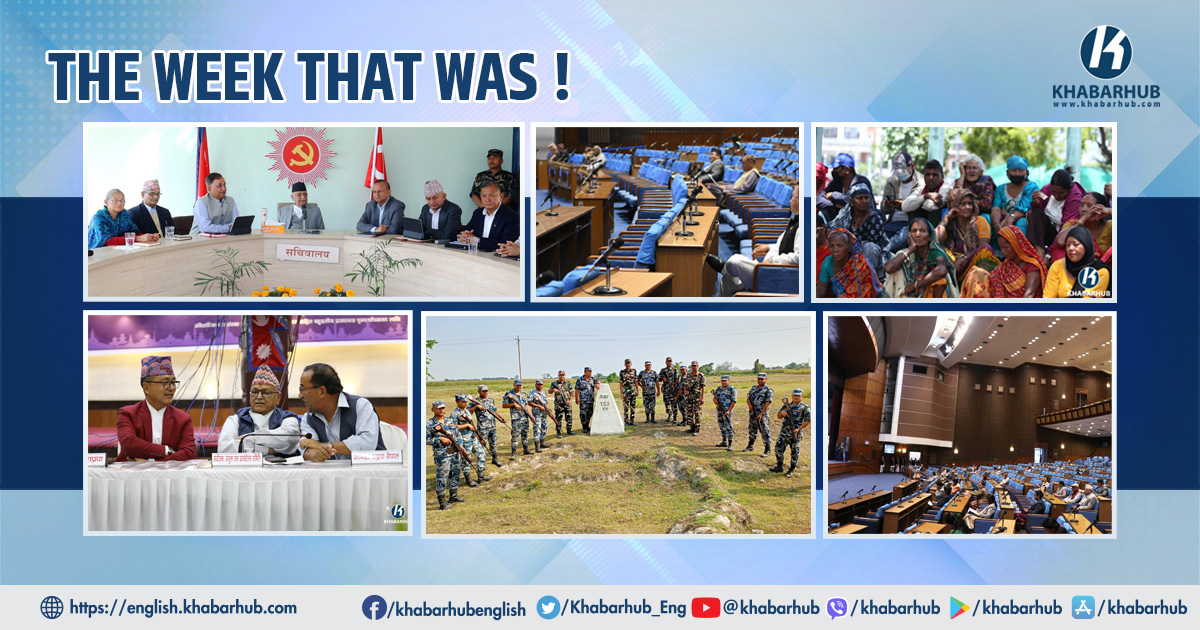
KATHMANDU: The week under review was marked by heightened political tensions, strategic maneuvering by key actors, and intensified regional anxieties that bled into Nepal’s internal discourse. This multifaceted political and policy turbulence unfolded across a backdrop of fluctuating economic signals and civil unrest that reflect both deep-rooted structural frictions and emerging realignments.
Nepal’s political landscape saw a turbulent week shaped by calculated royalist movement, deepening ideological rifts, and regional security spillovers, all set against a backdrop of economic volatility, civil discontent, and institutional fatigue.
Amid faltering public trust and geopolitical unease, the country grappled with the weight of transitional justice, corruption scandals, and uncertain economic signals—underscoring a fragile status quo straining under pressure from both within and beyond its borders.
Pro-monarchy campaign: Political nostalgia or national crisis?
The announcement by pro-monarchy forces to begin an “indefinite mass movement” from May 29 symbolizes a calculated escalation rather than spontaneous discontent.
Coordinated by Nawaraj Subedi and endorsed by prominent monarchists like Rajendra Lingden and Kamal Thapa, the movement aims to reintroduce both monarchy and Hindu nationhood—effectively challenging Nepal’s republican and secular identity established post-2006.
While Subedi framed the agitation as nonpartisan and anchored in civil disobedience, the timing and symbolism (May 29 marks Republic Day) point toward a narrative war for ideological legitimacy.
This movement seeks to exploit public disillusionment with the political class and economic stagnation, but it faces considerable hurdles, not least the fractured conservative bloc and declining mass appeal outside core royalist circles.
Notably, the UML’s internal assessment downplayed monarchist momentum, signaling confidence in the durability of the current system.
India-Pakistan tensions spill into Nepali Poolitics and security calculations
The escalation of conflict between India and Pakistan following airstrikes in Pakistan drew starkly divergent responses from Nepali Maoist leaders. Dev Prasad Gurung’s condemnation contrasted sharply with Janardhan Sharma’s defense of India’s counter-terrorism rationale, exposing internal ideological rifts within the Maoist Centre.
These fissures are symptomatic of a party grappling with both its legacy of anti-imperialism and its current role in parliamentary realpolitik.
Simultaneously, Nepal’s security establishment sprang into action. Emergency meetings led by the Central Security Committee and heightened border patrols by the Armed Police Force in coordination with India’s SSB reflect a growing awareness of Nepal’s geopolitical vulnerability.
The government’s diplomatic positioning—condemning terrorism while reaffirming neutrality—was exemplified by Prime Minister Oli’s meeting with the Indian Ambassador, where he tactfully reiterated Nepal’s non-alignment doctrine.
Transitional Justice: Momentum amid political gridlock
Transitional Justice (TJ) returned to the political foreground with renewed urgency. Home Minister Ramesh Lekhak’s assertive rhetoric emphasized centering victims and completing the legal framework, a shift from years of delay and ambiguity.
However, this policy ambition is complicated by elite-level bargaining, as evidenced by meetings between PM Oli, Prachanda, and Deuba to resolve deadlocks in commission appointments.
Although the rhetoric is promising, past inertia and opaque political horse-trading cast doubt on swift resolution. Prachanda’s critique of government policies as uninspiring—even to its own MPs—indicates that TJ could become another site of symbolic compliance rather than substantive justice.
NEPSE’s volatility and investment pledges
The NEPSE index’s erratic pattern last week—initial decline followed by a midweek recovery—exemplifies a ‘dead cat bounce,’ driven more by speculative cycles than structural confidence.
Despite the slight weekly gain, the underlying volatility points to persistent investor anxiety amid policy uncertainty and geopolitical tension.
Conversely, the Rs 152 billion in MoUs signed at the Koshi Province Investment Summit was a rare bright spot, signaling subnational efforts to drive growth through targeted partnerships.
However, the real challenge remains implementation, especially in light of Chief Whip Shyam Ghimire’s candid admission of financial constraints hampering federal policy delivery.
Corruption, scandals, and accountability gaps
The filing of a case against 17 individuals, including Rita Singh in the Bal Mandir land scam, marks a rare move toward accountability involving politically connected elites.
However, CIAA Chief Prem Kumar Rai’s criticism of the government’s reluctance to repatriate assets stashed abroad paints a bleaker institutional picture. His frustration underscores the systemic unwillingness to confront high-level corruption despite international cooperation.
Tourism: Divergent trends in Mustang and Chitwan
Tourism data revealed contrasting regional trajectories. Mustang experienced a remarkable 36.6% increase in foreign visitors in early 2025, highlighting its growing appeal as a high-value destination.
In contrast, Chitwan National Park saw a significant drop in both domestic and international footfall, raising concerns over regional imbalances in tourism strategy and environmental sustainability.
Power transitions and losses in the political class
The death of Pradeep Nepal, a seasoned leftist and former minister, signaled the fading of a political generation that once embodied revolutionary zeal and ideological clarity. His passing, coupled with new appointments like Kham Bahadur Garbuja as Minister of State for Energy, reflect both institutional continuity and generational turnover in governance.
Conclusion
Last week’s developments showcased a nation balancing precariously between institutional reform and political regression. The monarchy restoration movement, though limited in practical momentum, seeks to exploit a gap left by disillusionment with the republic’s inefficiencies.
Meanwhile, the government juggles transitional justice pressures, corruption scandals, economic ambiguity, and regional instability—all under the scrutiny of an increasingly skeptical public and international community. Nepal’s political stability remains intact for now, but its long-term resilience will depend on how it navigates systemic reform, geopolitical neutrality, and public trust.




Comment