




Recently, Nepali politics has become a cutthroat arena where survival relies more on outsmarting and betraying rivals than on visionary leadership or public service. This atmosphere is marked by frequent party splits and shifting alliances, as politicians focus more on personal ambition than on serving the public.
The relentless pursuit of personal gain, combined with a focus on power, highlights a troubling trend that ultimately hinders constructive political discussion and analysis. Such dynamics not only cloud the political landscape but also create significant challenges in encouraging informed and positive contributions to Nepali politics.
I acknowledge that my quick comments might lack depth. Still, those in power have a duty to focus on Nepal’s main issues. They need to carefully consider their roles and the authority they hold because, ultimately, they are expected to exercise the kind of principled, strategic decisiveness that has been crucial in past societies—taking actions firmly aligned with Nepal’s national interests.
I view cynicism as a logical response to a political culture that wrongly attributes problems to individuals rather than recognizing structural issues. We repeatedly rely on a small group of powerful politicians, whose influence leads to a chaotic mix of harmful consequences. This approach damages public discourse and pushes aside the essential, independent role of the state in creating real, meaningful change.
The future requires leaders who prioritize the nation’s well-being, and we must learn from past mistakes to create better governance going forward.
Political scientists have long noted that political movements driven by zero-sum thinking, denial of recognition, and extended economic stagnation often result in larger societal issues. The idealized notion of democracy—where an informed and rational populace debates the common good and collectively expresses its preferences—rarely occurs in practice. This prompts us to reevaluate what truly defines “democracy.”
The term itself has gained a reputation for inherent goodness, as if simply voting ensures progress, justice, and responsible governance. However, history shows that electoral democracy can have the opposite effect: instead of strengthening institutions and freedoms, it can lead to systems that gradually undermine themselves from within.
Karl Popper (2013) famously argued that the main question of democracy should not be “Who should rule?” but rather “How can we remove bad leaders without bloodshed?” Nepal’s political history highlights the urgency of this question.
Despite multiple leadership changes and waves of hope, we still see a troubling sense of helplessness: the political class often demonstrates shallow, incoherent, and unproductive beliefs, and those in power often lack the ability or willingness to contribute to the nation’s collective progress.
Many political scientists have concluded that elections—despite their widespread presence worldwide and their symbolic connection to democracy—do not always lead to democratic outcomes. In many countries, electoral victories have empowered populist leaders who gradually become authoritarian, demonstrating how elections can be almost meaningless without a true democratic culture and accountability.
Numerous studies have documented ongoing democratic setbacks, reversals, and outright failures. In Nepal’s case, although many political commentators note that democracy is often idealized in civics textbooks, the core issue lies in electoral behavior itself.
Voters are not choosing leaders committed to upholding democratic norms. The expectation that an informed electorate will deliberate on the common good and elect representatives who serve in the public interest has not materialized. Instead, leaders regularly disregard democratic principles—and voters continue to legitimize them.
While Harvard Professor Steven Pinker (2018) argues that political upheaval is not a temporary aberration but a recurring source of public suffering, the broader patterns of populist uprisings and the historical paths of inequality are fundamentally political and chaotic—shaped by far more than just the economic cycle.
Nepal clearly illustrates this paradox. Since 1990—especially after the political shift in 2006—the country has held multiple elections with promises of development, prosperity, and stability. However, these leadership cycles often lead to disillusionment rather than progress. Populist rhetoric has dominated public debate, while elected leaders have frequently become repressive, unaccountable, or self-centered.
Instead of fulfilling expectations, governments become weighed down by unkept promises, fueling public frustration and resentment. The result is a democracy caught in its own contradictions: elections happen, political leaders claim democratic legitimacy, but the system gradually loses trust and credibility. Without structural reforms that go beyond simply voting—toward greater transparency, accountability, and institutional checks—Nepal’s democracy risks causing more harm than good to collective progress.
The rise of Nepal’s Generation Z challenges a political system long marked by avoidance and self-interest, where both right-wing illusions and left-wing failures are fueled by greedy leaders. Despite regular elections, the system often leans toward authoritarianism as populist leaders ignore democratic principles. This reveals a harsh truth: elections are meaningless without support from democratic norms, institutional accountability, and a culture of moderation.
While some see the Generation Z movement as part of an Indo-Western conspiracy, it primarily reflects a local demand for accountability, inclusivity, and genuine democracy. These protests arise from everyday struggles for work, dignity, freedom, and safety.
Nepali democracy, flawed from the start, has rarely been sincere; trapped in cycles of short-term thinking, it has caused disillusionment and slowed progress. Yet this moment offers a rare chance to rethink democracy—not through the extremes of right or left, but by focusing on collective security, liberty, and human development.
The reality is clear: many people are losing their sense of meaning, purpose, belonging, and significance. By challenging the entrenched power of Nepal’s five most harmful political leaders mentioned above, the country has endured an autocratic style of governance under their rule. The Gen-Z uprising marks the start of a new chapter.
It’s difficult to categorize Nepal’s politics precisely; however, this moment has the potential to foster new political insight and renew a sense of purpose based on goals and values that may be essential steps toward human progress. This change is necessary simply because it is needed and, more importantly, because it is the right thing to do.
My generation, known as the baby boomers, is now in our sixties and seventies. We were raised on indirect answers, parables, and riddles, which shaped how we communicate and understand the world. This way of learning and sharing knowledge can offer valuable insights to Generation Z, who may find strength in collaboration and unity.
By connecting these different viewpoints, we can foster a deeper bond and create a supportive environment that benefits everyone. Genuine insights often come only after years of grappling with ambiguity. For decades, Nepali politics has been driven by self-interest and shortsightedness. However, we now see a new political landscape emerging. This shift gives Nepal a real chance to build communities that are open-minded and inclusive enough to pursue collective safety, freedom, and human flourishing.
Nepal has experienced major political upheavals: the late-1980s movement that restored the monarchy in 1990 and the even larger wave of 2008 that fully abolished it. However, the political system established in 2015 now seems increasingly disconnected from the country’s future.
It can be uplifting to believe that the current political system cannot last in its present form. However, this doesn’t mean we should fall into harmful escapism, such as adding alcohol and T-bones to our morning health drinks. Instead, we should focus on building trust, optimism, and happiness, as these qualities expand our sense of compassion. This, in turn, not only improves our health but also creates a foundation for a more inclusive and meaningful vision for society.
Indeed, Sushila Karki’s government was formed outside the constitutional framework, unlike previous governments. However, the idea of restoring the dissolved parliament raises serious concerns. It seems to be an attempt to reinstate individuals with questionable backgrounds—criminals, murderers, and opportunists—who have consistently put their interests above those of the public.
The previous parliament was not only flawed but also ineffective in addressing our society’s key issues. Instead of returning to the same corrupt and inept legislature, we should advocate for a new body built on accountability, transparency, and authentic representation. The future requires leaders who prioritize the nation’s well-being, and we must learn from past mistakes to create better governance going forward.
A major mistake Sushila Karki made was allowing Oli and Ramesh Lekhak, both involved in the Gen-Z massacre, to go free instead of detaining them and taking necessary steps to hold them accountable. This failure also extended to other corrupt figures like Sher Bahadur Deuba, Arzu Deuba, Madhav Nepal, and Pushpa Kamal Dahal, who played significant roles in the situation.
Moreover, she should have recommended a public referendum on key contentious issues, including the future of the monarchy, the current federal structure, and adopting a directly elected executive system. These critical questions should be presented to the public alongside the upcoming elections, with the results being legally binding.
Such accountability could have been achieved earlier if the Sushila Karki government—implicitly supported by the Nepal Army at that crucial moment—had taken decisive actions like revoking the passports of all members of parliament, senior bureaucrats, and security personnel. Politics requires unwavering decisiveness; however, her choices seemed more driven by personal agendas than by the nation’s greater good.
In this context, Sushila’s actions appear cowardly and self-centered. Yet, like characters in an American political drama, we must confront these challenges assertively, as the situation has reached a critical point that demands urgent action and accountability.
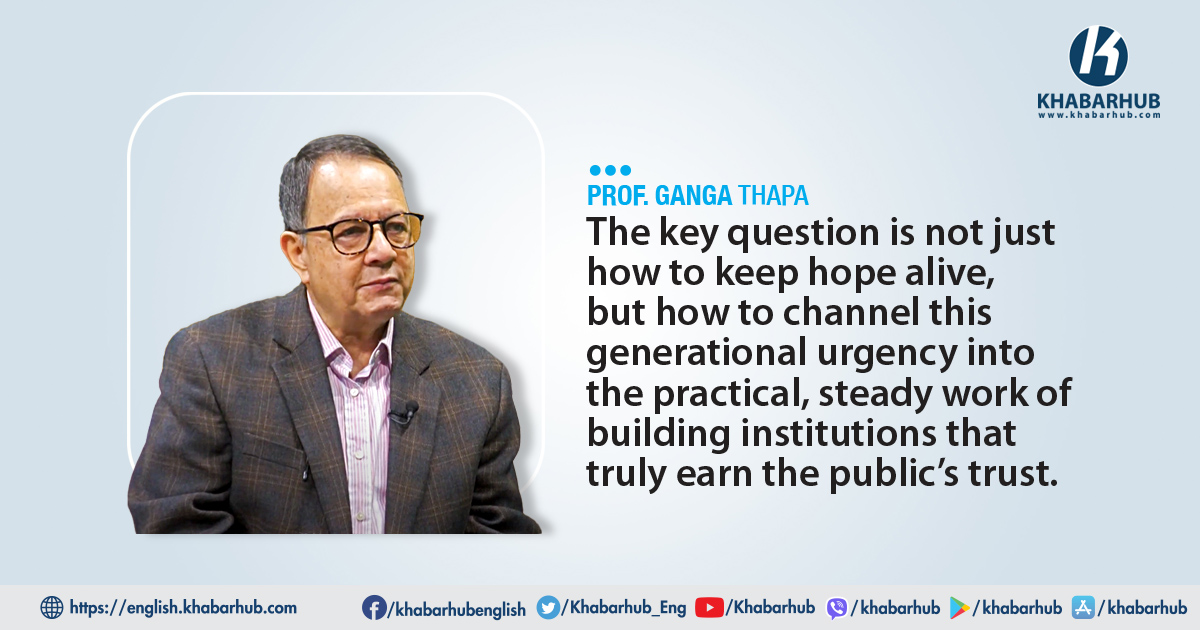
The key question is not just how to keep hope alive, but how to channel this generational urgency into the practical, steady work of building institutions that truly earn the public’s trust.
While serious risks come with concentrated power, a functioning government must still shield citizens from chaos and anarchy. Without this protection, desperation might lead people to support authoritarian solutions. For democracy to thrive, I oppose all systems that rely entirely on a single, idealized authority—whether charismatic leaders, theocracy, divine right of kings, colonial paternalism, revolutionary vanguards, or so-called “benevolent autocracies” like Lee Kuan Yew’s Singapore, Mahathir’s repressive Malaysia, or South Korea’s developmental state under Park Chung-hee.
Although these leaders may have achieved economic growth, they often masked their abuses with elections and democratic symbols. I do not want Nepal to follow such a political route. Instead, we must create a genuinely democratic system that gives everyone a voice and encourages meaningful participation.
Nepal has experienced major political upheavals: the late-1980s movement that restored the monarchy in 1990 and the even larger wave of 2008 that fully abolished it. However, the political system established in 2015 now seems increasingly disconnected from the country’s future.
The message is clear: to sustain and strengthen democracy, it is crucial to promote and support young people’s civic involvement. Such participation helps cultivate a generation of responsible citizens who understand common challenges and work together to address them. For Nepal, this means moving beyond the cycle of disillusionment with elections. It requires structural reforms that create transparent institutions, enforce real accountability, and protect civic space.
The Gen-Z defiance is not a conspiracy but a genuine call for a deeper, functional democracy. Their energy challenges the cynicism and short-term thinking that have long dominated Singha Durbar. Although the path is difficult, this moment offers a rare chance to develop a new political wisdom—one rooted not in past extremes, but in the collective pursuit of security, liberty, and human well-being. The key question is not just how to keep hope alive, but how to channel this generational urgency into the practical, steady work of building institutions that truly earn the public’s trust.





Comment