




Despite a seismic shift in political thinking across the globe—most notably, the collapse of oligarchs and plutocrats who monopolized power for decades, even centuries—Nepal remains shackled by blatherskite politicians like Khadga Prasad Oli, Pushpa Kamal Dahal, and Sher Bahadur Deuba.
These figures lack trustworthiness, honesty, decency, self-discipline, thrift, and patience—qualities once referred to in the nineteenth century as “character.” Today, they are better described as cold, heartless, soulless, unethical, greedy, exploitative, power-hungry criminals—mean-spirited and thoroughly materialistic.
No matter how brightly they are cloaked in hope, adorned with flattery, or entrusted by the nation, their nature remains unchanged. They will desecrate that trust, betray that hope, and leave behind the stench of squandered loyalty. Their legacy is not transformation—it is decay. And decay, unlike dreams, cannot be dressed.
A key point to understand is that Nepal’s ruling elites—whether led by the psychopathic Khadga Prasad, the terrorist Pushpa Kamal, or the decrepit Sher Bahadur—rely on mental shortcuts that distort reality and degrade national progress.
These individuals, often viewed as traitors to democratic ideals, fall prey to cognitive heuristics like stereotypes and implicit biases. Such “quick and dirty” thinking leads to serious misjudgments about people and situations.
Much of this dysfunction stems from the rapid pace at which their vulgar, subconscious instincts override any deliberate reflection on the nation and its people. Not everyone may be convinced, but the political figures mentioned above are widely regarded as emblematic of broader systemic issues—and, more specifically, as central to the major political crisis unfolding in the present moment.
Yet, ironically, this collision of egos and entrenched interests might offer space for a kind of ‘creative destruction’—the painful unmaking of hypocrisy and the abuse of authority among long-standing political figures notorious for their excesses.
The problem isn’t just that some politicians become corrupt when given the chance, or that they tolerate brazen greed and exploitation—the deeper rot lies in governance itself. Nepal continues to stagnate; misery still flows, and there’s no way to glorify the current political system.
In many ways, the ruling elite—whether left or right—have become increasingly wasteful and deceptive. The current government, jointly led by the cunning-faced Khadga Prasad—widely regarded as a mastermind of corruption—and the stone-cold Arzoo Deuba, whose name has been linked to human trafficking, embodies Nepal’s decline more vividly than any before.
Yet despite the decay, some observers still cling to cautious optimism, though the basis for such hope remains fragile at best.
It would be misguided not to acknowledge the major changes that unfolded between 1990 and 2008, including the dismantling of formal, legal, and state-sponsored authoritarianism. Yet it becomes painfully evident that the tangible benefits of political change have not reached those most in need.
George Orwell, in The Road to Wigan Pier (1937), as cited by J. DeLong (2022), argued that honesty, decency, prosperity, and liberty—with particular emphasis on decency—are essential foundations for building a liberal political order.
This mirrors the political theory of elite competition, where democracy functions less as a forum for public service and more as a stage for extracting benefits. Their shameless conduct reflects a Machiavellian style of politics—where survival and dominance override ethics and accountability. Such behavior erodes democratic legitimacy and breeds public cynicism, leaving citizens disillusioned with a system that promises representation but delivers personal gain.
Their governance not only destabilizes the present but sabotages the future by discrediting the very mechanisms needed for a functional federal democratic republic.
The institutions designed to uphold stability and legitimacy are increasingly hollowed out, leaving behind shells of formality with little substance. Brad DeLong, in his gripping 2022 work Slouching Towards Utopia, insightfully warns that as democratic norms erode, the ideal of a republic governed from the “commanding heights” of moral and civic leadership drifts ever further out of reach.
No one should be under the illusion that Nepal remains deeply entrenched in inequality, and widespread disillusionment grips much of the population. Successive governments have failed to provide citizens with a secure place in a stable and inclusive society, and the promise of truly participatory mass politics remains unfulfilled.
In fact, the opposite often appears to be true: both political and economic systems have become increasingly dysfunctional. The problem is not merely that political corruption has become intolerable or that it breeds uncertainty; it is that the bourgeois class—the very representatives entrusted with democratic governance—has systematically eroded the integrity and capacity of the political system itself.
In response, people and communities assert their right to basic entitlements—including the creation of a functional market economy that fosters growth and prosperity. Alongside this, they demand fairness and social justice, even as they confront overwhelming odds. The prevailing hope is that a more equitable economy, once realized, distributes the benefits of development in ways that reflect what people genuinely deserve.
Though perhaps belated, a moment like the upcoming November mayoral election in New York—where a young man named Mamdani has stunned both the Democratic and Republican establishments—must arrive for Nepal as well.
Somewhere, somehow, the nation must give rise to a bold and thoughtful individual—someone capable of humbling the wicked and dismantling the rot they’ve nurtured.
Human sensibilities have evolved continuously throughout history, revealing a profound relativity in concepts of good and evil, right and wrong, war and peace, and the interplay between power and powerlessness.
Across civilizations and eras, philosophical and religious traditions—from Plato to Hobbes to Kant—have consistently returned to the principle of the golden rule.
What is remarkable, however, is that despite political polarization and deep-seated intolerance, humanity retains a surprising degree of shared moral intuition about what is “right.” This common ground manifests in diverse and often unexpected forms of mutual understanding, transcending cultural and temporal divides.
Understanding how systemic power functions is crucial, particularly now. Nepal finds itself at perhaps its most precarious moment in history, where the fate of millions hangs in an ambiguous, shifting dilemma—an uncertainty we failed to notice until pessimism and resentment became constant companions.
The issue extends beyond institutional limitations; it’s embedded in the political culture itself. Ordinary citizens struggle to find voice, validation, and a sense of belonging, wary of saying the wrong thing or being excluded altogether.
They remain outside the established frameworks, unable to progress within a system that often fails to welcome them.
There remains a pressing question: do winner-take-all political elections genuinely reflect the will of the people? This is far from a hypothetical concern—if they don’t, it exposes a deep and troubling paradox.
In winner-take-all electoral systems, some argue that minority voices risk being overshadowed, raising serious concerns about the integrity of representation and the inclusiveness of democratic processes.
The paradox lies in the fact that a democracy based on the principle of the common good may be inherently undermined by a system where majority rule can silence minority voices. In essence, it’s difficult—if not impossible—to reconcile winner-take-all elections with a truly democratic society centered on equity and collective wellbeing.
This is a universal affliction—this yearning to be seen and heard. What must be acknowledged is that although Nepal has been historically distanced from consolidated democratic norms, its governance ostensibly upholds popular will.
Yet this very promise suffers under the weight of deteriorating institutions, enduring economic instability, and an ever-deepening public disillusionment.
Nepali democracy, in my view, grapples with a haunting paradox: it stands precariously at the edge, seized by forces that erode its very foundations and challenge the ideals it was built upon.
A particularly sharp dilemma arises from the wealthy leveraging their financial power to buy political influence, distorting democratic representation. Democracy and economic equity must advance hand in hand; fractured economies cannot sustain genuine democratic systems.
Political commentator George Will once argued that without rich people, there would be no poor people—a claim both illogical and dismissive. Hunger in Nepal is not alleviated by affluence in Luxembourg.
The antidote isn’t passive hope—it’s active confrontation. Reviving democracy demands more than ballots. It demands a cultural uprising against apathy, leadership with vision beyond self-preservation, and a people willing to reclaim ownership of the republic before it’s too far gone.
Moreover, the demise of democracy in Nepal signals more than a political crisis—it marks the unsettling beginning of a stranger, more opaque endeavor.
This shift feels less like a transition and more like an unraveling. In retrospect, one cannot help but wonder: is there any path left to resist the misrule that continues to erode the foundations of long-term political support?
As mentioned earlier, when Nepal is viewed solely through the lens of power, it becomes evident that entrenched injustices sustain themselves through cycles of neglect and exclusion.
To effect meaningful change at a systemic level, what’s needed is a transformation in political consciousness—one that enables leaders and citizens alike to respond with wisdom rather than mere emotional reflex.
Empowerment emerges when people are seen, heard, and engaged intentionally. And this principle applies across contexts: whether in policymaking, local governance, or community building.
Sadly, Nepal’s political landscape remains poisoned by too many leaders who broadly misuse their authority. Their actions erode the spirit of justice and virtue, leaving little space to explore these ideals meaningfully.
This is not just a failure of governance; it’s a failure of imagination. Only by confronting these patterns head-on can Nepal begin to rebuild trust and nurture a future rooted in dignity, dialogue, and deliberate action.
Meanwhile, the rise of rabble-rousers—figures who incite rather than uplift—has hardened resistance to meaningful reform. Their dominance reflects and deepens institutional failures, reinforcing the cycle of instability and collective despair.
Though Nepal’s democratic challenges are not unique, its obsessive pursuit of political power has fostered a civic neurosis—one that permeates the national psyche and continues to distort public discourse.
And indeed, Nepali politics mirrors the gridlocked dysfunction seen in many other nations. The relentless infighting within Nepal’s major political parties—between the psychopathic Khadga Prasad and the scheming Bidya Bhandari, the decrepit Sher Bahadur and Shekhar, and the violent extremists Dahal and Janardan—has spiraled into chaos.
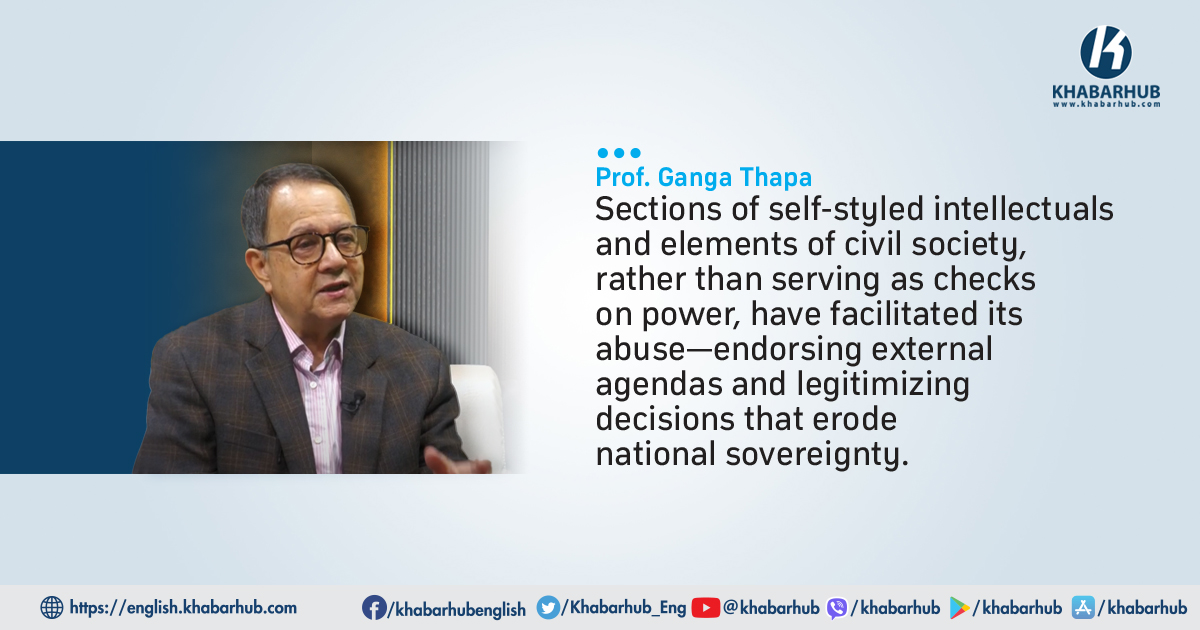
Equally disquieting is the internal complicity. Sections of self-styled intellectuals and elements of civil society, rather than serving as checks on power, have facilitated its abuse—endorsing external agendas and legitimizing decisions that erode national sovereignty.
These confrontations rarely stem from genuine efforts to build a democratic-egalitarian order. Instead, they reflect destructive power plays rooted in personal ambition and insatiable greed for state resources.
We revere those who honor their promises, while liars and cheaters earn our contempt. Altruists who act for the collective good are celebrated, whereas selfishness—no matter the context—rarely invites admiration.
Yet, ironically, this collision of egos and entrenched interests might offer space for a kind of ‘creative destruction’—the painful unmaking of hypocrisy and the abuse of authority among long-standing political figures notorious for their excesses.
For Nepal’s dominant parties, such confrontation has become inevitable. The hope, however faint, is that this rupture may pave the way for a new moral architecture—one that demands accountability and dares to imagine something better.
From a political science perspective, such a conclusion may seem cynical, yet it reflects an uncomfortable truth: Nepal’s major political parties and their leadership have consistently failed to act in the genuine interest of the nation.
Rhetoric surrounding nationalism, poverty alleviation, and good governance often masks complicity in the corrupt structures that have politically, ethically, and economically hollowed the state.
Equally disquieting is the internal complicity. Sections of self-styled intellectuals and elements of civil society, rather than serving as checks on power, have facilitated its abuse—endorsing external agendas and legitimizing decisions that erode national sovereignty.
In effect, they have contributed to the disorientation of party politics and obstructed the pursuit of authentic public interest.
(Views expressed in this opinion are the writer’s and do not necessarily reflect the editorial stance of Khabarhub — Editor)




Comment