





KATHMANDU: Economic Digest offers a concise yet comprehensive overview of significant business happenings in Nepal, presented in easily digestible summaries.
The recent economic developments in Nepal reveal a complex interplay of challenges and initiatives affecting multiple sectors. The sharp decline in NEPSE by 45 points reflects investor caution amid widespread losses, particularly in finance and hotel sectors, despite increased trading volume.
Concurrently, rising gold prices amid sliding silver indicate shifting market preferences, while floods and protests have inflicted substantial industrial damages and surged insurance claims, highlighting vulnerabilities in infrastructure and social stability. Government efforts, including concessional loans for exporters and women-led firms, flood-damaged road repairs, and power grid stabilization, aim to stimulate recovery, yet systemic issues like stalled hydropower projects, unresolved electricity billing disputes, and capital market reform delays persist, constraining growth.
Meanwhile, positive strides in tourism revival, health insurance coverage expansion, heritage promotion, and resource exploration showcase local resilience and potential, even as small farmers struggle for equitable access to modernization grants. Overall, Nepal’s economic outlook hinges on addressing governance gaps, infrastructure deficits, and social equity to sustain momentum amid external risks and internal pressures.
NEPSE falls 45 points amid mixed trading
The Nepal Stock Exchange (NEPSE) dropped sharply on Wednesday, sliding 45.36 points to 2,559.59. Though the market began with a modest 5 point gain, it lost ground during normal trading hours. Of 251 listed companies, 232 declined, 18 advanced, and one held steady. The finance and hotel sectors led the slide—each down about 3%. Turnover rose to Rs. 576 million, surpassing the previous day. Prabhu Insurance, Manjushree Finance, and First Microfinance endured the steepest losses.
Gold hits Rs 238,000 per tola as silver slides
Gold prices rose to Rs 238,000 per tola on Wednesday, up Rs 2,600 from Tuesday’s Rs 235,400, driven by sustained local demand. Meanwhile, silver prices fell slightly to Rs 2,955 per tola from Rs 2,960, according to the Federation of Nepal Gold and Silver Dealers’ Association. Traders noted steady gold buying amid festive and investment demand.
Floods inflict Rs 500 million damage on Morang Sunsari industries
Persistent rainfall and sudden floods have caused widespread destruction across industries in the Morang–Sunsari corridor, with losses exceeding Rs. 500 million. Arihant Multi-Fibers reported about Rs. 300 million in damages alone, halting production and impacting over 4,200 employees. Several factories—such as Quality Biscuit, Baba Maida Mill, and Hulas Wire—were submerged. Business owners blame inadequate drainage and insufficient flood mitigation infrastructure for the recurring damage.
Insurance claims from Gen Z protests hit Rs 22.25 billion
Insurance claims filed in the wake of the September 8–9 protests have surged to Rs. 22.25 billion. Of this, Rs. 18.61 billion pertains to property damage, Rs. 2.95 billion to motor vehicle losses, and Rs. 670.3 million to other categories. Oriental Insurance reported the highest individual claim total at Rs. 5.22 billion. The majority of claims originate from Bagmati Province. Surveyors are required to submit assessments within 60 days to initiate compensation.
NRB offers concessional loans for exporters and women led firms
Nepal Rastra Bank (NRB) has introduced special low interest loan schemes targeted at export businesses that employ at least 100 women. Companies exporting 25% of their output can borrow at just 1% above the base rate. Firms affected by the Gen Z protests may access salary and replacement loans at only a 0.5% premium, partially subsidized by the government.
Governance and investment gaps curb Nepal’s growth
The World Bank has pointed to systemic weaknesses—rampant corruption, limited opportunities, and a difficult business climate—as key factors stalling Nepal’s economic momentum. It has also cautioned that external threats like global slowdowns, trade volatility, social unrest, and AI driven labor disruption pose significant downside risks across South Asia.
Nepal moves to stabilize power after monsoon floods
In response to storm induced power outages, the government has initiated efforts to restore electricity and shore up the grid. Energy Minister Kulman Ghising prioritized repairs to flood-damaged infrastructure and maintaining steady supply. Key lines—such as the Marsyangdi 220 kV corridor and the Hetauda–Dhalkebar 400 kV link—are being reinforced, and winter readiness measures are also underway.
Over Rs 20 million worth of goats sold from Banke during Dashain
During the Dashain festival, over Rs. 20 million worth of goats were sold from Banke via 14 women led cooperatives. A total of 1,351 goats weighing 43,593 kg were distributed throughout cities nationwide, generating Rs. 23.81 million. Rapti Sonari Rural Municipality–9 led the trade with Rs. 3.18 million in sales. Goat farming, especially in forested areas like Rapti Sonari, is increasingly empowering local women farmers.
Government’s ‘fair price shops’ offer minimal relief in Nepalgunj
Ahead of Dashain, Tihar, and Chhath, the government operated ‘Fair Price Shops’ offering modest discounts on selected rice varieties: Steam Jeera at Rs. 83/kg (down from Rs. 88), Aruwa Medium at Rs. 59/kg (from Rs. 64), and Aruwa Coarse at Rs. 57/kg (from Rs. 62). Despite a target of 200 quintals by October 27, daily sales have remained low at 1–1.5 quintals due to scant stock and competition from cheaper border markets.
Govt plans Rs 12.38 billion for flood-damaged roads
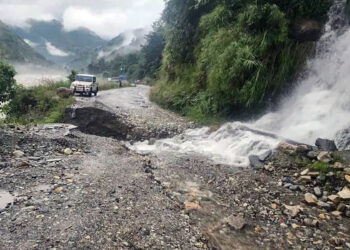
The government is set to allocate Rs 12.38 billion for repairing roads damaged by this year’s monsoon floods. Major highways, alternate routes, Bailey bridges, and 17 concrete/steel bridges will consume most of the funds, with Mechi Highway alone requiring Rs 1.5 billion. Around Rs 1.7 billion remains unspent from last year’s flood repairs. Minister Kulman Ghising said restoring roads is a top priority, with teams already mobilized for clearance and reconstruction.
SBAN urges immediate implementation of capital market reforms
The Stock Broker’s Association of Nepal (SBAN) has welcomed the capital market reform report from the Ministry of Finance’s task force, led by Rupesh KC. The recommendations include removing lending caps, loosening bank regulations, introducing new financial instruments, and restructuring NEPSE. SBAN is calling on regulators to enact the proposals promptly, noting that many previous reforms have stalled. Finance Minister Rameshore Khanal’s proactive stance is viewed as a potential turning point for capital market growth in Nepal.
Telecom operators phase out 3G services
Nepal’s telecom providers are gradually discontinuing 3G services to focus on 4G networks. Only 869,000 users remain on 3G, representing just 2% of broadband subscribers. Ncell plans to end 3G by 2025, while Nepal Telecom continues offering it based on customer demand. Over the past year, 7.3 million users switched from 3G to 4G, supported by widespread availability of 4G devices. Despite 5G’s potential, operators and government show limited investment interest, delaying the rollout of next-generation mobile technology.
Butwal-Bhairahawa industrial corridor industry challenges NEA bills
Industries in the Butwal–Bhairahawa corridor have appealed to Prime Minister Karki regarding disputed “Dedicated” and “Trunk Line” electricity charges. The Siddhartha Chamber of Commerce led the complaint, stating they did not consume the billed electricity and cannot pay inflated amounts. The government’s cancellation of the arrears review committee sparked accusations of unfair treatment, risking factory closures, 20,000–25,000 job losses, and financial sector instability. Industry leaders demand reopening legal processes or immediate resolution to ensure fairness.
Nalagad HP stalled despite DPR completion
Nepal’s pride, the 417 MW Nalagad Hydropower Project in Jajarkot, remains stalled seven years after starting. Although the Detailed Project Report and environmental assessments are done, construction has not progressed. External infrastructure and compensation work have been completed, but disputes over 555 houses have blocked fund release. The project is estimated to cost Rs 123 billion, requiring foreign investment as domestic funds fall short. Locals urge the government to prioritize the project to unlock regional economic and employment benefits.
Rajakot heritage trek campaign to boost economy
Young residents of Dangisharan Rural Municipality–2 are launching a trekking campaign starting November 18 to promote Rajakot, a historic hilltop site. Located 20 km south of Tulsipur at 1,556 meters altitude, Rajakot was once the summer residence of a Tharu king tied to medieval Bhuretakure rulers. It offers panoramic views of the Himalayas, Swargadwari, and Banke plains. Previously a major trade route to Nepalgunj, its usage has declined. The campaign aims to revive Rajakot as a living heritage site, tourist attraction, and economic hub.
Parbat’s iron mine reopening moves ahead with trail construction
A new trail to the Mahashila Iron Mine has been completed, enabling geological surveys and plans for reopening. The mine, inactive since the 1950s, covers about two kilometers and previously supported 400 households. Resistivity studies confirmed rich iron deposits, and the Department of Mines and Geology is preparing exploration under government directives.
Tourism picks up in Sauraha after quiet Dashain
Sauraha’s tourism sector is seeing renewed activity as foreign and domestic visitors return, increasing hotel bookings, restaurant demand, and safari services. Hotel operators report visitor numbers reaching around 30% of pre-pandemic levels, offering relief after a slow Dashain due to political uncertainty and travel disruptions. Improved roads and open jungle safaris are expected to further boost tourism revenue before Tihar.
Tanahun hydropower transmission line construction resumes
Construction of the transmission line for the 140 MW Tanahun Hydropower Project has restarted after earlier delays caused by forest clearance issues. The 36 km line from Damuli to Bharatpur is now 74% complete. Built by India’s KEC International, the project faced setbacks from COVID-19 and approvals but is now progressing toward completion.
67% of Syangja residents covered by health insurance
About 67% of Syangja’s population is enrolled in the government’s national health insurance scheme, with 80% of households covered. Kaligandaki Rural Municipality alone paid Rs 17.2 million to insure all residents. The program offers up to Rs 100,000 per family annually for a Rs 3,500 premium, with higher limits for larger families and free coverage for the poor and elderly.
Jumla small farmers miss out on Rs 16 million grants last fiscal year
Small farmers in Jumla were mostly excluded from last fiscal year’s National Agriculture Modernization Program grants, which cover 50% of costs. Only 119 farmers received Rs 16.06 million across 10 programs, mostly those with political ties or official access. Genuine smallholders, unable to afford the 50% co-investment, missed out on programs for apple and potato expansion, nurseries, and pulse crops. Officials call for policy reforms, better outreach, and inclusion of true small-scale farmers.





Comment