




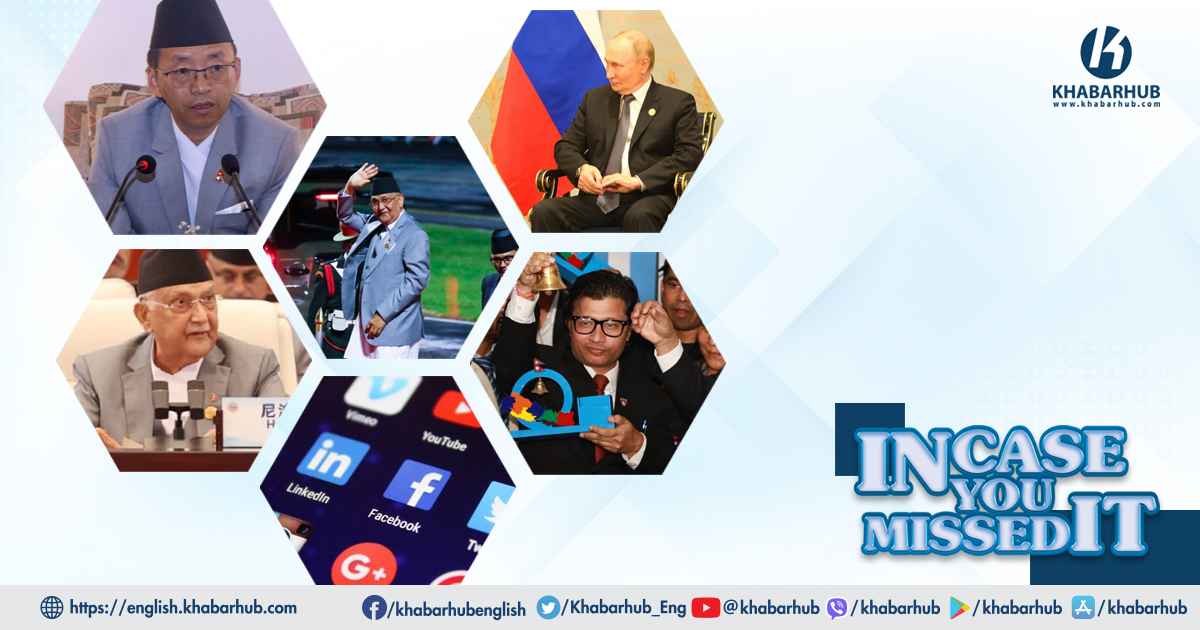
KATHMANDU: Last week was one of those rare yet telling moments in Nepal’s political and social landscape when domestic governance, international diplomacy, institutional reform, electoral politics, and cultural tradition collided within a span of a few days.
The decisions and statements made in Kathmandu and abroad, particularly by Prime Minister KP Sharma Oli during his China visit, as well as by Nepal’s judiciary and government at home, highlight both the fragility and the evolving maturity of the Nepali state.
The series of events—ranging from a sweeping ban on social media platforms to a careful clarification on foreign policy, from long-delayed civil service reforms to the celebration of Indrajatra—capture the country’s ongoing struggle to balance modern statecraft with tradition, sovereignty with diplomacy, and openness with regulation.
Government’s drastic social media ban: a governance experiment or overreach?
The most controversial and attention-grabbing decision of the week was undoubtedly the government’s ban on 26 major social media platforms, including Facebook, Instagram, YouTube, X (formerly Twitter), LinkedIn, and WhatsApp. The decision was formally justified as compliance with a Supreme Court directive in a contempt of court case, mandating that all online platforms, whether domestic or foreign, register with Nepali authorities before operating.
On paper, this move seems rooted in legitimate regulatory concerns. The government has long expressed frustration over its inability to hold large social media corporations accountable for issues like misinformation, hate speech, cybercrime, and non-compliance with local laws. The directive was couched in the language of digital sovereignty: Nepal asserting its right to regulate the online space in the same way it regulates traditional media.
Yet the sweeping ban raises several questions. First, the seven-day deadline for compliance was extraordinarily short, making it nearly impossible for multinational tech giants to restructure their operations to fit Nepal’s requirements.
Second, the blanket suspension of platforms—even those with critical functions in education, commerce, and professional networking—creates a perception of authoritarian overreach. In practice, the ban disrupts communication for millions of Nepalis, undermines businesses that rely on digital platforms, and risks alienating the country’s young, tech-savvy population.
This decision therefore symbolizes a deeper tension in Nepal’s governance: how to balance state control and accountability with democratic freedoms and digital openness. While the government insists the ban is temporary and reversible upon registration, the move may erode public trust and harm Nepal’s image as an open society.
Clarification on China’s Global Security Initiative: Diplomacy under pressure
If domestic politics saw a clampdown on digital freedoms, Nepal’s diplomacy was characterized by a defensive clarification. Following Prime Minister Oli’s meeting with Chinese President Xi Jinping during the Shanghai Cooperation Organization (SCO) summit, a Chinese government statement claimed that Nepal supported Beijing’s Global Security Initiative (GSI). This sparked immediate controversy back home, where many saw such alignment as a breach of Nepal’s non-aligned foreign policy.
Nepal’s Foreign Secretary Amrit Bahadur Rai moved quickly to clarify: Nepal supports China’s Global Development Initiative (GDI), but not the GSI or any other military-security frameworks. This clarification was crucial. The GSI is widely interpreted as China’s counterweight to U.S. and Western security alliances. For Nepal, a small state wedged between India and China, overt support for such a framework would compromise its delicate foreign policy balance.
The episode reveals two insights. First, China’s diplomatic assertiveness increasingly tests Nepal’s non-alignment. Second, Kathmandu is willing to publicly assert its position, even if it means contradicting Beijing’s interpretation. In a region where smaller states often succumb to great power pressures, Nepal’s clarification reflects both vulnerability and agency.
Civil Service Bill: Delayed but necessary institutional reform
While the government was embroiled in digital and diplomatic controversies, the National Assembly passed the long-delayed Federal Civil Service Bill, a cornerstone for implementing federalism. Since the adoption of federalism in 2015, Nepal has struggled with the question of how to restructure and manage civil servants across federal, provincial, and local levels.
The passage of this bill is therefore historic. It seeks to resolve long-standing disputes over employee deployment, chain of command, and accountability. Minister for Federal Affairs Bhagwati Neupane hailed the bill as a breakthrough for making the bureaucracy compatible with federal governance.
Critics argue the bill comes too late and may not fully address entrenched bureaucratic resistance or political interference. Yet its passage marks a symbolic step forward: Nepal’s institutions are gradually adapting to the federal experiment, even if reforms are painfully slow.
Prime Minister Oli at the SCO
Prime Minister KP Sharma Oli’s China visit and participation in the SCO summit dominated Nepal’s foreign policy agenda. In his speech, Oli warned against the weakening of global multilateralism and called for a reinvigorated, inclusive, and result-oriented international order. He highlighted Nepal’s vulnerabilities to climate change, cyber threats, and pandemics, stressing that no country can secure prosperity in isolation.
Oli also reiterated Nepal’s aspiration to upgrade from dialogue partner to full SCO membership. While Nepal’s limited geopolitical weight makes full membership uncertain, the aspiration itself signals a desire to be seen as more than a peripheral state. By raising issues such as the Lipulekh agreement between China and India in his meeting with Xi Jinping, Oli also attempted to subtly assert Nepal’s territorial concerns in front of global powers.
This balancing act—seeking benefits from China, asserting sovereignty, and calling for stronger multilateralism—reflects Nepal’s diplomatic tightrope walk. Whether Oli’s approach enhances Nepal’s global standing or risks entangling it further in great power rivalry remains to be seen.
Electoral and party politics: Manang by-election and RSP’s gamble
On the domestic electoral front, the Election Commission announced a November by-election in Manang following the disqualification of Rajiv Gurung (Deepak Manange). This by-election, though small in scale, carries symbolic significance: it reflects the gradual enforcement of constitutional norms against individuals with questionable legal and political backgrounds.
Meanwhile, the Rastriya Swatantra Party (RSP) confirmed Dr. Lekh Jung Thapa as its candidate for Rupandehi-3 despite controversy over his marital status. The party’s decision to stand by Thapa, armed with proof of his divorce, illustrates the RSP’s strategy of projecting resilience against smear campaigns by larger parties. It also reveals the fragility of Nepali politics, where personal issues often overshadow policy debates.
Culture and tradition: Indrajatra’s enduring vitality
Amid the turbulence of governance and diplomacy, Kathmandu’s streets came alive with the annual Indrajatra festival. The eight-day celebration, marked by the erection of the lingo pole, vibrant dances, and the chariot procession of the Living Goddess Kumari, offered a reminder of Nepal’s rich cultural continuity.
In a week dominated by anxieties about social media bans and global alliances, Indrajatra provided a counterpoint: a collective reaffirmation of identity rooted in tradition. The President’s participation in worship ceremonies further highlighted the festival’s role in linking state authority with cultural legitimacy.
Military diplomacy: Sagarmatha Friendship Exercise
The week closed with the start of a joint military exercise between Nepal and China, focusing on disaster management and humanitarian assistance. Though couched in non-military terms, the exercise inevitably raises questions about Nepal’s growing military engagement with Beijing. Kathmandu frequently conducts joint exercises with India and the U.S. as well, but the China exercise will be closely watched for signs of shifting alignments.
Conclusion
Taken together, last week’s events reveal a country grappling with multiple contradictions. Nepal wants to assert regulatory control over digital platforms, but risks alienating its citizens in the process. It seeks to deepen ties with China while reaffirming its non-alignment. It passes long-delayed institutional reforms, but only after years of delay. It celebrates cultural festivals even as political crises simmer. And it aspires to global influence even while struggling with domestic governance.
These contradictions are not signs of failure, but of transition. Nepal is a young federal republic navigating its path in an era of digital disruption, great power rivalry, and cultural resilience. The test for its leaders will be whether they can turn these moments of tension into opportunities for building a more coherent, sovereign, and democratic state.





Comment