




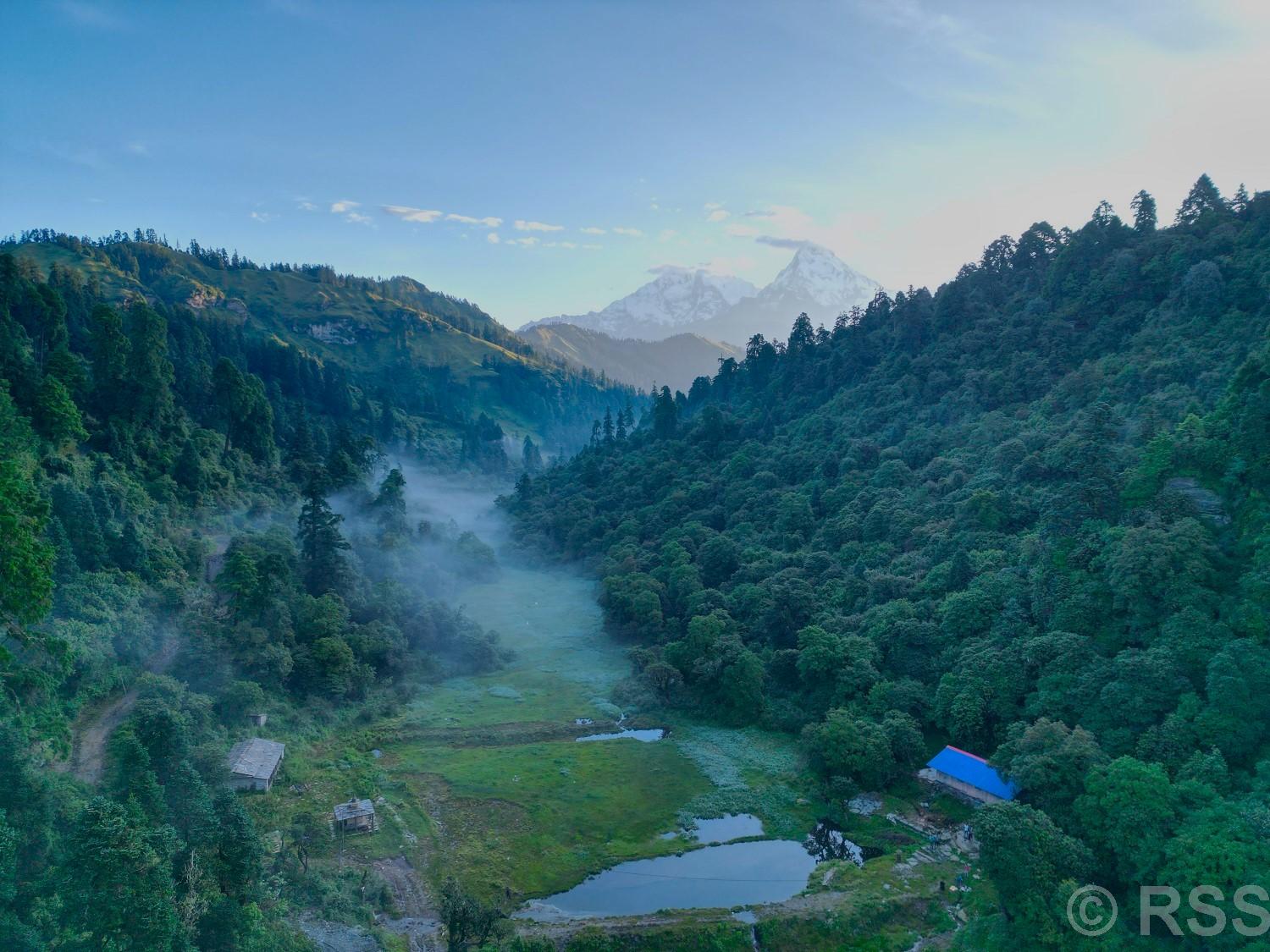
MYAGDI: Jaljala, located at the tri-junction of Myagdi, Parbat, and Kaski districts, holds significant religious and tourism potential but remains largely neglected due to lack of infrastructure and promotion.
The Jaljala area, spanning Modi Rural Municipality in Parbat and Annapurna Rural Municipality in Myagdi, is referred to in Hindu scriptures as Hampal, Kalanjar, and Mrigasthali. Despite its religious importance, the area suffers from underdevelopment and poor accessibility.
According to cultural and heritage expert Prof. Dr. Jagannath Regmi, Hindu scriptures including Agni, Garuda, Kurma, Baraha, Skanda, Shivamaha, Padma, Brihannaradiya, Linga, Matsya Puranas, the Mahabharata, and the Shrimad Bhagavatam mention Hampal and Kalanjar.
“Despite being praised in sacred texts, Kalanjar—highlighted by Muktakantha in mythological literature—remains underdeveloped due to lack of publicity, remoteness, limited road access, and the absence of documented materials beyond oral traditions and natural and cultural sources,” said Regmi.
He noted that some ancient temples, shelters, and caves in the area are now at risk of disappearing due to a lack of protection. Religious texts claim that sages once performed penance in the Jaljala region, using its herbs for medicine, gaining spiritual insights, and offering Pinda (ancestral offerings) to attain salvation.
Tika Pun of Lespar, Modi Rural Municipality-4, who operates a small restaurant in Jaljala, said that due to limited awareness of the site’s religious and scenic value, tourist and pilgrim numbers remain low.
“Visitors mainly arrive during Mahayagyas held in autumn and spring. Otherwise, the place remains deserted,” he added.
Situated at an altitude of 3,300 meters, Jaljala features a gorge surrounded by breathtaking views of the Annapurna range. Just two decades ago, locals from Jaljala and Modi Rural Municipality used to graze cattle here during the monsoon, a practice that has since vanished.
From Jaljala, a 10-minute walk to Wi-Fi Hill offers views of Annapurna, while a 30-minute hike to Mateko Lake reveals panoramic views of Dhaulagiri, Annapurna, and Machhapuchhre.
According to Govinda Sharma, a visitor from Kushma, the scenic beauty of the region and surrounding settlements makes the challenging journey worthwhile.
Jaljala is also rich in biodiversity. Medicinal herbs such as bojo, satuwa, chiraito, amilo, brahmi (bholatapre), pashanbhed, jethimadhu, padamchalnu, niramasi, jatamasi, timmur, and siltimmur are found here. Wildlife sightings include deer along the banks and birds like vultures, cuckoos, and owls.
The region is accessible by trekking routes from Ghodepani, Pun Hill, Mohare Danda, Nagi (in Myagdi), and Modi Rural Municipality in Parbat. A dirt road connects Jaljala to Lekphant and Shalija in Jaljala Rural Municipality, according to Vice-Chairman Deepak Acharya.
“A grand yagya was organized to highlight Jaljala’s religious significance, and electricity has now been extended to the area,” Acharya said. “The federal government has allocated Rs 30 million for tourism infrastructure development here.” The Beni–Lekphant road has also been blacktopped recently, and further road upgrades have been requested.



Comment