




If someone were to ask what Nepal’s primary problem was 15–20 years ago—and still is today—the answer would be clear: governance.
Governance remains Nepal’s foremost and most fundamental development agenda. Yet, it continues to be ignored. The government neither understands governance, nor do we as citizens.
In the 2014 Indian elections, Narendra Modi popularized the slogan: “Less government, more governance.” That slogan resonated with voters, leading to his victory. In Nepal, however, we continue to conflate the two—government and governance. But they are not the same. Governance can function even in the absence of a formal government.
Let me share two examples to illustrate this. During the devastating earthquake of 2015, I traveled to Sindhupalchowk on April 27. In a village called Irkhu, children were playing in the fields. No relief had arrived. Who was responsible for the immediate relief efforts?
It should have been the government. Yet everything was in ruins, and people had no food. Who was looking after them? That, too, should have been the government’s responsibility.
I asked the locals what they were eating. They replied, “Those whose homes weren’t destroyed and who still have food are sharing it with us.”
Just look at that—a situation where the state was absent during a crisis. Governance existed, but without a functioning government. That’s what governance looks like—operating through community and informal systems when the state fails.
Why is investment not increasing? Where is all this money going, if not to productive sectors? Why is consumer demand stagnant? Why is purchasing power still so low? Don’t we have the tools to address this?
Here’s another example. At the peak of the Maoist conflict, I visited Taksera, a remote village in Rukum. The government was nowhere to be found. Secretaries of the Village Development Committees were all stationed in district headquarters.
Agricultural technicians were in district centers. VDC chairpersons were in Kathmandu—or at best, also in district towns. Everyone had retreated. Even the few brave individuals had left the villages.
Who remained? Only small children and the elderly. I asked how they were managing. One of the schoolteachers said he had to go to the district headquarters for any administrative tasks.
“What do you do there?” I asked. Even just reaching the district headquarters required a visa—an entry permit from the Maoists. That teacher had taken such a permit to carry villagers’ requests: money and prescriptions to bring back medicine, or documents for pending court cases.
Governance was still functioning—but in the complete absence of a government. The local police post had been dismantled and relocated to the district.
Yet people found ways to maintain basic systems. This shows that governance mechanisms continue to operate even without formal state presence.
The point is: Governance continues—it must. But that governance must be made effective through proper leadership. That’s what we seek. The government alone cannot solve every problem.
Unfortunately, in Nepal, the government often seems to manufacture the very conflicts it is meant to resolve—through shutdowns, political gridlocks, or negligence—and then watches from the sidelines. It is supposed to earn the public’s trust and resolve conflicts, not create them.
I have observed this governance dynamic firsthand over the course of my life. In 2002, I helped organize the Donor Group Meeting of the Nepal Development Forum in Kathmandu, in the very building where Parliament now sits.
Previously, the World Bank representative chaired such meetings. But that year, for the first time, Nepal’s own Finance Minister took the chair. It was a proud moment—leaders, ministers, ambassadors, everyone was present.
Mieko Nishimizu, the World Bank’s Vice President for the South Asia Region, was also in attendance. In her speech, she remarked, “You have political leaders, but they seem more focused on throwing stones during protests. I visited Humla, and when I asked people whether leaders come here, they said leaders only show up during elections to ask for votes.”
She continued, “Nepal may need roads, schools, hospitals—but its most urgent problem is misgovernance. Only if Nepal prioritizes good governance as its primary development agenda for ten years will it begin to progress.”
Her remarks upset many. People scolded me: “Didn’t you hear her speech? She insulted all of us.” But to me, she simply said what needed to be said. She urged Nepal to embrace good governance for at least a decade.
In 2012, I emailed her: “It has been 10 years since your speech, but good governance in Nepal remains only an agenda item. It will likely remain so for the next 25 years.”
When I was involved in drafting Nepal’s Poverty Alleviation Strategy in 2010—as an ex-officio member of the National Planning Commission—I worked hard to build the plan on four foundational pillars.
One of them was good governance. It was the first time governance had been formally introduced into Nepal’s development framework.
That was during the 10th Five-Year Plan. But by the 11th Plan, that agenda had faded. So what did we gain? The problem still persists.
Paul Collier, in his books War, Guns, and Votes and The Bottom Billion, discusses this issue in depth. After the rise of democracy, 26 out of 40 African countries descended into civil war. Collier, a professor at Oxford, traveled to Africa and asked why democracy had led to such turmoil. The people answered, “Because you cannot eat a ballot paper.”
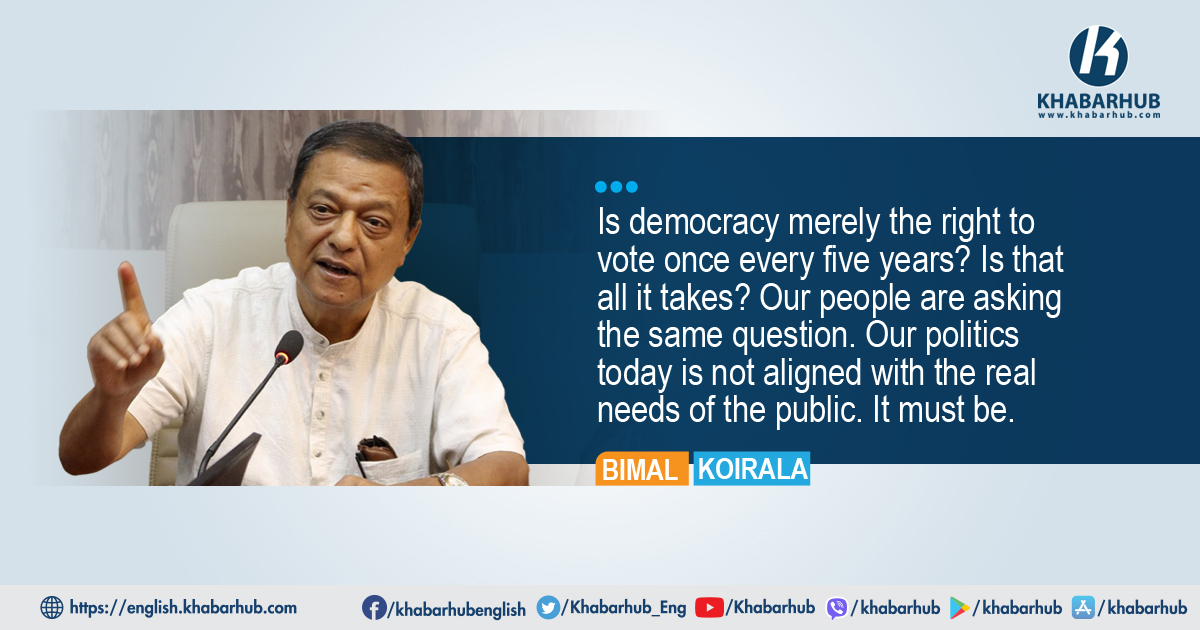
Is democracy merely the right to vote once every five years? Is that all it takes? Our people are asking the same question. Our politics today is not aligned with the real needs of the public. It must be.
Let me offer another example to further clarify the issue. In Why Nations Fail – Power and Progress, authors Daron Acemoglu, Robert Simpson, and James A. Robinson provide a compelling analysis.
They highlight the contrast between Arizona in the United States and Sonora in Mexico—two neighboring regions. Children from Sonora attempt to cross into America, often without proper clothing or access to basic necessities. In contrast, children in Arizona are clothed, educated, and generally supported by functioning institutions.
This raises a vital question: are our own delivery institutions in Nepal strong enough? Are they honest and capable of serving the people? These are the fundamental concerns we must pay attention to.
Unfortunately, we have systematically destroyed our institutions. The first to suffer was the bureaucracy—followed by the civil service, police, judiciary, and even, arguably, the army. I cannot say with certainty that any institution remains untouched.
We are now trapped in a web of mismanagement so deeply rooted that it is increasingly difficult to break free. Public trust in institutions has collapsed.
Take the healthcare system, for example. If a doctor from Bir Hospital opens a private clinic, we flock to the clinic instead of the hospital. Why? Because we don’t trust the hospital to provide quality care—even though the same doctors work there, with access to public resources and infrastructure. This is a trust crisis.
Consider the Office of the Auditor General. No international institution is willing to accept an audit report from there. When I was in government, it took considerable negotiation to get development partners to agree to a joint audit.
Even then, members of parliament were alarmed. “How can this be allowed?” they asked. “Only the Auditor General should conduct audits, not in partnership.” Subash Nembang, who was in the Accounts Committee at the time, asked the MPs to reflect on their own behavior.
“How many of you trust these institutions yourselves?” he said. “How many of you actually use their services?” The room fell silent. The donors added, “If you yourselves don’t trust your institutions, why should we?”
That silence captured the core of the governance crisis. The root of good governance lies in institutional integrity. How do we make our courts, bureaucracy, police, and administrative systems more effective?
Even in the smallest things, the rot is visible. Take pollution inspection stickers for vehicles. They cost only 50 to 55 rupees. But a driver trying to get one often finds the inspection center non-functional—sent today, told to come tomorrow, then told to wait again.
Finally, someone says, “Sir, it doesn’t work like this—just pay 500 rupees.” And from a booth outside, without ever entering the line, a sticker is produced and applied.
This is the state of our governance. I remember an incident involving Carol Long, then head of the United Nations Development Programme (UNDP) in Nepal.
When I was in the Ministry of Industry, we started the Hearts Smog Unit (HSU) to monitor vehicle emissions. A new model vehicle assigned to Carol Long by the UN failed the pollution test. She came to me, visibly upset.
“Bimal, what’s going on?” she asked. Her driver interjected, “Madam, if you pay, it will pass. If you don’t, it won’t.” That’s the level we’re operating at.
We need to strengthen our institutions—and we need the courage to do so. Nareshji is rightly raising this issue for public discourse. We must raise our voices. But institutional reform cannot be achieved from the sidelines. Cosmetic changes are not enough.
As Raghuram Rajan, the former Governor of the Reserve Bank of India, once said, “You can’t turn a pig into a queen just by putting lipstick on it.” The same applies here.
To truly clean the system, the change must come from the top. You can’t wash your body by pouring water from your feet—you must start from the head. In Nepal’s case, a bold and decisive move is required at the political level. The country is descending into chaos, and the current breakdown is a glaring example of misrule.
Take the Civil Service Bill currently under discussion. The level of disorder and negligence it reflects is alarming. Everyone is implicated—MPs who vote without reading, the Speaker who lets flawed bills through, committee chairs who ignore expert input, and bureaucrats who draft legislation without proper analysis. The entire system is failing—collectively and individually.
How do we explain this to the people? How do we justify the dysfunction of a system meant to serve them? In a democracy, isn’t it the state’s duty to ensure access to public institutions for all citizens—especially the poor? If the state fails, who steps in?
Just a few years ago, we faced an absurd situation. There was no money in circulation. During Dashain, the Nepal Rastra Bank advised citizens to give dakshina (festive gifts) in Indian currency due to a shortage of Nepali notes.
I’m not saying only the government is at fault. In Nepal, the private sector acts like it’s private, the public sector acts like it’s public, but neither truly is. The government doesn’t function like a government.
Is this the sign of a functioning state? What kind of country needs to tell its citizens to use a foreign currency during its most important festival because the central bank has no cash?
These are not isolated incidents. They represent the structural decay of our institutions. If we want genuine progress, we must start by restoring trust and accountability in the public systems that govern our daily lives. Without this, governance will remain a mere agenda item—discussed endlessly, but never realized.
Today, money is flowing freely in the economy, yet the Nepal Rastra Bank is focused largely on managing this flow by artificially drawing in liquidity. But the real question is: what is the state of our economy? What are we doing to address aggregate consumer demand and aggregate investment demand?
Why is investment not increasing? Where is all this money going, if not to productive sectors? Why is consumer demand stagnant? Why is purchasing power still so low? Don’t we have the tools to address this?
We have no shortage of economists and experts. And if the regulatory interventions of the central bank fail to boost aggregate demand, then one might as well tear up the economics textbooks.
So why isn’t it working? And yet, we seem content. Why? Because remittance money is still flowing in. We’re spending it without hesitation, as though it’s a permanent safety net. This has numbed us into policy inaction.
In the past, we used to say, “Good policies are born under pressure.” You must feel the heat to act—and good policies are often the response to that heat. But today, there is no such pressure. Remittance has become our crutch.
But let’s be clear: remittance is temporary. Relying on it is like administering chemotherapy to a cancer patient—it may buy some time, but it doesn’t cure the disease.
Now look at the structural side of bank lending. It’s not even been two decades since our financial institutions moved away from recurrent to non-recurrent lending.
Yet even now, banks continue the old practice: pledge collateral, give personal guarantees, and receive only 40–50% of the loan value. That was the foundation of our industrial financing.
With the advent of hydropower and large-scale projects, we were supposed to move towards non-recurrent lending—project-based lending. But even there, banks continue to demand collateral and guarantees. We’ve failed to reform our lending model.
The Rastra Bank hasn’t awakened to this mismatch. It’s still governing through arithmetic—managing numbers, not systems.
Take electricity consumption. We talk about increasing it, but continue with outdated systems. We’ve installed meters as if we were still in the Pharping era when electricity was first introduced in Nepal.
In San Francisco, for example, electricity is priced differentially based on time of use (TOU). I don’t iron clothes at 10 a.m. there—because it’s cheaper at 3 a.m.
That’s how demand is managed intelligently. We’re still stuck in a century-old approach, and yet we expect different results?
Modernity isn’t just about wearing fashionable clothes or appearing sophisticated. Modernity means evolving our thinking, especially in how we govern and deliver public services. Sadly, we’ve failed in that.
A country qualifies for graduation if it meets the threshold in at least two of these three indicators. Based on this, Nepal has been recommended for graduation and given a transition period until 2026.
I’m not saying only the government is at fault. In Nepal, the private sector acts like it’s private, the public sector acts like it’s public, but neither truly is. The government doesn’t function like a government.
And the private sector doesn’t act like a private sector either. Businesspeople make processions, and behind closed doors, they whisper to secretaries, “Make sure this happens for me.”
They’re not thinking about national industrial development. They’re thinking only about their own businesses.
I recall the early days of liberalization. We worked closely with the private sector. But I remember Binod Chaudhary tearing up a policy paper we had introduced at the Blue Star Hotel—because, under liberalization, the protective shield was gone.
He had thrived under protectionism. But post-liberalization, the private sector needed to transform itself. The public sector also needed reform. That’s when we introduced the idea of Public-Private Partnership (PPP). But today, neither side trusts the other. Where is PPP in action today?
The industrial and manufacturing sectors’ contribution to GDP has declined, while trade has expanded. Why? Because trading delivers quick returns. Industries have long payback periods—often five years or more.
When industrialists meet ministers, they’re immediately asked, “Can you hire five of my people? Can you contribute something to my campaign?” With such interference, how can businesses thrive? Cost structures become unsustainable. New industries can’t survive.
So how do we break this cycle? The answer lies in good governance. Institutions must be made fair, merit-based, predictable, and efficient. They must be able to deliver—from the poor to the rich.
Everyone knows that the system is deteriorating—it’s not ignorance, it’s inertia. This is not a problem the National Planning Commission or the government alone can solve. I’ve said it before.
When I was an ex-officio member of the Planning Commission in 2010, during the drafting of the Poverty Reduction Strategy Paper, I included good governance as one of the four strategic pillars. But by the 11th Plan, that pillar had quietly disappeared.
So, the question is: how do we realize this vision at the grassroots? Our job is to keep raising these issues. And we continue to do so. This is what I always tell my students when I teach.
Bureaucrats—public servants—are equally responsible. Historically, Nepal’s bureaucracy has been plagued by favoritism, sycophancy, and self-serving motives. Institutional performance is rarely prioritized.
In Nepal, good governance exists only as a topic in public policy classrooms. We don’t practice it. The challenge now is: how do we take this theory and translate it into practice at the highest levels? That’s where we need to move next.
After LDC graduation: Strategy beyond the label
Nepal’s upcoming graduation from the Least Developed Country (LDC) category is not a problem in itself. The United Nations has established three broad criteria for this transition: the Economic and Environmental Vulnerability Index, the Human Assets Index, and Gross National Income (GNI) per capita.
A country qualifies for graduation if it meets the threshold in at least two of these three indicators. Based on this, Nepal has been recommended for graduation and given a transition period until 2026.
However, the real question is not if we graduate—but what happens after 2026.
Following graduation, concessional financing from institutions like the International Development Association (IDA) will gradually decline.
While there may be a short grace period, Nepal will eventually need to rely more on commercial borrowing. This is not necessarily a bad thing—Nepal can do it, and there are international precedents to learn from.
Take Sri Lanka, for instance. After its graduation, it approached the World Bank with a nuanced argument: although its national per capita income met the threshold, regional disparities—such as in the Jaffna peninsula—remained severe.
On this basis, it lobbied for continued concessional support. China, too, continued to negotiate favorable terms long after graduation, citing structural and regional imbalances.
The key issue for Nepal is not just managing the transition but developing a coherent post-graduation strategy. We need to prepare—not merely meet technical thresholds.
The issue is not unclear, but given the confusion that sometimes arises in public discourse, I felt it important to clarify what I know.
Governance: the persistent challenge
When we talk about governance in Nepal, we often hear terms like bad governance, ill governance, or even sick governance. But governance failures are not just the fault of politicians.
Whether it’s the formation of commissions or implementation of reforms, the old order prevails. As a result, Nepal’s administrative structure has been unable to evolve with the times.
Bureaucrats—public servants—are equally responsible. Historically, Nepal’s bureaucracy has been plagued by favoritism, sycophancy, and self-serving motives. Institutional performance is rarely prioritized.
Let me share a small but telling example. In 2004, Nepal ranked 91st in the World Governance Index. I retired in 2005, but before that, I called a meeting of all government secretaries. I told them we needed to improve our ranking—bring it to 80 by 2008.
I asked each ministry to prepare an action plan and submit concrete recommendations. I assured them that I would personally advocate for necessary resources. But we needed measurable progress.
Weeks passed. No one submitted anything. At the next meeting, I noticed the secretaries sitting with their heads down. I asked what the matter was. One of them finally said, “Sir, your target is too ambitious. Let’s aim for 85 instead of 80.”
I said, “Fine, let’s aim for 85. But at least bring me an action plan.” Even then, there was no response. Instead, some were more interested in when I would retire—eager to wait me out. That was the reality. Who should we blame?
This is the deeper issue in Nepal’s bureaucratic culture. Whenever a conflict arises between modern power—which seeks reform—and traditional power—which resists it, the traditional wins.
Whether it’s the formation of commissions or implementation of reforms, the old order prevails. As a result, Nepal’s administrative structure has been unable to evolve with the times.
This resistance to change is why governance has remained stagnant. Even now, I doubt whether any public official is setting measurable governance targets—or being held accountable for failing to meet them. When I checked back in 2008, Nepal’s governance ranking had fallen to 117. Now, it stands at 144. These numbers speak for themselves.
(Based on the remarks of former Chief Secretary Bimal Koirala at a public dialogue on good governance organized by the Institute for Strategic and Socio-Economic Research (ISSR) at Durbar Marg)






Comment