




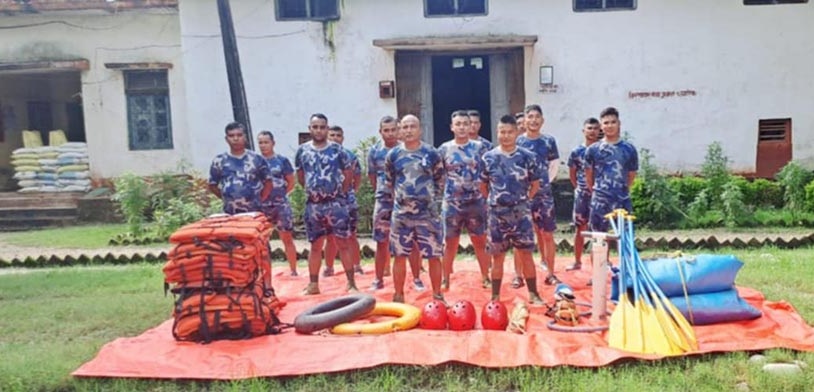
KATHMANDU: The Armed Police Force (APF) has established temporary monsoon response bases at 41 locations across the country, including several within the Kathmandu Valley.
In the Valley, bases have been set up at Kolmateshwor Temple, Dharmasthali, Dhapasi, Lele in Lalitpur, and Sanothimi in Bhaktapur.
According to Deputy Inspector General Kalidas Dhauwaji, the central spokesperson for the APF, these bases are part of efforts to support rescue and relief operations during monsoon-related disasters.
Elsewhere in the country, bases have been established in Bakhari of Morang and Harakpur of Okhaldhunga under Koshi Province. In Madhes Province, bases have been set up in Bhardaha and Barsain of Saptari, Mil in Siraha, Dubarkot in Dhanusha, Raghunathpur and Banauta in Mahottari, Dharahara in Sarlahi, Fatuwa in Rautahat, Telkuwa and Kalaiya in Bara, and Pokhariya in Parsa.
In Bagmati Province, bases have been established in Sunaula of Makawanpur, Khalthok and Mangaltar in Kavre, Kharanitar in Nuwakot, Bhaldhunga in Chitwan, Lincoln Bazaar and Singti in Dolakha, and Tatopani in Rasuwa.
Similarly, in Gandaki Province, monsoon response security bases have been set up in Khahare of Parbat, Arughat of Gorkha, and Chhachok of Kaski. In Lumbini Province, the bases are located in Chormara of East Nawalparasi, Rajapur of Bardiya, Butwal of Rupandehi, Kunda and Kachnapur in Banke, Turang in Gulmi, and Dobhan in Palpa.
In Karnali Province, the bases have been established in Badki of Jumla, Dimurkhara of Mugu, and Dalli of Jajarkot. In Sudurpaschim Province, Khani Danda of Kailali and Budar of Doti have been designated as monsoon response locations.
The Armed Police Force stated that these bases have been strategically set up in areas identified as being at high risk of monsoon-induced disasters.
Security personnel at each base are equipped with disaster response tools and are on standby to carry out rescue operations and provide immediate assistance to affected communities.
In preparation for disaster response, the APF has identified 168,956 disaster risk indicators across the country. Highlighting the importance of local community participation, Deputy Inspector General Dhauwaji added that 990 individuals have received disaster volunteer training to support relief efforts during emergencies.






Comment