




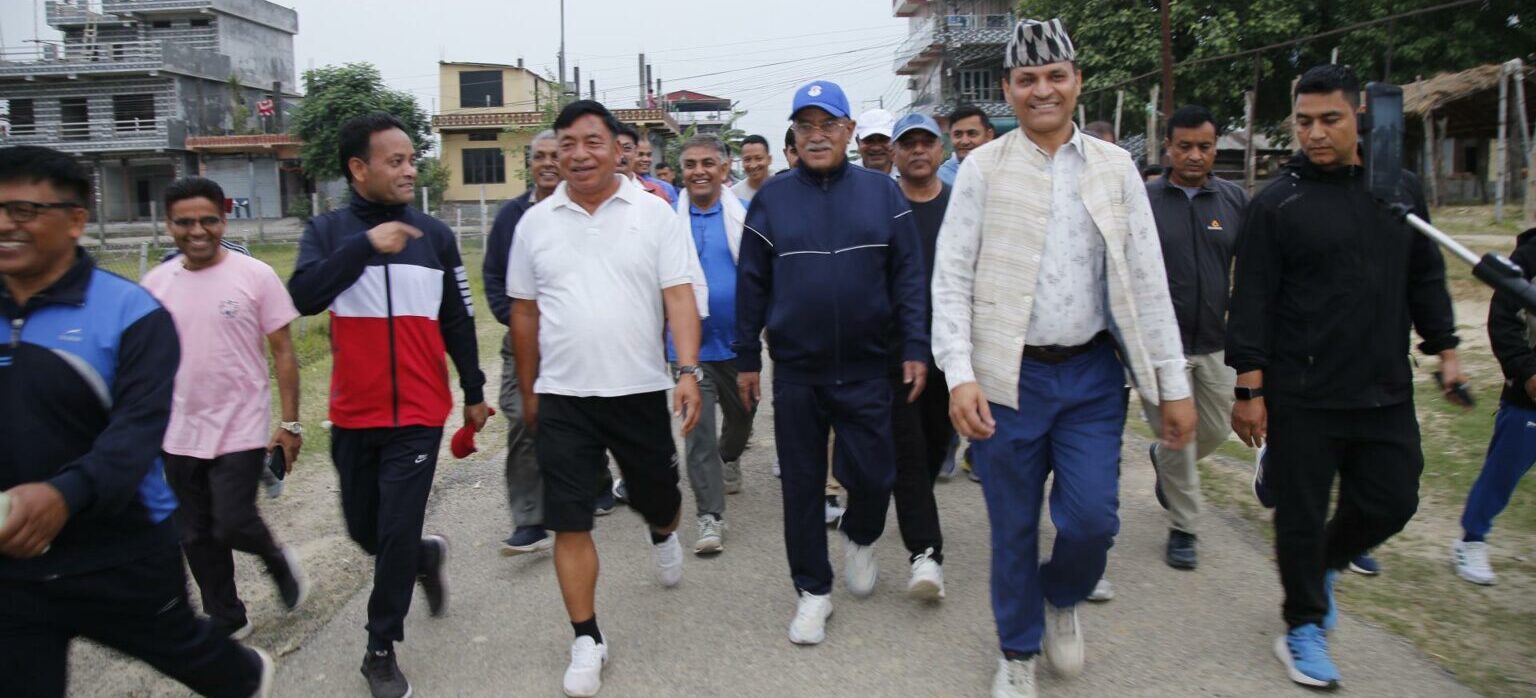
KATHMANDU: The Maoist Center recently concluded its 50-day “Maoist Tarai-Madhes Awareness Campaign with the People,” a grassroots initiative launched from Kachankabal, Jhapa, on February 24, 2025, and wrapped up in Mahendranagar, Kanchanpur, on April 29.
The campaign’s core goal was to listen to the grievances of the people of Tarai-Madhes, reflect on the party’s past, and reconnect with its original agenda.
Led by party Chairman Pushpa Kamal Dahal ‘Prachanda’, the campaign covered 20 districts along Nepal’s Postal Highway. The party conducted district-level meetings, visited families of martyrs, wore local attire, ate local cuisine, and tried to live the daily lives of the people. Leaders stayed with locals from dawn till late night, in a symbolic return to their roots.
While the campaign was initially scheduled to end on March 20, it was delayed due to the rise of the royalist movement and student union elections. However, the resumed journey proved valuable for the party. Leaders say it helped them reflect, reconnect, and realign with the people’s issues.
“The people were very hopeful about us,” said Vice-Chairperson Pampha Bhusal in an interview with Khabarhub. “This campaign offered clarity and direction. It has reminded us of our purpose—to work for the people.”
Bhusal admitted that the Maoists had long neglected the Madhes region. People expressed frustration that, even after the Maoists were in government, many demands from the region remained unfulfilled.
“We listened, documented their problems, and lived among them,” said Deputy General Secretary Shakti Basnet. “The presence of Chairman Prachanda made a huge difference. People were vocal, engaged, and emotional. We were late in re-engaging with Tarai-Madhes, but this campaign has reignited that connection.”
Prachanda’s self-critique: Missteps in power and blame on Oli
Prachanda, who led the government for 19 months following the 2079 elections, has been serving as leader of the main opposition since July 14, 2024.
He admitted that during his time in power, he distanced himself from the public and made political alliances that alienated his support base.
After stepping down, party leaders advised him to reengage with the grassroots. The 50-day campaign became a platform for his self-reflection. In his addresses across the 20 districts and six provinces, Prachanda admitted that trusting KP Sharma Oli for the sake of left unity in 2074 BS was a mistake.
“I was sincere about left unity,” he said, “but Oli was not. That betrayal led us down the wrong path.”
Prachanda apologized to the public for compromising with both right- and left-wing parties simply to preserve the ruling coalition. He acknowledged that such political balancing diluted the Maoist agenda.
He also reaffirmed his commitment to the dreams of the martyrs and warned that the Oli-led government was losing legitimacy and popular support. Though he insisted he was not eager to rejoin the government, he suggested that political conditions might soon force his return.
“The Maoists have always stood with the oppressed, Dalits, and marginalized border communities,” Prachanda said. “But various power plays have prevented us from making an emotional connection. I’ve reviewed these shortcomings honestly.”
Mixed Public Sentiment, Growing Expectations
Despite criticisms and skepticism from locals, especially in areas where development has lagged, the campaign appeared to rekindle some hope. While some saw the Maoist outreach as performative, others welcomed the leaders’ return to the grassroots after years of top-down governance.
Whether this campaign will transform into long-term commitment and tangible outcomes remains to be seen. But for now, it has reminded the Maoist leadership of its original mission—and brought it face-to-face with the people it once claimed to represent.
The leaders themselves admit that the Maoist organization is weak in the districts along the Hulaki Highway. Analyzing the elections after 2064 BS, the Maoist influence in this area is not very visible.
The 2027 election will show how much influence the Maoists have managed to make by reaching there this time. But the leaders believe that the Maoists will get good support from this area in the upcoming elections.
According to Maoist General Secretary Dev Gurung, he claims that the Hulaki Highway (Postal Highway) campaign has given the Maoists a way to transform the party and become the first force again. He claims that this campaign has tried to unify the understanding of the Maoist party among the people.
‘We also had direct conversations with professors, teachers, businessmen, intellectuals, farmers, workers, minorities and women. They have expressed their problems with great confidence,’ leader Gurung told Khabarhub, “They have said that you should listen to our problems and try to solve them, we are with you. Our campaign with the people has aroused enthusiasm in them. We will also introspect and highlight their problems.”
Mandate of the meeting of office bearers
The Maoists were the first party to enter parliamentary politics for the first time in 2064 BS. Since then, it has been on a continuous downward journey. Now, the fourth party is the Maoist Center.
At the Maoist office bearers’ meeting held on Sunday, leaders have suggested to Prachanda, who criticized Oli in the campaign, not to criticize the government and not to talk about toppling the government.
‘This government will collapse on its own. We don’t have to speak. This is what has happened.’ Informing about the meeting, an office bearer said, ‘We have also discussed whether to criticize the government or not. We also suggested the chairman the same.’
Deputy Secretary General Shakti Basnet, who walked in the Hulaki Highway campaign, says that everyone has once again felt the need for the Maoists in national politics.
“The main thing is the people’s psychology that the Maoists should be given an opportunity once again. This campaign has helped the Maoists to change and transform their own weaknesses,” Basnet told Khabarhub,
“While we were in the coalition process for a long time, the party’s agendas became a ghost. Not being able to raise the political agenda in a real way has become a weakness. We have felt it ourselves. Regular meetings and dialogue with the people have broken down. This has become our weakness.”
Basnet feels that there has also been a ‘gap’ in conveying the party’s message to the people during the campaign. He also admits that they have seen weaknesses in formulating party policies by bringing the feelings of the people.
“While being in the coalition process for a long time, the policies and programs of the party and the government have become the same. The identity and agenda of the Maoists have been overlooked.”
Basnet added, “The party has felt these concerns and suggestions. We also felt that it has become different from the agenda.”
Meanwhile, party secretary Ram Karki also says that the People’s Party has broken dialogue and cooperation with the people. This is also the reason why the people are disappointed, they claim that the campaign has raised hope.
“The ‘cycle’ of contact between the people and the party was broken. We have ‘re-established’ it. The party was a ghost, now it has been sharpened,” Karki said, “The party has not been able to provide information to the people about what decisions it has made under what circumstances. This is a serious matter.”
Secretary Karki said that a meeting of Maoist office bearers has been held on Sunday to review the campaign. The meeting reviewed the suggestions and problems seen in the ‘Maoist Tarai-Madhes Awareness Campaign with the People’ and discussed the party’s policy by documenting them.
According to Devendra Poudel, another secretary of the Maoist Center, Sunday’s meeting decided to document the memorandums related to development and construction and submit them to the Ministry of Finance.
He said, “It has been decided to self-review the suggestions received. These suggestions will also be included in the party’s policy. It has been decided to submit the memorandum related to development and construction to the Ministry of Finance as a document.”
A new campaign
The Maoists, which had launched a four-month ‘Maoist Special Transformation Campaign with the People’, had also prepared a report at that time. Immediately after, at the statutory conference held at Pragya Bhavan in Kathmandu from Falgun 1, there were many complaints from cadres against the Maoists in the government at that time.
The cadres were angry that they were power-oriented, ignored the victims of armed conflict, and ignored the families of martyrs.
Secretary Poudel said that the Maoist Center decided on Sunday to launch an east-west awareness campaign focusing on the Mid-Hill Highway from June 2.
Question to PM: Has relationship with Maoists improved after Chauthaiwale’s visit?
KATHMANDU: Discussions began on Monday in both Houses of the Federal Parliament on the government’s policies and programs for the upcoming fiscal year, presented by President Ram Chandra Poudel last week.
During the House of Representatives session at the Federal Parliament building, lawmakers raised various concerns during the zero and special hours.
The debate between CPN-UML and Maoist Center representatives grew heated, particularly on issues of corruption and governance.
Prime Minister KP Oli was also present to table the policies and programs for deliberation. Upon his arrival, UML Chief Whip Mahesh Bartaula greeted him outside the Parliament building. However, what followed was an unexpected exchange.
As PM Oli stepped out of his vehicle with a smile, a journalist posed a pointed question: “Have relations with the Maoists improved after the visit of the BJP’s Foreign Affairs Chief?”
The question visibly irritated the Prime Minister. “Go the other way,” PM Oli responded sharply, motioning toward the meeting hall. “You have your own way.”
Despite this tense moment, what unfolded inside the chamber painted a different picture.
Prime Minister Oli was seen chatting and even shaking hands with Maoist Center Chairman Pushpa Kamal Dahal ‘Prachanda’ as he made his way to table the document.
Oli’s secretariat later shared a photograph of this exchange with the press—an image reminiscent of similar publicized moments when relations between the two leaders were reportedly warming.
Behind-the-Scenes Dialogue on TRC
This cordiality came shortly after Oli and Dahal held separate talks on Transitional Justice (TJ) under the pretext of discussing the Truth and Reconciliation Commission (TRC).
Previously, TRC talks had involved the top three leaders—Oli, Dahal, and Nepali Congress President Sher Bahadur Deuba. But on Sunday, Oli held one-on-one talks with Dahal at Singha Durbar, notably excluding Deuba and other Nepali Congress leaders.
Prime Minister Oli was accompanied by UML leader and human rights advisor Agni Kharel, while Dahal brought along Maoist Deputy General Secretary Barshaman Pun, a known advocate for unity among leftist forces.
The exclusion of Congress from this meeting has drawn political interest, hinting at a possible realignment or at least a strategic recalibration among key parties.
Chauthaiwale’s visit sparks speculation
The journalist’s question that irked Oli referred to BJP Foreign Affairs Department chief Bijay Chauthaiwale, who visited Nepal last week. His visit added fuel to the political speculation.
During his trip, Chauthaiwale met with Prime Minister KP Oli, former Prime Ministers Sher Bahadur Deuba, Madhav Kumar Nepal, and Pushpa Kamal Dahal. In total, he held meetings with 19 political figures from across the spectrum—excluding only pro-monarchist leaders.
His itinerary included talks with UML General Secretary Shankar Pokharel, Finance Minister Bishnu Poudel, Maoist Deputy General Secretaries Barshaman Pun and Janardan Sharma, as well as RSP acting president DP Aryal and Vice Chair Swarnim Wagle.
From the Nepali Congress, he met with Shekhar Koirala, General Secretary Gagan Thapa, spokesperson Dr. Prakash Sharan Mahat, former foreign ministers NP Saud and Uday Shumsher Rana, and current ministers Ramesh Lekhak (Home) and Dr. Arzu Deuba Rana (Foreign). He also met Loktantrik Samajwadi Party Chair Mahant Thakur and Janamat Party President Dr. CK Raut.
Interestingly, Chauthaiwale avoided any meetings with monarchist leaders, despite rising pro-monarchy rallies across Nepal.
His snub of royalist figures—including former King Gyanendra Shah and his supporters—has been widely interpreted as India distancing itself from the monarchy restoration campaign.




Comment