




Proceeding toward elections without addressing the fundamental demands raised during the Gen Z Uprising would not merely be a political miscalculation; it would be a deliberate betrayal of a generation that risked everything to reclaim the nation’s dignity.
The uprising of September 8 and 9, carried out with extraordinary courage by Nepali youth, was not a symbolic protest; it was a decisive moment that forced a corrupt and complacent political order to its knees. Attempting to convert such a transformative movement into a routine electoral exercise would be disastrous for the country’s political future.
For three decades, a small circle of leaders and interest groups systematically looted the state, captured institutions, and weaponized power to perpetuate corruption. The Gen Z uprising compelled these forces to surrender morally and politically. To now prepare an election designed to return those very actors—unchallenged, unaccountable, and untransformed—back to the helm of power is indefensible. It is an assault on the sacrifices of the young people who walked into gunfire so the country could breathe again.
The uprising had three central demands: lifting the social-media ban, instituting a directly elected executive system to guarantee political stability, and restructuring or replacing the public and regulatory institutions that had become irredeemably corrupt. It also demanded strict accountability and prosecution of those who hollowed out the nation from within—across the executive, judiciary, and legislature—over the last three decades.
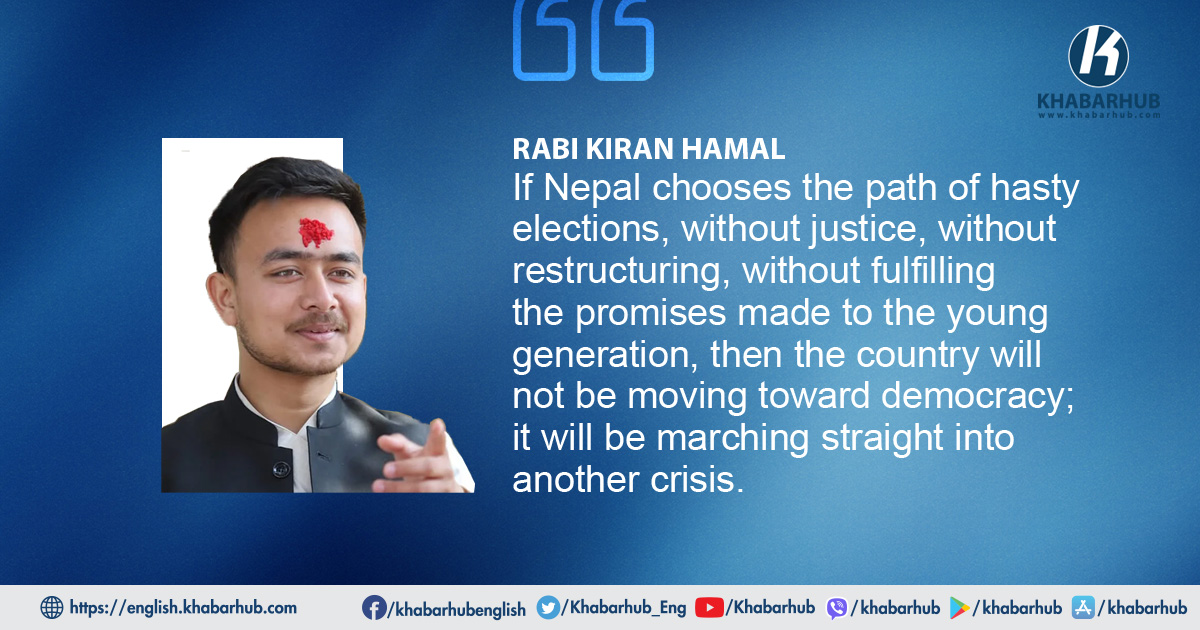
If Nepal chooses the path of hasty elections—without justice, without restructuring, without fulfilling the promises made to the young generation—then the country will not be moving toward democracy; it will be marching straight into another crisis. And this time, the betrayal will not be forgiven.
Of these demands, only the superficial one—the lifting of the social-media ban—has been fulfilled. The structural, institutional, and justice-oriented demands have been pushed aside. To rush into elections while leaving these core issues unresolved is to disregard the blood that was spilled on the streets.
The uprising exposed a hard truth: Nepal’s security forces, bureaucracy, and political leadership collectively failed. The police, armed police, army, and the civil service all capitulated; the entire state surrendered. A capital city unable to protect itself cannot be the foundation of national stability.
Preserving these institutions exactly as they are and expecting peace to emerge is a fantasy. Their collapse during the uprising was not incidental; it was the direct result of decades of politicization, incompetence, and elite capture. Without restructuring them, the nation cannot move forward.
Much has been said about the looting, arson, and vandalism that occurred during the chaos. But few ask the deeper question: why did these incidents occur? When a president and prime minister flee, when state institutions disintegrate and abandon their constitutional responsibilities, a vacuum inevitably emerges. In a moment of state collapse, opportunistic criminal behavior becomes inevitable. Blaming the youth for these incidents while ignoring the state’s total failure is politically convenient but profoundly dishonest.
After the uprising, young leaders put forward a vision of a strong, capable government—one that could imprison the corrupt, rewrite the constitution, and end the cycle of political stagnation. But the formation of an election-focused government instead of a reform-focused transitional authority was the moment the uprising’s mandate was hijacked. The spirit of the movement was sidelined, diluted, and gradually distorted.
Nepal’s youth—particularly Generation Z—constitute the country’s largest and most powerful demographic bloc. Nearly a third of the population belongs to this generation. A political process that ignores their demands cannot claim legitimacy, let alone promise stability. If the uprising’s goals are not institutionalized—if the wounds it exposed are left untreated—the country cannot realistically hope for peace.
Reducing democracy to elections alone is the very mindset that pushed Nepal toward rebellion. Democracy is not periodic voting; democracy is the voice of the people who stood unarmed in the streets, absorbing bullets for the dream of a better nation. The uprisings of September 8 and 9 were not merely protests—they were the loudest democratic expression Nepal has witnessed in decades.
Elections, therefore, cannot provide a solution at this moment—not until the uprising’s demands are genuinely addressed and structurally embedded into the political system. The electoral process must be paused. The reform agenda must move forward. Only then can elections regain legitimacy and national consensus.
If Nepal chooses the path of hasty elections—without justice, without restructuring, without fulfilling the promises made to the young generation—then the country will not be moving toward democracy; it will be marching straight into another crisis. And this time, the betrayal will not be forgiven.





Comment