




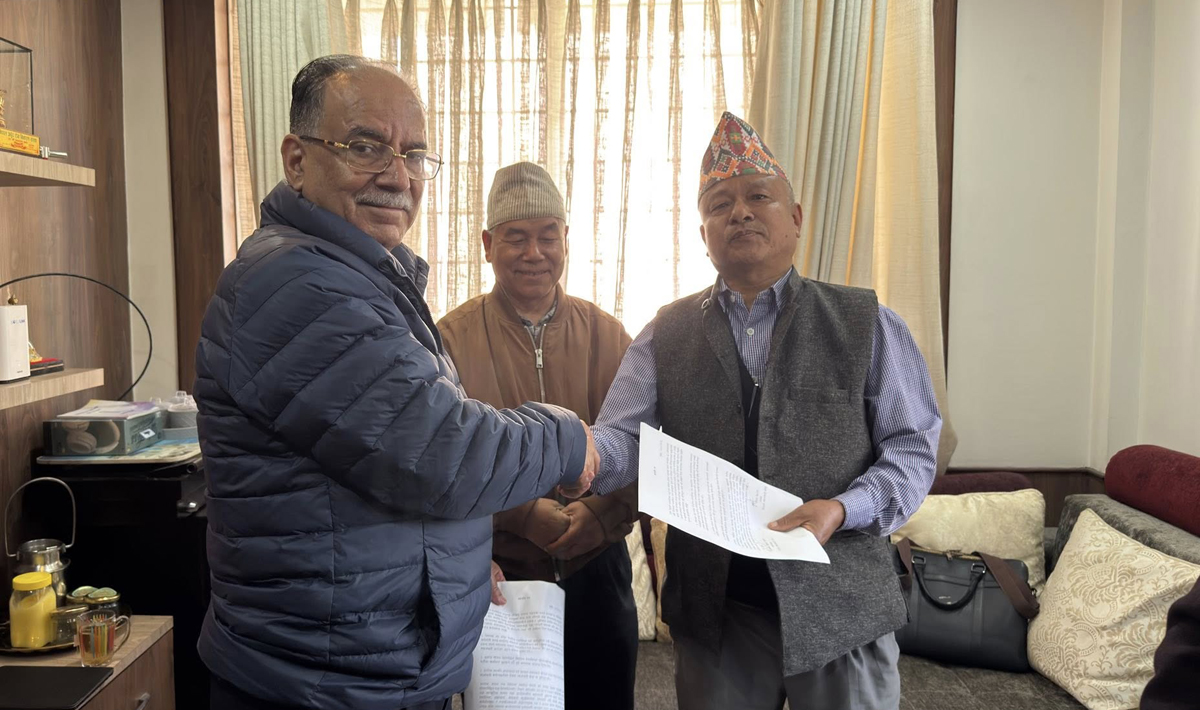
KATHMANDU: In a major political development amid Nepal’s ongoing left-wing fragmentation, the CPN (Maoist Center) and the Deshbhakt Samajbadi Morcha have reached an agreement to unite and consolidate leftist and nationalist forces under a single front, marking the return of Gopal Kirati to Pushpa Kamal Dahal ‘Prachanda’s’ leadership after eight years in political exile.
The agreement, announced after a meeting between Maoist Chairperson Prachanda and Morcha Chairperson Kirati, envisions bringing together patriotic, socialist, and revolutionary forces under the Maoist Center’s leadership.
Both parties described the move as a response to the risky and regressive state of Nepali politics, stressing that unity among revolutionary forces is indispensable to turn adversity into opportunity, echoing Maoist-era ideals of the People’s War.
The joint statement outlines three key commitments: first, to conduct an objective review of past ideological, political, and organizational weaknesses and rebuild unity at the grassroots level; second, to hold systematic internal discussions on Kirati’s concept of socialist democracy with patriotic identity and adopt policies based on people’s democracy; and third, to formally integrate Kirati-led Marxist revolutionaries into the CPN (Maoist Center).
The document, signed by both Prachanda and Kirati, also calls for collaboration among patriotic, socialist, and identity-based movements to protect Nepal’s sovereignty and implement the Constitution’s socialist-oriented governance. It urges the youth to join the struggle to end corruption and comprador capitalism.
Kirati’s return carries deep symbolic weight. Once a hardline Maoist commander who led the Kirat Janawadi Workers Party during the insurgency, he had joined the Maoist rebellion in 2000, helping the movement expand in eastern Nepal. However, he broke away in 2017, just before the general elections, opposing the Maoist Center’s alliance and later unification with the UML and Naya Shakti.
Disenchanted with what he saw as ideological betrayal, Kirati formed a “Reorganized Maoist Center” and later the Deshbhakt Samajbadi Morcha, promoting ethnic federalism and constitutional rewrite campaigns under slogans such as “Abolish Mandale provinces and rewrite the Constitution for socialist statehood.” His faction, however, soon faded from national prominence.
Now, eight years later, Kirati has reconciled with Prachanda. On Monday, he saluted the Maoist chief with a Lal Salaam, the symbolic red salute of the insurgency era, declaring, “We will complete the Nepali revolution and defeat both domestic and foreign reactionaries.”
His political journey, once defined by defiance, has come full circle. Ironically, as Kirati reenters the Maoist fold, several senior leaders including Janardan Sharma and Sudan Kirati, his one-time comrades, are reportedly preparing to leave the party.






Comment