




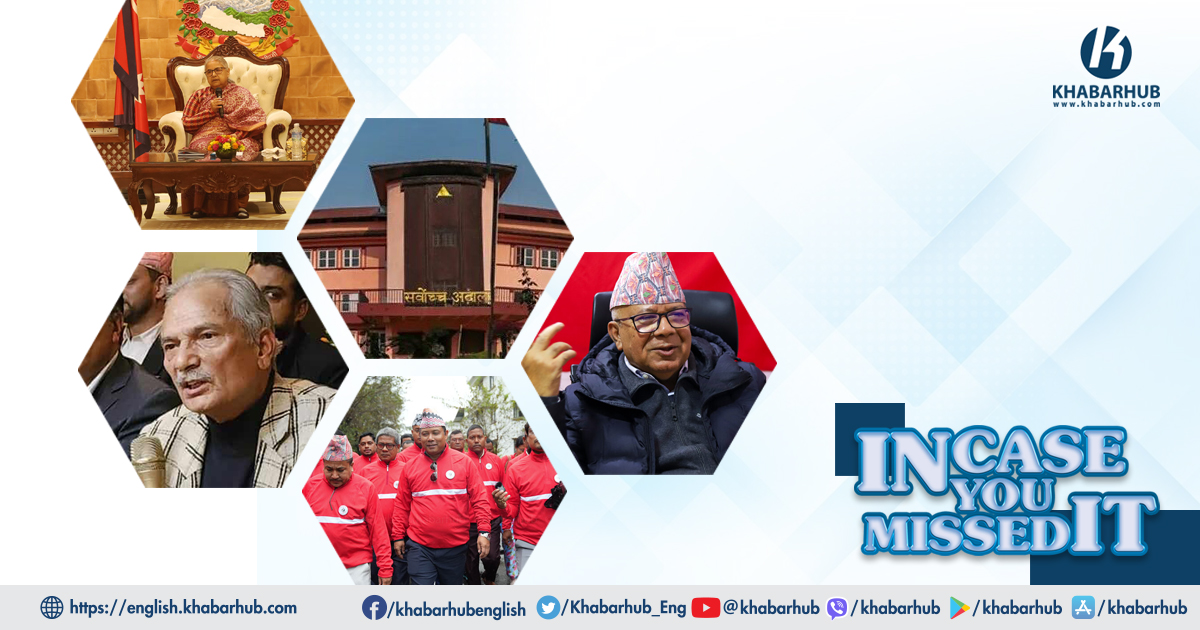
KATHMANDU: The events of the past week portray a Nepal in the midst of a controlled yet fragile political transition, as the government of Prime Minister Sushila Karki seeks to balance the demands of stability, accountability, and reform in the lead-up to the March 2026 general elections.
At the heart of last week’s developments was Karki’s assurance that the elections will be held on schedule and in a secure environment. In a meeting with editors, she and Home Minister Om Prakash Aryal projected confidence that security challenges—exposed during the September 9 unrest—were under control.
Their message was clear: the state remains functional and committed to credibility despite lingering doubts. The disclosure that about half of the 1,200 weapons looted during the unrest have been recovered, and that most others have been located, served both as reassurance and as a subtle acknowledgment of the depth of the earlier crisis.
The government’s emphasis on “dialogue and consensus” with both traditional political actors and Gen-Z representatives suggests a recognition that legitimacy in the present context depends as much on inclusion as on control.
At the administrative level, the cabinet expansion and appointment of new ministers reflected an effort to strengthen the government’s technocratic credentials rather than to consolidate partisan power.
The week’s events thus illustrate Nepal’s ongoing experiment in post-crisis governance—an attempt to deliver calm, credible leadership while responding to the pressures of generational change and public scrutiny.
Figures such as Dr. Sudha Sharma and Bablu Gupta lend an image of competence and continuity, signaling that the interim government seeks to maintain institutional stability ahead of the polls. Yet this image of control was challenged by the judiciary’s growing scrutiny of executive actions.
The Supreme Court’s orders requiring explanations for the recall of eleven ambassadors and the imposition of passport restrictions on former Prime Minister KP Sharma Oli and others highlighted the tension between administrative assertiveness and legal accountability. These judicial interventions reinforce the perception that Nepal’s democratic institutions, though often in conflict, remain active in checking each other’s powers during a sensitive political period.
Meanwhile, the shifting landscape of party politics revealed both fragmentation and attempts at consolidation. Resham Chaudhary’s formal split from the Nagarik Unmukti Party and registration of a new organization underlines the ongoing volatility in regional and identity-based parties, many of which continue to realign in the wake of the Gen-Z movement.
At the same time, the CPN (Unified Socialist)’s decision to merge with the Maoist Center pointed toward renewed efforts at leftist unification, though the internal dissent from senior figures such as Jhalanath Khanal and Ghanashyam Bhusal demonstrated that ideological and generational divisions persist within Nepal’s left.
Adding to this flux, the Rastriya Swatantra Party initiated a series of political dialogues aimed at forging cooperation among forces supporting change. By inviting both reformist politicians and leaders of new movements, the RSP positioned itself as a bridge between institutional politics and civic activism, reflecting a generational shift in the country’s political discourse.
Within the Nepali Congress, however, the reformist impulse met resistance from entrenched hierarchy. General Secretary Gagan Thapa’s boycott of the central committee meeting over disagreements on the timing of the party’s general convention symbolized the party’s internal struggle between renewal and inertia.
The friction between Thapa and acting president Purna Bahadur Khadka underscored how even the most established party remains vulnerable to generational discontent, mirroring the broader tension between old structures and new expectations that defines Nepali politics today.
Beyond the political maneuvering, the government’s administrative decisions last week suggested a quieter but significant attempt at rationalizing governance. The simplification of visit visa requirements for Nepali citizens marks a small but symbolic reform in favor of transparency and citizen convenience, reflecting the government’s awareness of public frustration with bureaucracy.
Likewise, the decision to delay new ambassadorial appointments, opting instead for caretaker management by senior officials, projected prudence and restraint—an acknowledgment that an interim government should avoid long-term commitments.
Taken together, these developments paint a picture of a state trying to steady itself after months of turbulence. Prime Minister Karki’s administration projects confidence and order, yet operates within a fragile equilibrium. The convergence of judicial assertiveness, party fragmentation, and civic activism means that stability remains provisional, contingent on continued dialogue and careful management.
The week’s events thus illustrate Nepal’s ongoing experiment in post-crisis governance—an attempt to deliver calm, credible leadership while responding to the pressures of generational change and public scrutiny.
It is a moment defined less by decisive transformation than by cautious recalibration, as the country prepares for elections that will test not only the government’s competence but the resilience of Nepal’s democratic institutions themselves.






Comment