





KATHMANDU: Economic Digest offers a concise yet comprehensive overview of significant business happenings in Nepal, presented in easily digestible summaries.
Nepal’s recent economic and policy developments reflect a push toward financial discipline, infrastructure expansion, and climate-resilient agriculture amid internal and external pressures. The government has tightened foreign currency regulations to prevent illicit financial flows, while the IMF’s release of a delayed credit tranche underscores ongoing structural reform commitments.
Major hydropower projects like Humla Karnali-2 signal long-term energy goals, yet delays in road infrastructure reveal persistent administrative inefficiencies. Meanwhile, monsoon-related warnings have led to proactive advisories and vehicle restrictions to mitigate disaster risks. In tourism, places like Manang face severe downturns due to unrest and natural calamities, highlighting sector vulnerability.
Initiatives like concessional lending, mutual fund dividends, and digital Dakshina illustrate efforts to foster inclusion, investment, and modernized financial habits, though cultural and logistical challenges remain. Collectively, these trends illustrate Nepal’s balancing act between economic modernization, risk management, and inclusive growth amid a shifting socio-political landscape.
Nepal introduces new foreign currency limits: $5,000 entry, $1,500 holding cap
The Finance Ministry has promulgated new rules on foreign currency entering and being held within Nepal. Nepali and foreign nationals may now bring up to USD 5,000 (or equivalent in other currencies) into the country without making a customs declaration; amounts above that must be declared. Locals may retain up to USD 1,500 in cash—sourced legitimately via remittances, business, or travel allowances—but may face scrutiny under money laundering laws for unexplained sums. The government also reiterated that transactions exceeding NPR 1 million must go through formal banking channels and encouraged broader adoption of digital payments to curb illicit cash hoarding.
Humla Karnali 2 hydropower project advances with EIA submission
The 335 MW Humla Karnali 2 Hydropower Project has progressed after its Environmental Impact Assessment (EIA) was submitted to the Ministry of Forests and Environment by the Ministry of Energy, Water Resources and Irrigation. Originally proposed by Sichuan Wangping Energy Science and Technology, the project is now under the stewardship of Ruru Hydropower. Situated in Kharpunath and Sarkegad rural municipalities of Humla district, the run-of-river scheme will require a 62-meter dam, two diversion tunnels, and the acquisition of 61 hectares of land. With a projected cost of NPR 72.9 billion, construction from 2026–2031 is expected to impact 56 households, create approximately 1,805 construction jobs, and 115 long-term roles post construction.
IMF disburses sixth tranche of Nepal’s extended credit facility after delayed review
The International Monetary Fund (IMF) has approved the sixth installment under Nepal’s Extended Credit Facility (ECF), releasing about USD 41 million after a three month delay. The delay stemmed from Nepal Rastra Bank’s failure to complete a mandated review of commercial banks’ loan portfolios—a key IMF condition. With that review now in place and progress on structural reforms underway, the IMF’s executive board cleared the disbursement. To date, Nepal has received approximately USD 350 million under the seven-tranche ECF agreement launched in late 2021 to stabilize foreign reserves and balance-of-payments pressures; only the final tranche remains pending in this four-year program.
Govt issues special agro meteorological bulletin ahead of intensified monsoon
As monsoon rains are forecast to intensify from October 3 to 5, the government has issued a special agro met advisory urging farmers to take protective measures. The bulletin recommends ensuring proper drainage in paddy fields, nurseries, and orchards; suspending pesticide spraying; and relocating harvested crops and farm materials away from flood-prone zones. Livestock owners are advised to avoid feeding wet or moldy fodder, monitor for digestive ailments, and keep grain stocks dry. Beekeepers are told to provide sugar syrup to sustain hives, poultry operators to guard against parasites, and fish farmers to secure ponds using mesh covers to prevent losses.
Tourist hubs fall silent in Manang amid protests and landslides
Manang, once teeming with trekkers and holiday-goers during the autumn season, lies eerily quiet this year. The combined effects of the Gen Z protests, landslide disruptions, and blocked access routes have driven away foreign visitors and canceled hotel bookings. Hot springs in Chame that once saw nightly visitors are now deserted. With many locals away celebrating festivals in urban centers, villages lie empty and local businesses—heavily reliant on tourism—are reeling. Stakeholders warn that without rapid government intervention, Manang’s tourism-dependent economy may not easily rebound.
Nighttime vehicle ban on BP Highway amid monsoon threats
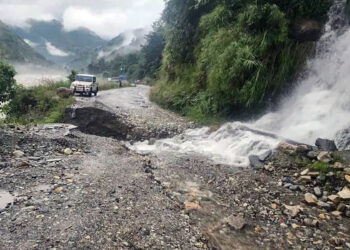
To curb risks posed by the ongoing monsoon, authorities have prohibited night travel from 5 p.m. to 5 a.m. on the Kavrebhanjyang–Bhakundebesi–Sindhuli segment of the BP Highway from October 2 to 7 (Ashoj 16–21). The ban excludes emergency and essential service vehicles and follows warnings from the National Disaster Risk Reduction and Management Authority. Officials note that vehicles may be halted at any time if conditions worsen. The restriction aims to prevent accidents along a stretch previously battered by landslides, where reconstruction remains incomplete.
Nepal reopens concessional loan program with stricter conditions, 3% interest subsidy
After a two-year hiatus, the government has revived its subsidized loan scheme, backed by approximately NPR 10 billion in cleared interest payments. Under tighter regulation, the program now includes ceilings on loan types—such as NPR 50 million for agriculture, NPR 2.5 million for women entrepreneurs and startups, NPR 2 million for returnee migrants and Dalit entrepreneurs, NPR 5 million for industrial boiler upgrades, and NPR 0.5 million for disaster-impacted households. The interest subsidy has been scaled back to 3%, and repayment is capped at five years to discourage misuse.
Digital dakshina: Dashain tradition meets Nepal’s push for cashless payments
Nepal’s biggest festival is seeing a shift in how dakshina (festival offerings) are given. Traditionally presented in cash, the practice is gradually evolving toward mobile banking, wallets, and apps—a change accelerated by the COVID 19 pandemic. Digital dakshina offers benefits such as lower risk, reduced printing and handling costs, and better financial traceability. Yet challenges remain: many elders still prefer physical currency, and cultural attachment to giving new bills is strong. Experts argue that awareness campaigns and training will be key to wider acceptance, and with backing from Nepal Rastra Bank, digital dakshina may emerge as the modern face of a centuries-old tradition.
India’s cross-border loan push faces legal roadblocks in Nepal
India’s new monetary policy proposes internationalizing the Indian rupee by enabling Indian banks to offer cross-border loans to neighboring countries like Nepal, Bhutan, and Sri Lanka. However, the initiative faces significant legal and regulatory challenges. Both India’s Foreign Exchange Management Act (FEMA) and Nepal’s Foreign Exchange Regulation Act mandate prior approvals, and such loans would be subject to oversight by both the Reserve Bank of India (RBI) and Nepal Rastra Bank. Additional concerns—such as enforcing collateral, taxation issues, and dispute resolution—remain unresolved. As a result, cross-border lending is currently feasible only for large firms or government-backed projects, not for individuals or small businesses, who would face complex compliance hurdles.
Kathmandu’s 1,500-year-old water systems offer modern lessons in sustainability
Amid Kathmandu Valley’s growing water scarcity, experts point to the region’s ancient water management systems as a model of sustainable design. Dating back to the Kirati and Lichchhavi eras, early inhabitants built sophisticated networks of canals (kulo), ponds, and stone spouts (dhunge dhara) that delivered clean water for household, agricultural, and religious use. Royal canals (rajkulo) connected natural water sources to settlements, while stone spouts often included carbon filtering and multi-layered flow systems. Over time, rapid urbanization and neglect have degraded these once-efficient systems. Conservationists stress that reviving traditional practices could help address current water challenges and promote long-term resilience.
Nepal’s eastern trade sees widening gap as exports fall and imports rise
Nepal’s eastern trade corridor, particularly through Kankhavitta, experienced a 21% drop in exports in the first two months of FY 2082/83, totaling NPR 3.06 billion. This decline occurred despite a 43.9% surge in cardamom exports. Tea exports fell by 34%, and products like ginger, lentils, and chhurpi saw only modest demand. Meanwhile, imports increased 9%, reaching NPR 8.9 billion, driven by petroleum products, jute, pulses, and ready-made garments. Customs revenue also rose nearly 9%. Trade experts emphasize the urgent need for export diversification, improved logistics, and value-added production to close the growing trade imbalance and support sustainable economic growth.
Delayed road projects in Parbat spark frustration and disruption
Two key road projects in Parbat District—Milanchok–Salyan–Ghaket–Dharapani Thotneri and Lunkhudeurali–Milanchok–Balakot–Hoshrrangdi—have seen long delays, despite initial contracts promising completion within two years. Progress remains sluggish, with one project only 64% complete and the other at 35%. Contractors cite material shortages and challenging terrain, but authorities say repeated deadline extensions are no longer acceptable. Local communities, including Mahashila Rural Municipality, report growing difficulties in transportation and commerce. Infrastructure officials are now considering terminating the contracts unless work resumes promptly. The continued delays have undermined trust and hampered regional mobility and economic development.
Mutual funds announce FY 2081/82 dividends, up to 21% return for investors
Forty mutual funds in Nepal have declared dividends for fiscal year 2081/82, following their book closures. Returns ranged from 3.8% (Muktinath Mutual Fund 1) to 21.05% (Sanima Large Cap Fund). Other leading performers include Laxmi Unnati, Siddhartha Equity, RBB Mutual Fund 1, and Sunrise Bluechip, offering between 13% and 20%. Several major institutions—NIC Asia, Nabil, NMB, and Prabhu—provided cash dividends between 4.27% and 15%. The payouts reflect the funds’ financial performance during the previous fiscal year and provide unit holders with a steady source of investment income.





Comment