




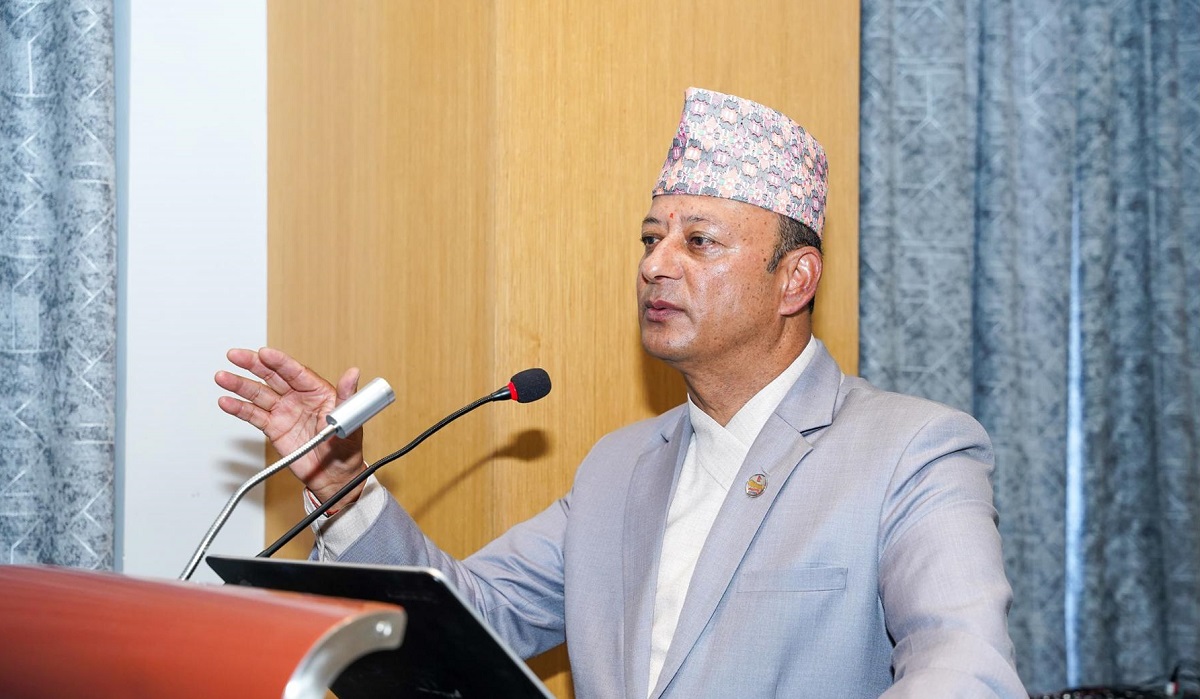
KATHMANDU: Minister for Energy, Water Resources and Irrigation, Deepak Khadka, has reaffirmed the government’s commitment to prioritizing the development of large-scale, reservoir-based hydropower projects across the country.
Responding to questions in the National Assembly during discussions on the Appropriation Bill 2025, Minister Khadka said the government is actively working to mobilize investment and advance construction of major projects such as Karnali, Upper Karnali, Bheri, and Jagdulla. These efforts, he said, are aligned with the annual government policy and programme.
Regarding the Jagdulla Hydropower Project, Minister Khadka informed lawmakers that the contract bidding process has been completed and a notice of intent has already been issued following bid evaluation. He also highlighted that an agreement to develop the Upper Karnali project was signed with India’s GMR Group under the Electricity Act 1993 and the Public-Private Partnership Act.
He further said a memorandum of understanding has been signed between Nepal’s Electricity Generation Company and India’s NHPC Limited for joint investment in the Phukot Karnali Project. However, implementation has been put on hold due to a legal case filed at the Supreme Court seeking to annul the agreement.
The proposed Mugu Karnali reservoir project, which would benefit the districts of Bajura in Sudurpaschim Province and Kalikot, Humla, Jumla, and Mugu in Karnali Province, is also a priority for the government, according to the minister. A feasibility study is nearing completion and the environmental impact assessment report is currently being prepared.
Minister Khadka added that the Budhi Gandaki Hydropower Project will move forward under a public-private partnership model. The government plans to convert its current capital investment in the project into equity and initiate construction with a robust financial structure and clear operational framework.
He also noted that the Energy Ministry has proposed revisions to the “take-and-pay” power purchase arrangement in the upcoming fiscal year’s budget. A formal request has been sent to the Ministry of Finance to amend the policy.
“Based on the Nepal Electricity Authority’s recommendations, we’ve proposed changes to allow power purchase agreements under take-and-pay provisions for small hydropower projects up to 10 MW and large run-of-river projects where consumption or export of electricity is guaranteed,” he said.
Stating that energy is the backbone of national development, Khadka reiterated Nepal’s ambitious target of producing 28,500 megawatts of electricity by 2035. To meet this goal, a diversified energy mix will be adopted, 17,446 circuit kilometers of transmission lines of various voltage levels will be constructed, and substation capacity will be increased to 40,000 MVA.
The minister also said the government is coordinating with the Ministry of Finance, the Nepal Electricity Authority, and other relevant bodies to rebuild hydropower infrastructure damaged by floods and landslides last year.
To ensure sustainable operation of small and micro hydropower projects, a master plan is being developed jointly by the Nepal Electricity Authority and the Alternative Energy Promotion Centre, he said.
Acknowledging the importance of traditional canals and small irrigation systems for rural agriculture and food security, Minister Khadka said such projects have been prioritized in the budget.
He added that integrated river basin water resource management, watershed conservation, and irrigation programs are being implemented in hilly and mountainous regions to maximize resource use, reduce disaster risk, and boost agricultural productivity.
Speaking on the much-discussed Kaligandaki–Tinau Diversion Multipurpose Project, Khadka said progress had been delayed in the past due to environmental and local concerns, but environmental impact assessment work has resumed following a directive order from the Supreme Court.
Finally, he addressed recent issues of power outages, clarifying that despite increased power generation during the monsoon season, temporary load-shedding occurred due to grid management challenges during high transmission. “Nepal currently has sufficient electricity for domestic consumption and is also exporting surplus power to India,” he said, noting that outages are primarily caused by technical issues such as storms, lightning, and transmission faults.





Comment