




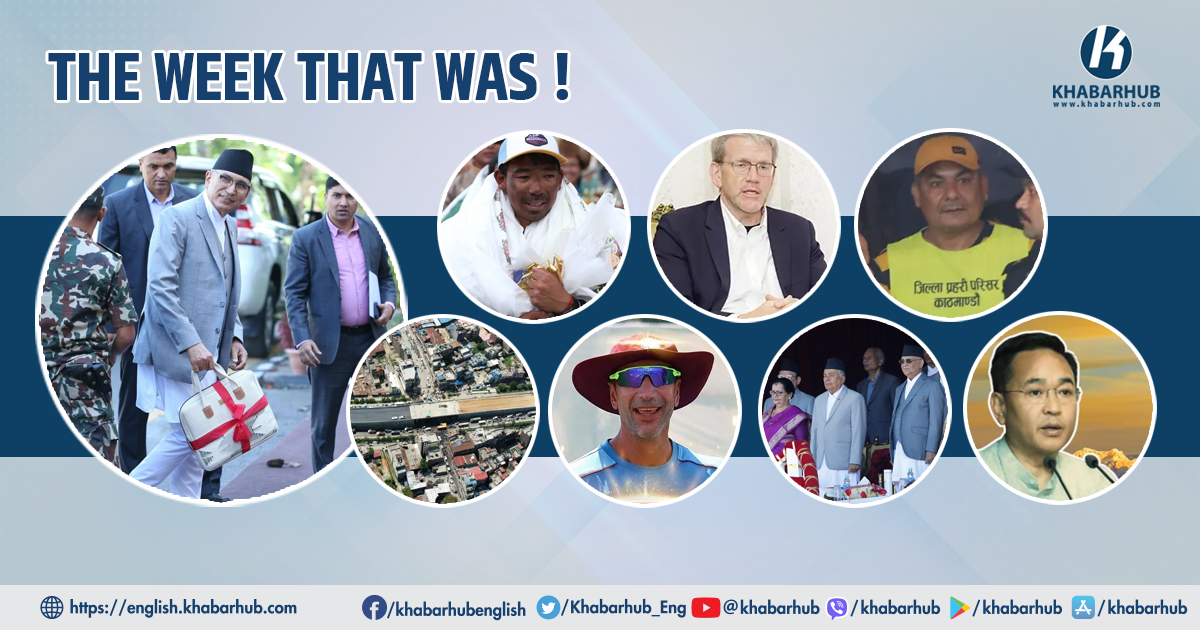
KATHMANDU: In a week marked by major political, economic, and diplomatic activity, the government unveiled a Rs 1.96 trillion budget for FY 2025/26, with significant allocations for education, health, infrastructure, and local governance. Tensions flared between Nepal and India over the Kanchenjunga summit, prompting diplomatic unease.
Republic Day was observed with renewed calls to protect democratic gains, even as Prime Minister Oli warned against attempts to re-centralize power. Controversy deepened over a visa scam involving Home Minister Ramesh Lekhak, drawing opposition demands for his resignation.
Meanwhile, mountaineers Kami Rita and Tashi Gyalzen set new Everest records, legal developments saw Aftab Alam acquitted, and 61 were charged over royalist protests.
Amid these events, the MCC project and key infrastructure developments like the Gwarko flyover also gained attention.
A budget that promises continuity, not transformation
The government’s unveiling of a Rs 1.96 trillion budget for FY 2025/26 may have been the headline event of the week, but it largely reflects incremental continuity rather than bold transformation.
Finance Minister Bishnu Paudel’s allocations prioritize current expenditure (Rs 1.18 trillion), leaving less than a quarter of the total budget for capital investment (Rs 477.89 billion)—a pattern critics argue exemplifies Nepal’s persistent struggle to transition from consumption to development-led budgeting.
The education and health allocations (Rs 211.17 billion and Rs 95.81 billion respectively) continue to receive attention, but policy changes remain repetitive rather than reformative—such as mergers of schools, a concept floated many times before without measurable success.
Similarly, while the mid-day meal program continues, questions remain about monitoring and delivery, especially in remote areas.
Notably, youth and sports received a symbolic boost with allocations for cricket stadiums, perhaps an effort to channel national pride into productive recreation—but it also underlines the government’s tendency to focus on showcase infrastructure rather than systemic sports development.
Kanchenjunga controversy revives border tensions and identity politics
The Indo-Nepal dispute over the Kanchenjunga ascent by an Indian team represents more than a territorial grievance—it is an intersection of nationalism, religious identity, and diplomatic complexity.
Nepal asserts the mountain lies within its territory, while Indian voices from Sikkim are invoking cultural sanctity rather than mere sovereignty.
The Sikkimese backlash, especially from indigenous Bhutia and Lepcha communities, reflects India’s internal friction over identity politics, while CM Prem Tamang’s plea to New Delhi to pressure Nepal externalizes a domestic cultural concern into a diplomatic flashpoint.
For Nepal, this is a reminder that national sovereignty isn’t just about boundary markers—it’s about cultural stewardship and international diplomacy, areas where the government must tread carefully.
Republic Day rhetoric vs. creeping centralization
Prime Minister KP Sharma Oli’s Republic Day speech, warning of ongoing attempts to re-centralize power under privileged lineages, was clearly aimed at royalist movements like those seen at the Tinkune protests. Yet, his remarks ring hollow to critics who see Oli himself as a centralizing figure in Nepal’s recent political history.
The irony lies in Oli championing democracy while undermining federal structures in practice, suggesting a broader disconnect between political rhetoric and institutional reality in Nepal.
Ramesh Lekhak in damage control amid growing pressure
Home Minister Ramesh Lekhak finds himself embroiled in a credibility crisis amid the visit visa scam scandal. His defense—that allegations don’t necessitate resignation—is technically accurate but politically tone-deaf, especially given the scale of reported human smuggling.
With opposition leader Prachanda demanding Lekhak’s resignation and even internal party murmurs against him, this scandal could evolve into a litmus test for the Nepali Congress’s commitment to political accountability. Lekhak’s refusal to step down may feed growing public perception that Nepal’s political elite shields its own, irrespective of moral grounds.
MCC limbo reflects geopolitical hesitation
The MCC project discussion between Energy Minister Deepak Khadka and US Ambassador Dean R Thompson reflects ongoing geopolitical indecision. Though projects have begun, the government’s hesitation to fully embrace the MCC, coupled with domestic controversies surrounding its implications, showcases Nepal’s tightrope walk between infrastructure development and political sovereignty.
Minister Khadka’s request for continued US support, while vaguely criticizing the pause, shows a diplomatic balancing act, caught between public skepticism and the reality of Nepal’s need for modern infrastructure—especially in energy transmission.
Aftab Alam’s release rekindles justice system debates
The release of Mohammad Aftab Alam, acquitted in a gruesome murder case, brings into sharp focus questions about Nepal’s legal system, political interference, and the fragility of public trust in institutions.
Although the High Court cited lack of evidence, many interpret the verdict as another example of powerful individuals escaping justice—a narrative with dangerous implications for public perception of rule of law.
Royalist uprising and its political ramifications
The formal charging of 61 individuals, including Durga Prasai and senior RPP leaders, over the March 28 Tinkune protest underscores the growing assertiveness of royalist factions, some of whom now face charges as severe as attempted murder and organized crime.
The protest’s violent turn, leading to deaths and property destruction, has transformed it from a fringe nationalist movement to a serious law-and-order crisis. The state’s response—firm yet legally methodical—may be intended to deter similar future movements, but it also risks martyring the accused in the eyes of sympathizers.
Heroic climbs highlight Nepal’s soft power potential
While tensions flare on the ground, the mountain tops have offered inspiration, as climbers Kami Rita Sherpa (31st Everest summit) and Tashi Gyalzen Sherpa (4 summits in 15 days) captivated the world. Their feats not only elevate Nepal’s profile in global mountaineering but also remind the nation of its potential in adventure tourism and soft power diplomacy.
The government would do well to invest in mountain safety, climber insurance, and high-altitude infrastructure, leveraging these achievements beyond headlines.
Gwarko flyover delay reveals infrastructure woes
Minister Dahal’s assurance that the Gwarko flyover will be completed by mid-June is welcome—but the fact that this Rs 176 million project has already missed multiple deadlines reflects the chronic bureaucratic inefficiency and weak project oversight plaguing Nepal’s infrastructure sector.
This project’s progress—or lack thereof—serves as a microcosm of Nepal’s wider infrastructure malaise, where even minor urban projects are riddled with delays and excuses.
Earthquakes remain the silent, lurking threat
The 4.4 magnitude quake in Kaski is yet another reminder of Nepal’s vulnerability to seismic disasters. Though no damage was reported, the frequent tremors highlight the need for sustained investment in disaster-resilient infrastructure and public awareness programs, areas that remain underfunded despite their critical importance.
Conclusion: A nation at crossroads—between aspiration and inertia
Nepal’s past week reveals a complex nation balancing rhetoric and reality, sovereignty and development, and justice and impunity. The government’s budget offers some ambition but mostly reiteration. Political friction, identity debates, and infrastructure challenges underscore the gap between public expectation and state capacity.
Yet, amidst the noise, moments of inspiration—from high-altitude heroism to democratic commemoration—remind us that Nepal’s story continues to unfold in ways both frustrating and hopeful.




Comment