




Introduction: A relationship at the crossroads: Few bilateral relationships in South Asia are as intertwined and deeply rooted as that between Nepal and India — bound by open borders, the weight of history, geography, shared culture, emotions, and a history of mutual interdependence. Yet, this closeness has also bred complacency and mistrust.
Trust has waned, political polarization in Nepal has deepened, and economic stagnation and intensifying regional competition have cast a shadow over the customary assumptions of mutual confidence.
With the Generation Z revolution, the voices of the people in Nepal are calling for a stable political system and an effective governance model.
For India, it is time to move beyond the temperamental diplomacy of managing crises and embrace a proactive partnership — one that not only builds confidence but also empowers it.
A credible, cohesive, and economically resilient Nepal, anchored in political coherence, economic vitality, and strategic balance, serves not only its own national permanence but also fortifies India’s strategic neighborhood and broader South Asian stability.
Revisit Nepal outlook to address political and social fragmentation
For decades, India has viewed Nepal through the prism of political personalities, alignments, and ethnic arithmetic. Such selective engagement — favoring factions or individuals — has often deepened mistrust, politicized bilateral relations, created a perception of interference, and fragmented Nepal’s internal politics. In the process, the broader goal of nurturing a cohesive and democratic partner and neighbor has been neglected.
A recalibrated approach must prioritize institutions over individuals. India should encourage Nepal’s political actors to focus on democratic consolidation and constitutional discipline rather than opportunistic coalitions. Engagement with all legitimate political forces — beyond dominant power brokers — can foster inclusive dialogue across federal and provincial levels.
This should be coupled with strengthening parliament, supporting governance reform and anti-corruption initiatives, and engaging youth voices, local governments, and civil society to reinforce democratic resilience and a more participatory culture.
Strengthening Nepal’s institutional framework — parliament, election bodies, and anti-corruption agencies — while promoting constructive dialogue among Kathmandu elites, provinces, and marginalized groups will help bridge political divides and build trust in the democratic process.
The credibility dividend is twofold: a politically stable and unified Nepal reduces opportunities for foreign interference and enhances its international standing. For India, such stability ensures a more predictable neighborhood and a firmer base for regional peace, connectivity, and cooperative development.
Viewing Nepal through a broader institutional lens strengthens both nations. A cohesive and credible Nepal not only stabilizes South Asia’s democratic frontier but also affirms that regional stability can be achieved through shared democratic resilience.
Industrial development in South Nepal: A shared economic frontier
The Terai plains — with proximity to North India, fertile land, and established transport corridors — remain the most promising yet untapped zone despite their immense potential. With fertile land, strong road-rail connectivity, and cultural proximity, this region could become the foundation of a transformative economic partnership between the two nations.
Nepal and India should jointly develop industrial corridors — such as Birgunj–Raxaul, Bhairahawa–Sunauli, and Biratnagar–Jogbani — anchored by Special Economic Zones (SEZs) and shared investment frameworks. Simplified customs procedures, stable energy supply, and predictable policies would attract entrepreneurs from both sides of the border.
For Nepal, this means job creation, reduced youth outmigration, reduced dependence on the remittance economy, and vital technology transfer. For India, it secures a reliable production and supply base, regulated labor mobility, reduced informal trade, and a buffer of economic stability along its Himalayan frontier. Economic interdependence through industrial cooperation would turn migration pressure into structured labor mobility — symbolizing partnership rather than dependence.
Economically, India’s exports to Nepal are not one-sided benefits but vital components of an interconnected supply chain. Nepal is India’s 14th-largest export destination in 2024–25, up from the 28th position in 2014.
Main exports from India to Nepal are petroleum, iron and steel, automobiles, machinery, and cereals. Open borders and connectivity projects have been major facilitators of increased India–Nepal trade. Exports from India constitute almost 16% of Nepal’s GDP.
Similarly, remittance flows from Nepal to India — largely through cross-border labor and informal trade — remain significant for communities on both sides. Nepal received over USD 11 billion in total inward remittances in 2023. In 2022, India received USD 111.2 billion in remittances (a 3.3% increase), while Nepal received a smaller amount of USD 9.3 billion.
These exchanges sustain livelihoods, local economies, and people-to-people connectivity. Regularizing this economic interaction through formal banking channels and structured labor frameworks would deepen interdependence and transparency.
A productive and prosperous Nepal reflects partnership, not dependence. It enhances the credibility of both states and demonstrates the success of India’s Neighborhood First policy through tangible, mutually beneficial results.
By turning the Terai into a shared industrial heartland, New Delhi and Kathmandu can redefine their frontier — not as a line of division but as a corridor of prosperity and regional stability.
Connectivity and supply chain security: Turning promises into delivery
Connectivity is the lifeline of Nepal–India relations, yet it has too often become a story of delays and unfulfilled commitments. Slow progress on rail links, highways, integrated check posts, and energy grids has eroded confidence and constrained regional integration. For India, delivery — not diplomacy alone — must now define engagement.
To rebuild confidence, India should champion a Connectivity and Supply Chain Security Framework based on two pillars:
First, ensuring secure and diversified trade routes. Co-developing logistics parks, digital tracking systems, and redundancy corridors through new border points would protect Nepal from future disruptions. Integrating Nepal into India’s Gati Shakti multimodal infrastructure network could synchronize planning and speed up implementation.
Second, ensuring timely and transparent project delivery. Joint monitoring mechanisms and milestone-based financing can hold both governments accountable. Priority must be given to the Kathmandu–Raxaul railway, pending energy transmission lines, and integrated check posts.
Equally vital are project delivery and energy integration. Transparent tendering, joint monitoring mechanisms, and milestone-based funding can ensure accountability. Completing the Kathmandu–Raxaul railway, operationalizing pending Integrated Check Posts (ICPs), and expanding hydropower trade and transmission lines must take priority.
Connectivity, at its core, is not just about infrastructure — it is about credibility. For Nepal, it means access and autonomy; for India, credibility and trust. When projects move from promise to performance, the Himalayas transform from a frontier of frustration into a bridge of shared prosperity, enhancing India’s reliability as a partner — where goodwill is measured by delivery, and partnership by reliability.
Visionary planning 2050: Joint management of water resources
Water — the most vital and contested resource — must anchor a Nepal–India Water Vision 2050. Despite sharing major rivers such as the Koshi, Gandaki, and Mahakali, cooperation has remained episodic and project-based. A basin-oriented, long-term framework can transform these rivers into engines of shared prosperity.
The new water vision, or hydro diplomacy, should integrate hydropower development, irrigation networks, and climate resilience under a single strategic approach. Joint flood control, sediment and aquifer management, and environmentally sound river governance are essential to secure both livelihoods and ecosystems.
For Nepal, this partnership promises predictable hydropower revenue, ecological stability, and the conversion of its vast water endowment into a sustainable national asset. For India, particularly in Bihar and Uttar Pradesh, it ensures reliable water supply, enhanced food security, and reduced flood vulnerability.
A credible and cooperative water strategy would elevate both nations’ leadership in climate adaptation and environmental diplomacy. By moving from transactional projects to strategic partnership, Nepal and India can demonstrate that shared rivers — once seen as sources of contention — can become models of regional resilience and global climate stewardship.
Bridging perceptions and realities
A stronger Nepal–India relationship also requires a more nuanced and responsible role from media houses. Sensationalist or patronizing coverage often fuels misunderstanding and resentment.
Balanced reporting that reflects both nations’ democratic aspirations, developmental challenges, and regional contributions would foster mutual respect and trust. The media, as a bridge of perception, should project the partnership’s shared interests — not its periodic differences.
Collectively, responsible media engagement, secure supply chains, and mutually beneficial financial flows can turn interdependence into credibility — reinforcing that Nepal–India relations thrive best when they are grounded in fairness, respect, and shared prosperity.
The strategic logic of mutual benefit
Mutual benefit is the cornerstone of durable trust between Nepal and India. A credible, stable Nepal contributes directly to India’s security and economic resilience, while a supportive India enhances Nepal’s global standing and developmental confidence.
Industrial growth and formal labor mobility can replace illicit networks and chaotic migration, transforming potential vulnerabilities into engines of shared prosperity. As employment expands and economies interlink, the space for extremism and external manipulation narrows.
Together, Nepal and India can redefine South Asian geopolitics — shifting from dependency and competition toward coordination and complementarity. Their partnership can demonstrate that regional stability is not imposed by power but built through shared opportunity, mutual credibility, and sustained trust.
Conclusion: Building credibility through cooperation
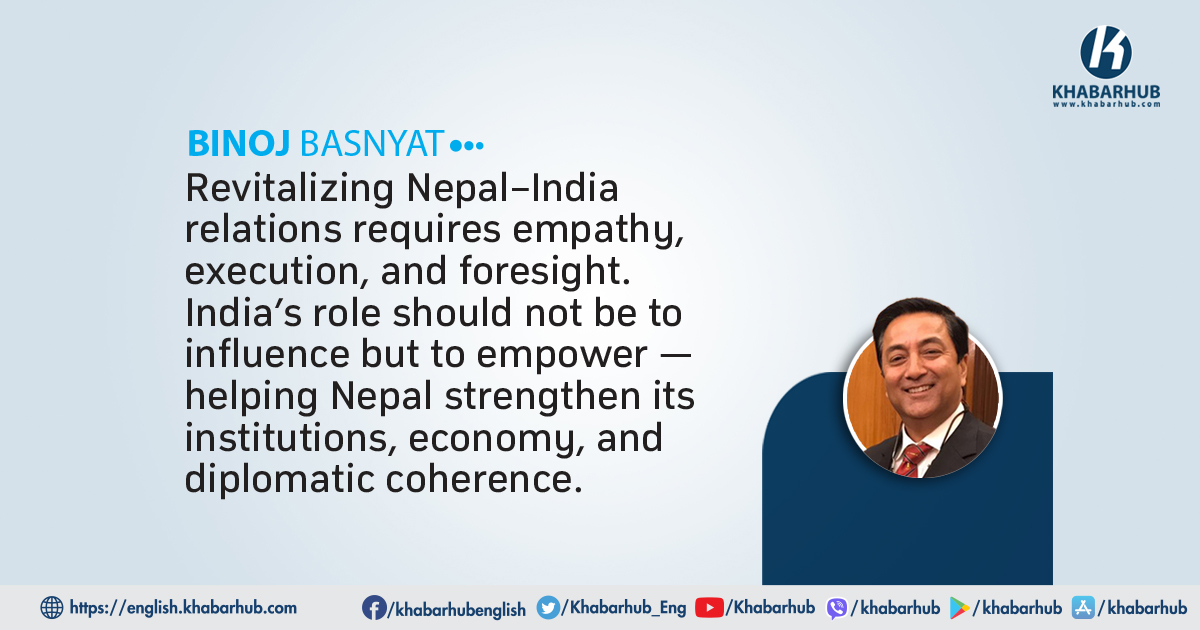
Revitalizing Nepal–India relations requires empathy, execution, and foresight. India’s role should not be to influence but to empower — helping Nepal strengthen its institutions, economy, and diplomatic coherence.
A confident and credible Nepal is India’s most valuable partner in sustaining peace and prosperity in South Asia. Supporting Nepal’s stability is not an act of charity but of strategic prudence. India’s regional leadership will be measured not by dominance but by dependable friendship — by trust built through tangible cooperation and consistent delivery.
(Basnyat is Maj. Gen. (Retd.) and a strategic affairs analyst based in Kathmandu. He writes on South Asian geopolitics, national security, and the intersection of governance, diplomacy, and stability.)






Comment