




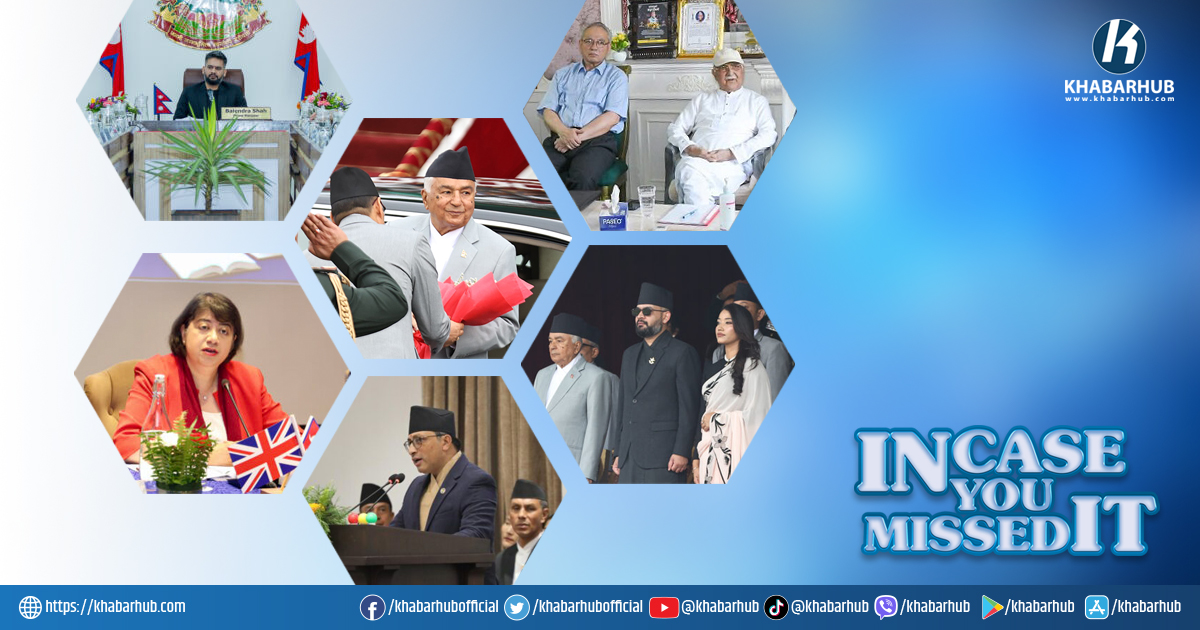
KATHMANDU: The past week was dominated by the unveiling of the federal budget for fiscal year 2026/27, the first full budget of the government led by Prime Minister Balendra Shah.
More than a fiscal document, the Rs 2.124 trillion budget represents an attempt by the new administration to translate its election promises of governance reform, economic revival and institutional restructuring into concrete policy measures.
Several of the budget’s provisions are clearly intended to restore confidence among households, investors and the private sector. The decision to increase the personal income tax exemption threshold from Rs 600,000 to Rs 1 million offers meaningful relief to middle-income earners, while the treatment of capital gains tax on listed securities as a final tax simplifies compliance and removes uncertainty for investors.
Likewise, allowing Non-Resident Nepalis (NRNs) to participate in the secondary securities market reflects a long-standing effort to mobilize diaspora capital and deepen Nepal’s financial markets.
These measures indicate a shift toward encouraging investment and consumption at a time when economic activity remains subdued. The government appears to recognize that stimulating private-sector confidence is essential if Nepal is to move beyond the sluggish growth that has characterized recent years.
The challenge behind the 7 percent growth target
The most ambitious element of the budget is the government’s target of achieving 7 percent economic growth in the coming fiscal year. While such a target reflects optimism and political confidence, it also raises questions about feasibility.
The National Statistics Office has projected economic growth of only 3.85 percent for the current fiscal year, substantially lower than the government’s own estimate of 6 percent. This gap highlights the disconnect that often exists between official aspirations and economic realities.
Nepal continues to face several structural challenges. Private investment remains weak despite abundant liquidity in the banking system. Credit expansion has been slow, industrial productivity remains limited, and economic activity continues to rely heavily on remittances rather than domestic production.
Under such conditions, doubling the growth rate within a year will require more than favorable budget announcements. It will demand improvements in project implementation, regulatory efficiency, investment facilitation and infrastructure delivery.
Growth targets can inspire confidence, but they also risk undermining credibility if they consistently fail to materialize. The coming year will therefore test whether the government’s reform agenda can translate into measurable economic outcomes.
Revenue ambitions and fiscal discipline
Alongside its spending plans, the government has set a revenue target of Rs 1.405 trillion and expects to finance part of the budget through foreign grants and Rs 410 billion in domestic borrowing.
Historically, revenue collection has been one of Nepal’s persistent fiscal challenges. Governments often announce ambitious revenue targets, only to revise spending plans later when collections fall short. This pattern has frequently resulted in cuts to development expenditure and delays in infrastructure projects.
The current budget attempts to balance fiscal discipline with social spending commitments. Civil servants will receive a 10 percent salary increase, agricultural subsidies have expanded, social protection programs are receiving greater funding, and infrastructure investment remains a priority.
Managing these commitments while maintaining fiscal stability will require stronger revenue administration and more efficient public expenditure management than Nepal has traditionally demonstrated.
The government’s credibility will therefore depend not only on how much it plans to spend but also on how effectively it mobilizes revenue and controls wasteful expenditure.
Addressing long-standing structural weaknesses
Several allocations reveal the government’s attempt to address long-standing weaknesses in key sectors.
Agriculture remains one of Nepal’s largest employers, yet productivity remains low. The decision to allocate more than Rs 32 billion for fertilizer subsidies reflects the state’s continued effort to support farmers. However, the recurring dependence on imported fertilizers underscores a broader problem: Nepal still lacks a comprehensive strategy for agricultural modernization.
Similarly, the allocation for health protection programs seeks to expand access to healthcare services, particularly for vulnerable populations. While increased spending is welcome, effective implementation will determine whether these programs improve health outcomes or simply add to administrative burdens.
The government’s pledge to resolve issues related to squatters and landless citizens within the fiscal year also addresses a politically sensitive issue that successive administrations have struggled to tackle. Success will require balancing social justice concerns with legal and property rights considerations.
Tourism and aviation reforms gain importance
Tourism featured prominently in the government’s economic vision. The proposal to position Nepal as a global wellness tourism destination aligns with international travel trends and could help diversify the country’s tourism offerings beyond traditional trekking and mountaineering.
However, tourism development is closely linked to aviation reform. The government’s decision to restructure the Civil Aviation Authority of Nepal (CAAN) by separating its regulatory and service functions addresses a recommendation that international aviation bodies have advocated for years.
This issue gained additional significance during Prime Minister Shah’s meeting with European Union ambassadors and mission heads. The continued aviation restrictions imposed by European authorities remain a major obstacle for Nepal’s aviation sector and international reputation. Progress on aviation governance reforms could help improve safety standards and strengthen Nepal’s standing in global aviation markets.
The budget’s tourism ambitions will therefore depend significantly on whether these aviation reforms are implemented effectively.
Diplomatic outreach and economic messaging
One of the week’s most notable political developments was Prime Minister Shah’s joint meeting with ambassadors and representatives of European Union member countries.
The meeting appeared designed to reassure international partners following the formation of a new government. Shah emphasized policy stability, democratic values, investment promotion and a balanced foreign policy. Such messaging is particularly important at a time when Nepal seeks greater foreign investment and development cooperation.
International investors place considerable importance on political predictability. The Prime Minister’s commitment to maintaining a stable policy environment may help alleviate concerns about abrupt policy shifts or political uncertainty.
The positive response from diplomats suggests that Nepal’s international partners remain willing to support economic reforms, governance improvements and investment initiatives if the government demonstrates consistency and credibility.
Republic Day and the unfinished democratic project
The celebration of the 19th Republic Day provided an opportunity to assess Nepal’s democratic journey nearly two decades after the abolition of monarchy.
President Ram Chandra Paudel used the occasion to highlight both achievements and shortcomings. While praising the republic for expanding political rights and strengthening citizen sovereignty, he also acknowledged the persistent challenges of poor governance, delays and institutional inefficiency.
His observation that Nepal’s greatest enemy is not an external force but internal failures resonates strongly with public sentiment. Citizens increasingly judge democratic institutions not by constitutional milestones but by their ability to deliver jobs, services and opportunities.
The republic has undoubtedly expanded political participation and strengthened local governance through federalism. Yet public frustration remains significant because economic transformation has not kept pace with political change. The President’s remarks reflected a growing recognition that governance reform has become the central challenge of Nepal’s democratic era.
Internal pressures within UML
The week’s political developments were not limited to government affairs. The CPN-UML’s Secretariat meeting exposed growing tensions within one of Nepal’s largest political parties.
For the first time in years, calls for leadership transition within UML were voiced openly by senior leaders. Although party chair KP Sharma Oli rejected suggestions that he step aside, the discussion itself reflects broader generational pressures within Nepal’s political system.
Many younger leaders argue that political renewal requires leadership change alongside policy reform. Meanwhile, veteran leaders continue to emphasize experience and organizational continuity. This tension is increasingly evident across Nepal’s major political parties.
Oli’s decision to postpone leadership discussions until after organizational reviews and election assessments was a strategic move that preserved his authority while delaying confrontation. Nevertheless, the growing demand for internal reform suggests that succession debates within UML are far from settled.
Rule of law and institutional accountability
Another important development came from the Supreme Court’s intervention in the case involving former Prime Minister Sher Bahadur Deuba and Arzu Rana.
The court’s decision was significant not because it addressed the substance of the allegations, but because it emphasized due process. By questioning the legality of the arrest procedures followed by investigators and the Kathmandu District Court, the Supreme Court reaffirmed the principle that state authority must operate within legal boundaries.
The ruling serves as a reminder that accountability and rule of law must advance together. Public demand for anti-corruption measures remains strong, but investigations that ignore procedural safeguards risk undermining both justice and public confidence.
In many respects, the decision demonstrates the growing role of institutions in balancing political power and protecting constitutional rights.
Human capital and Nepal’s future
British Minister Seema Malhotra’s visit highlighted another issue that deserves greater attention: human capital development.
Discussions focused on education, technical training and skills development—areas that are becoming increasingly important as Nepal’s economy evolves. With tens of thousands of students studying abroad and millions of Nepalis working overseas, the country’s future competitiveness will depend heavily on the quality of its workforce.
The emphasis on vocational training, research-oriented education and stronger educational partnerships reflects a growing consensus that sustainable economic growth requires investment in people as much as investment in infrastructure.
For a country where remittances remain a major source of income, improving skills and educational outcomes could significantly increase productivity and create new economic opportunities.
From promises to implementation
Taken together, last week’s developments reveal both optimism and uncertainty. The government has presented an ambitious budget, articulated a reform agenda, engaged international partners and committed itself to governance improvements. Political institutions remain active, democratic debate continues, and important reforms are being discussed.
Yet Nepal’s familiar challenges remain visible beneath the surface. Economic growth remains weak, implementation capacity is limited, public institutions face credibility issues, and political parties continue to grapple with leadership and organizational questions.
The coming year will ultimately be judged not by the scale of promises made in the budget but by the government’s ability to implement them. Whether it is achieving higher growth, exiting the FATF grey list, attracting investment, reforming aviation, strengthening governance or improving public services, execution will be the decisive factor.
Last week’s events therefore offered a clear message: Nepal possesses no shortage of ideas, ambitions or policy announcements. The real test, as always, lies in converting those aspirations into tangible results that citizens can see and feel in their daily lives.





Comment