




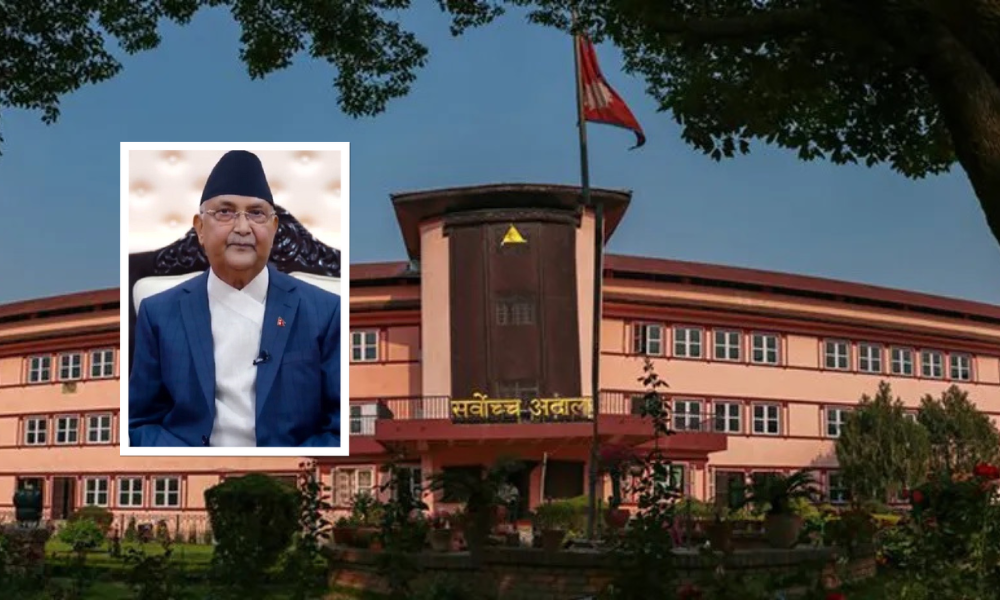
KATHMANDU: Hearing of a writ petition filed at the Supreme Court against the appointment of CPN-UML Chair KP Sharma Oli as the new Prime Minister of Nepal is scheduled for Sunday.
The hearing is set to be conducted by the bench of Judge Bal Krishna Dhakal.
PM Oli on the other hand is scheduled to take a vote of confidence from the House of Representatives today.
Earlier, Advocates Khagendra Chapagain, Shailendra Gupta, and Deepak Adhikari filed the writ petition on Monday, demanding that Oli’s appointment be annulled and a new Prime Minister be appointed as per Article 76 (3).
President Ram Chandra Paudel appointed Oli as the Prime Minister under Article 76 (2) of the Constitution of Nepal on Sunday last week.
The petitioners have maintained that after the outgoing PM Pushpa Kamal Dahal failed to secure his vote of confidence, the new PM must have been appointed as per Article 76 (3).
They have also demanded the President to appoint the parliamentary party leader of the largest party in the parliament as the new PM after Dahal lost his confidence vote.
The petitioners have named the Office of the President, the Office of the Prime Minister and Council of Ministers, the Secretariat of Parliament, and the House of Representatives as defendants in the case.
What is Article 76 (2) and 76 (3)?
Article 76: Constitution of Council of Ministers
76 (1): The President shall appoint the leader of the parliamentary party that commands a majority in the House of Representatives as the Prime Minister, and the Council of Ministers shall be constituted under his or her chairpersonship.
76 (2): In cases where no party has a clear majority in the House of Representatives pursuant to clause (1), the President shall appoint as the Prime Minister a member of the House of Representatives who is able to command a majority with the support of two or more parties representing the House of Representatives.
76 (3): In cases where the Prime Minister cannot be appointed pursuant to clause (2) within thirty days after the date of declaration of the final results of the election to the House of Representatives or where the Prime Minister so appointed fails to secure a vote of confidence pursuant to clause (4), the President shall appoint as the Prime Minister the leader of the parliamentary party which has the highest number of members in the House of Representatives.






Comment