




KATHMANDU: Khabarhub provides an in-depth weekly recap of significant events every Monday morning.
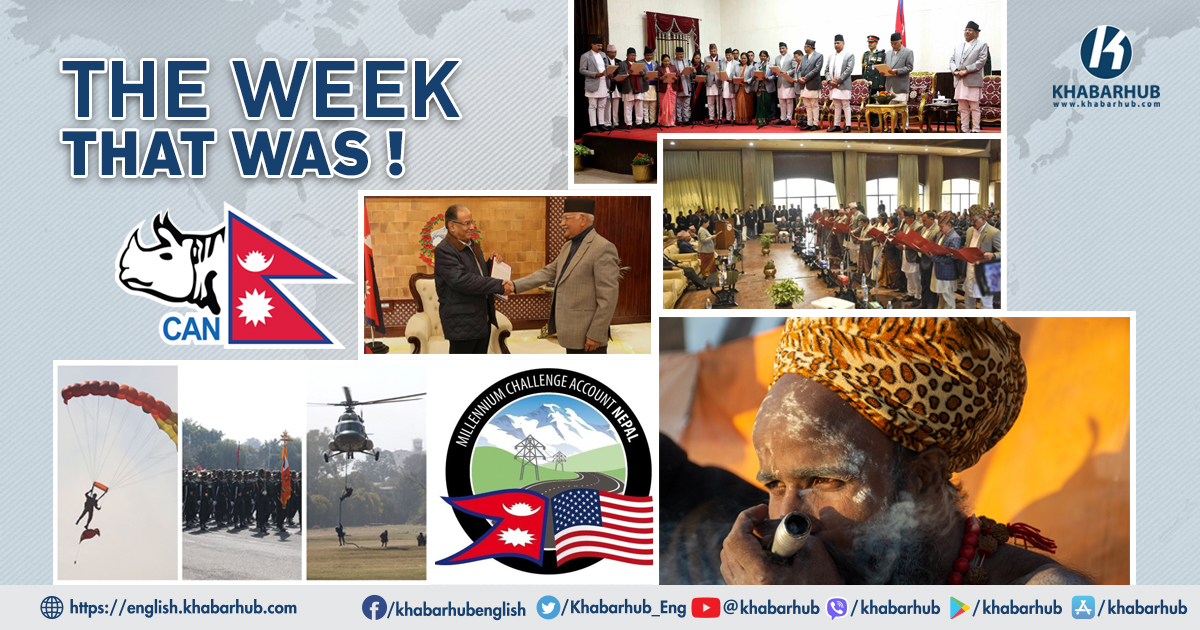
The political landscape in Nepal underwent significant changes last week, marked by the dissolution of the former alliance with the Nepali Congress (NC) and the subsequent formation of a new coalition led by Prime Minister Pushpa Kamal Dahal Prachanda.
The appointment of a 20-member Council of Ministers brought in a mix of leaders from various parties, including CPN-UML, JSP, RSP, and the Unified Socialist.
Notably, the cabinet includes three Deputy Prime Ministers, with JSP Chairman Upendra Yadav expected to assume a crucial role.
The distribution of ministerial portfolios has been outlined, with key positions assigned to members from different coalition parties.
Barshaman Pun from CPN-Maoist takes charge of the Ministry of Finance, while Rabi Lamichhane from RSP becomes the Home Minister.
Narayan Kaji Shrestha from Maoist Center is designated as the Minister for Foreign Affairs, showcasing a collaborative effort in forming a diverse and inclusive government.
However, the political dynamics remain in flux, with ongoing negotiations over ministerial appointments for the Ministry of Forests and Ministry of Health and Population.
This has resulted in a delay in the full constitution of the Council of Ministers, as Janata Samajwadi Party and other fringe parties stake their claims.
Simultaneously, the National Assembly witnessed the swearing-in of newly-elected members, reflecting the diverse representation of various political parties.
The coalition of CPN-UML, Maoist Center, RSP, and JSP solidified their commitment through an eight-point pact, outlining their shared vision for governance.
This collaborative effort aims to establish a stable government with a clear division of roles among the coalition partners.
In a surprising turn of events, Prime Minister Dahal warned of ongoing turmoil in the country as long as he remains alive, presenting himself as a forward-thinking and progressive leader.
The week also saw a significant religious gathering at Pashupatinath Temple for Maha Shivaratri, coinciding with the Nepali Army’s celebration of Army Day, symbolizing the convergence of religion and culture in the country.
This statement raises questions about the political stability and direction under his leadership.
Last week, the Nepali Congress withdrew its support for Prime Minister Dahal’s government following the unexpected revival of the coalition with CPN-UML.
The new ruling coalition now includes CPN-UML, CPN-Maoist Center, RSP, and JSP, with the Unified Socialist also deciding to join, subject to further discussions on ministerial portfolios.
In other notable developments, the Millennium Challenge Account-Nepal has prioritized advancing the 18 km Nepal portion of the Butwal-Gorakhpur power transmission line, emphasizing its critical importance to cross-border power trade between Nepal and India.
On the international front, Deputy Prime Minister and Foreign Minister Narayan Kaji Shrestha engaged in a telephone conversation with Russian Foreign Minister Sergey Lavrov, urging swift repatriation of deceased Nepali nationals and facilitating the return of Nepali citizens serving in the Russian Army.
In terms of sports, the government allocated Rs 50 million to the Cricket Association of Nepal for the T20 World Cup preparations, showing support for Nepal’s participation in the upcoming event.
Likewise, Indian Ambassador Naveen Srivastava reassured that Nepal’s internal political changes would not impact bilateral relations with India.
The week also saw a significant religious gathering at Pashupatinath Temple for Maha Shivaratri, coinciding with the Nepali Army’s celebration of Army Day, symbolizing the convergence of religion and culture in the country.





Comment