




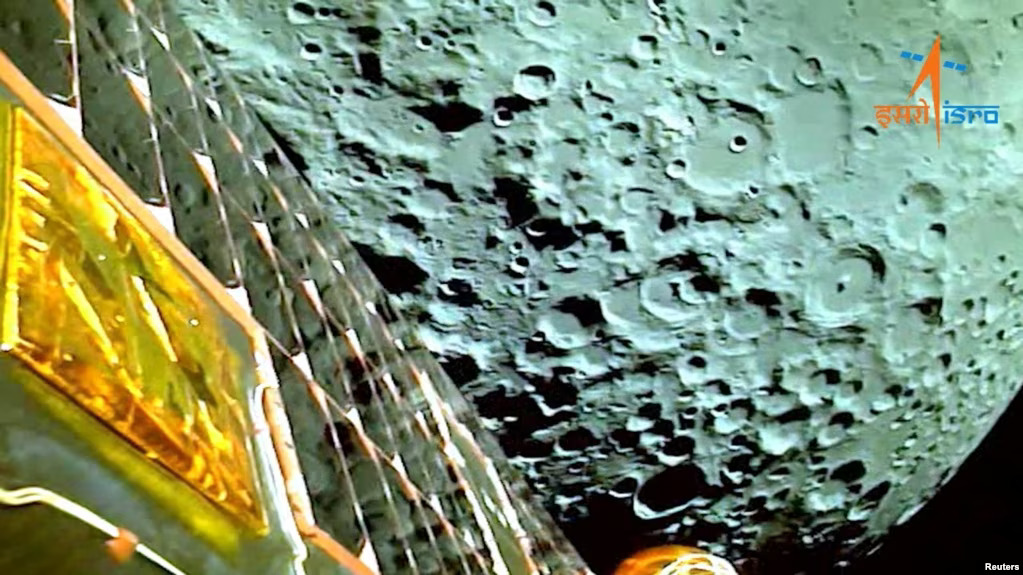
BENGALURU: India’s space agency released images of the moon taken from its Chandrayaan-3 spacecraft as it approaches the lunar south pole, a previously unexplored region thought to contain water ice where Russia is trying to land first.
The video, taken on Thursday just after the separation of the rocket’s lander from the propulsion module, showed a close-up of craters as Earth’s only natural satellite spun around.
“The Lander Module [LM] health is normal. LM successfully underwent a deboosting operation that reduced its orbit to 113 km x 157 km,” the Indian Space Research Organization [ISRO] tweeted later.
The Indian space agency launched the rocket carrying the spacecraft on July 14, blasting off from the country’s main spaceport in the southern state of Andhra Pradesh. The lander is scheduled to attempt a touchdown on Aug. 23.
Russia launched its first moon-landing spacecraft in 47 years on Aug. 11, taking a more direct course to reach the moon’s south pole where scientists have detected water ice that could be used for fuel, oxygen and drinking water for future moon missions or a lunar colony.
Russia’s moon mission is on track to land the Luna-25 on Aug. 21, two days before India’s spacecraft.
Rough terrain is expected to complicate a landing on the lunar south pole. A previous mission by India’s space agency, the Chandrayaan-2, crashed in 2019 near where the Chandrayaan-3 will attempt a touchdown.
Chandrayaan, which means “moon vehicle” in Sanskrit, includes a 2-meter-(6.6-foot)-tall lander designed to deploy a rover expected to remain functional for two weeks running a series of experiments.
Both India and Russia have national interests in successful landings and in claiming the historic first at stake.
For Russia, the moonshot, which has been planned for decades, will test the nation’s growing independence in space after its 2022 invasion of Ukraine severed nearly all of its space ties with the West.
Russia’s space agency Roscosmos has said the Luna-25 mission would spend five to seven days in lunar orbit before descending to one of three possible landing sites near the pole.
For India, a successful moon landing would mark its emergence as a space power at a time when Prime Minister Narendra Modi’s government is looking to spur investment in private space launches and related satellite-based businesses.
Since 2020, when India opened to private launches, the number of space startups has more than doubled. Late last year, Skyroot Aerospace, whose investors include Singapore’s sovereign wealth fund GIC, launched India’s first privately built rocket.
Indian officials have privately played down the race with Russia to land first, saying there was no competition.
(VOA/Reuters)






Comment