




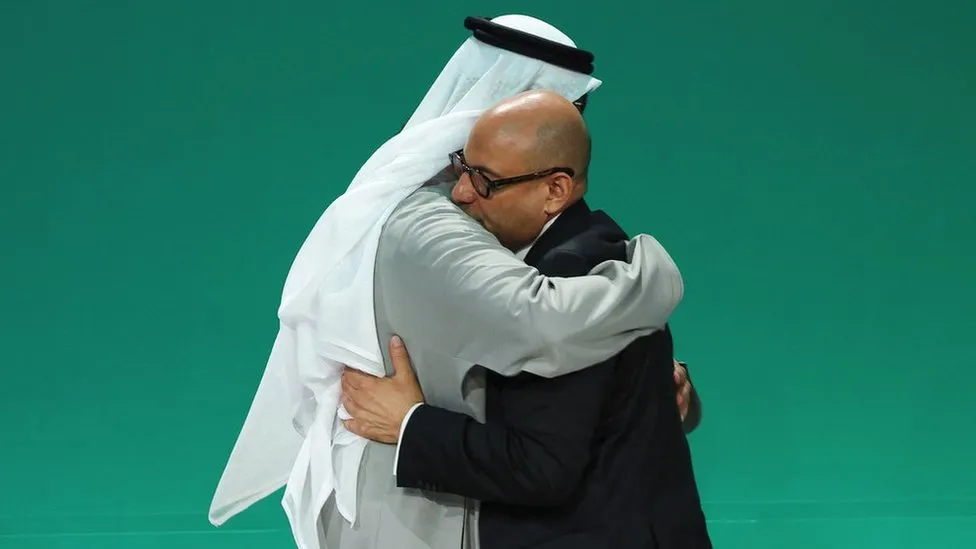
Once the gavel came down in Dubai, the warm words flowed – but will it really have an impact on climate change?
The agreement reached in this glitzy metropolis for the first time nails the role of fossil fuel emissions in driving up temperatures and outlines a future decline for coal, oil and gas.
In UN terms that is historic, and the biggest step forward on climate since the Paris agreement in 2015.
But by itself, will this deal be enough to save the “north star” of this COP – keeping temperatures under 1.5C this century?
Most likely not.
The major element of the deal, the transition away from fossil fuels in energy systems, is indeed a landmark moment.
But the language is far weaker than many countries desired.
The UAE presidency had included strong text on the idea of a fossil fuel phase out from the start of the meeting.
But in the face of opposition from many, they dropped it from their first attempt at a draft agreement,
Cue fury among progressives and much finger pointing at oil producers.
This wasn’t all the fault of countries like Saudi Arabia.
A key factor in softening the text was the attitude of middle-income developing countries who were very uncertain about the much hyped phased out of fossil fuels.
For Nigeria, Uganda, Colombia and others there were complaints that they needed to use revenues from the sale of coal, oil and gas to ensure they could pay for the transition to greener energy.
Colombia complained that by moving away from fossil fuels, credit agencies had downgraded their rating, meaning that international loans to go green would cost them far more.
The final pact now calls on countries to “transition away” from fossil fuels specifically for energy systems, but not for plastics, transport or agriculture.
The agreement also has many other elements that will help limit emissions including a new commitment to triple renewables and energy efficiency by 2030.
This will see wind and solar displace some coal, oil and gas.
Another important factor is the requirement for countries to submit stronger carbon cutting plans by 2025.
If China and India put a rapid transition to green energy at the heart of these new commitments, that could make a massive difference to the global effort.
But there is also a recognition of the role of “transitional fuels” in the agreement – which is UN code for continuing use of natural gas.
There is also support for the use of carbon capture and storage, a technology that oil producers want to use to continue drilling.
Small island states were also irate that the deal was gavelled through while they weren’t in the room.
They see the lack of greater short-term emissions cuts as the key weakness that threatens their way of life.
“We feel you, we see you. And we see that this text might not be enough for you, or your children,” said German foreign minister Annalena Baerbock.
She said the deal in Dubai is just a starting point – and I think that is an important takeaway.
Observers here believe that this meeting and the next two COPs, in Azerbaijan and Brazil, are part of a package deal that will help the world correct course on climate.
The view is that with the cost of renewables continuing to fall, the pressure on fossil fuels will continue to grow.
The feeling here is that in 2025, Brazil’s President Lula will have chance to put fossil fuels beyond the pale, for ever.
(With inputs from BBC)






Comment