




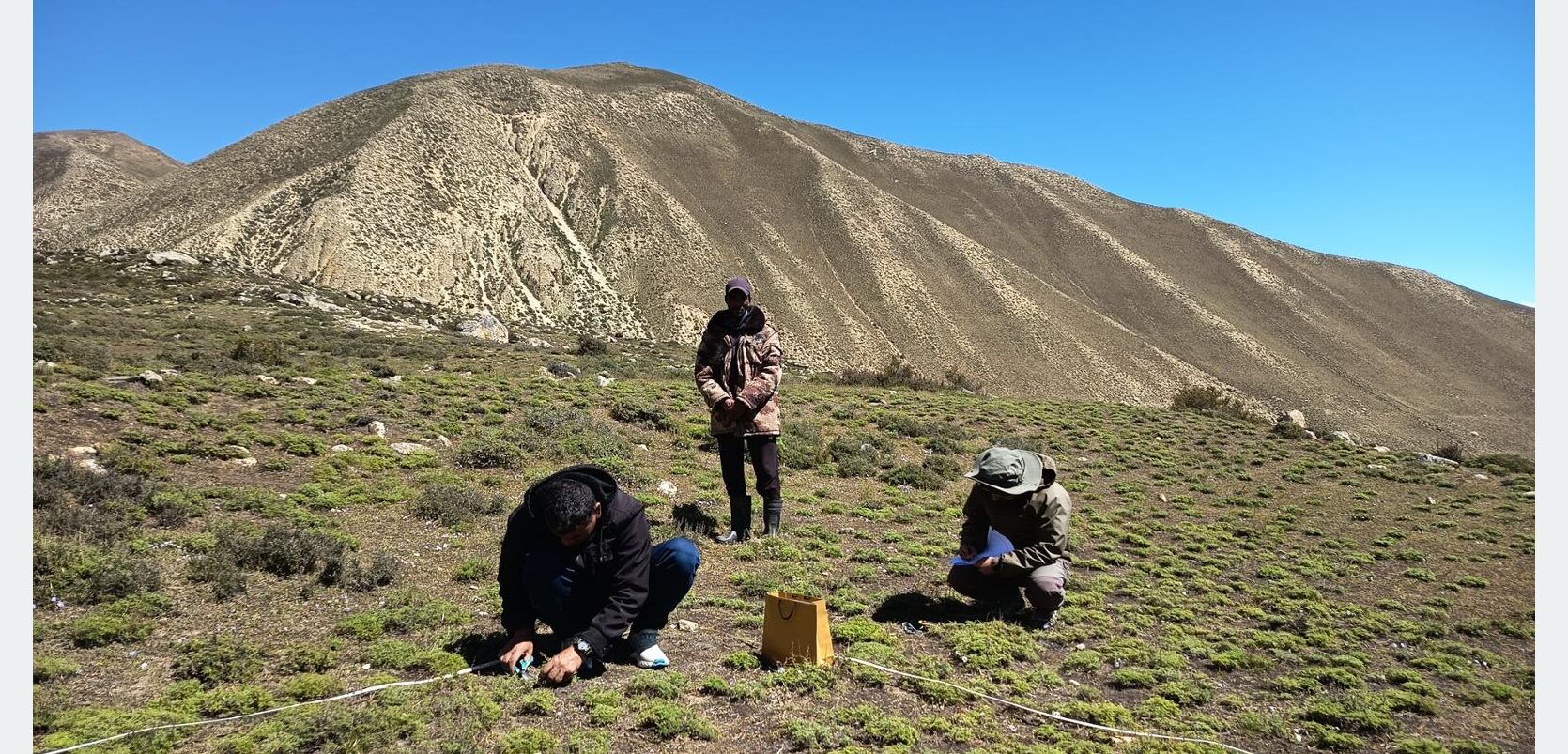
MUSTANG: Studies of high-altitude grazing areas and grass samples have begun in Mustang to assess the impact of climate change on pasture conditions and support the conservation of snow leopards and their primary prey, the Himalayan blue sheep.
The availability and quality of grass in Mustang’s highland pastures have reportedly been declining due to climate change, raising concerns about the food sources of Himalayan blue sheep and, consequently, the long-term survival of snow leopards.
The Annapurna Conservation Area Project (ACAP), under the National Trust for Nature Conservation (NTNC), has launched separate studies through its Jomsom and Lomanthang offices to assess pasture conditions and help conserve and increase the population of Himalayan blue sheep, locally known as naur.
Sanjog Thakali, Senior Natural Resource Conservation Assistant at ACAP, told RSS that a camera has been installed in Lower Mustang to study snow leopards, while pasture and grass assessments are being conducted in three locations in Upper Mustang.
Grass samples will be collected to assess grazing conditions, identify grass species and their diversity, measure organic matter content and examine nutrient levels.
As part of the study, researchers are collecting grass samples in Baragung Muktichhetra and Gharpajhong rural municipalities by establishing 10-square-metre plots, each containing smaller one-square-metre subplots.
According to Thakali, samples of grasses consumed by Himalayan blue sheep will be collected from 15 pasture plots in Baragung Muktichhetra and nine in Gharpajhong Rural Municipality, covering a total of 48 subplots in Lower Mustang.
The sampling covers high-altitude locations in Baragung Muktichhetra, including Sangta, Phalyak, Lupra, Muktinath, Kagbeni and Jhong. In areas where camera traps have been installed, sampling sites are being maintained at least 500 metres apart.
Similarly, ACAP’s Lomanthang office has begun assessing pasture conditions and grass quality in three locations in Upper Mustang where cameras had previously been installed for snow leopard monitoring.
Umesh Paudel, head of ACAP Lomanthang, said increasing the population of snow leopards requires ensuring an adequate population of prey species, which in turn depends on the availability and quality of grazing areas.
Grass samples are being collected from 150 plots across Lomanthang and Loghekar Damodarkund rural municipalities. In the three designated snow leopard study areas, sampling covers pastures within a five-square-kilometre grid system.
Depending on grass coverage, samples will be collected from up to 40–50 plots, Paudel said. Researchers will also measure the weight of both green and dry grass during the survey.
The collected samples will be sent to laboratories for analysis of their nutritional content and quality. The findings are expected to help identify measures to improve the availability and nutritional value of forage for Himalayan blue sheep.
Paudel said the study would also examine how the availability and quality of grass affect the physical condition, body fat and reproductive capacity of blue sheep, the principal prey species of snow leopards.
The overall objective is to scientifically assess pasture conditions and grass diversity to identify ways to improve the habitat and food resources of Himalayan blue sheep, thereby contributing to the conservation of snow leopards and their prey species.





Comment