




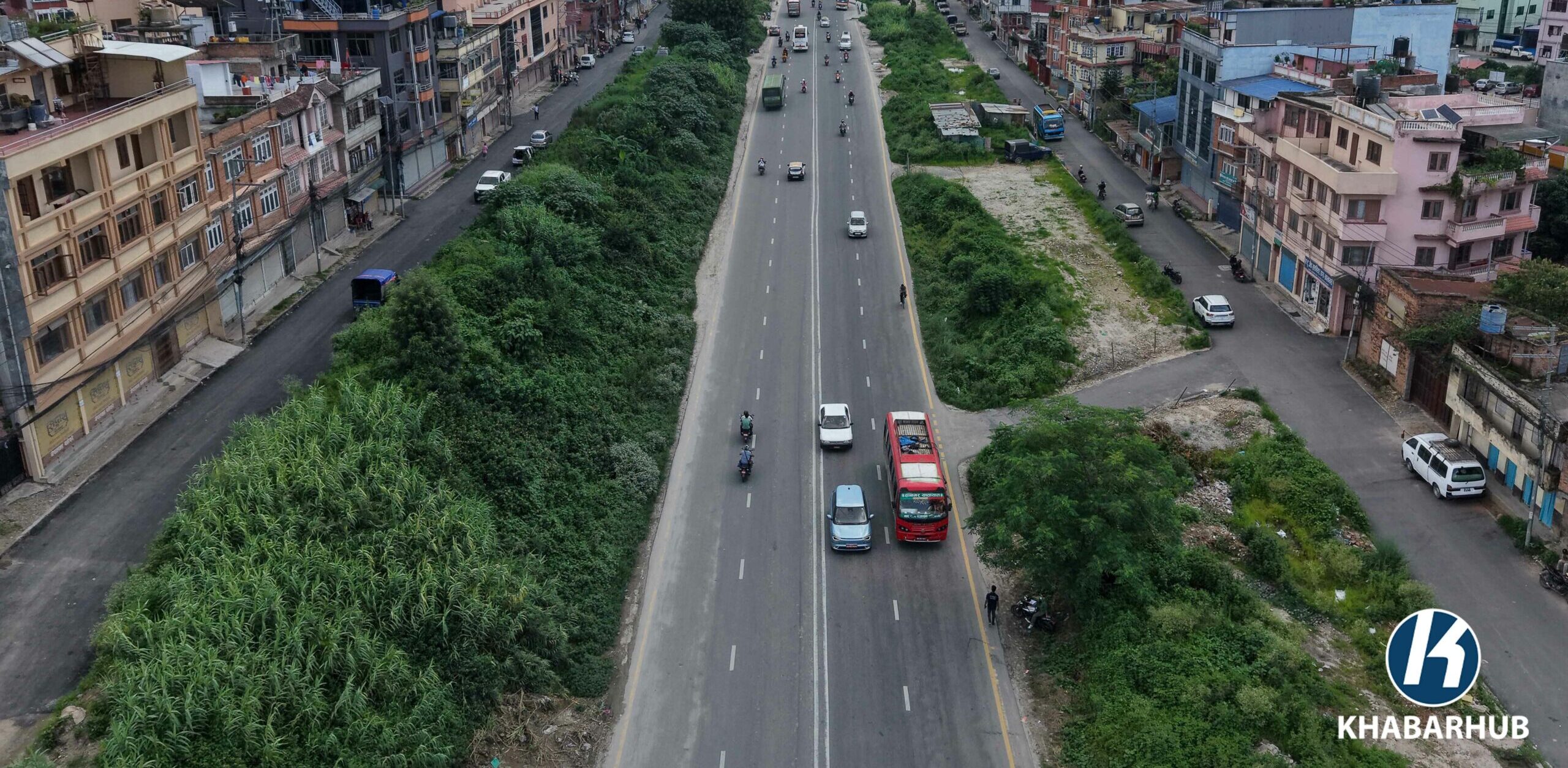
KATHMANDU: The expansion of the ring road section from Basundhara to Tinkune has moved forward in phases, but land disputes and funding limitations continue to slow overall progress.
The Department of Roads, through the Kathmandu Road Division Office, began work on the Basundhara–Tinkune stretch in October 2024 after the Chinese government withdrew from the broader expansion project due to unresolved land issues.
China had earlier committed to expanding the entire 27-kilometer ring road under a grant. However, disputes along the Koteshwar–Basundhara section led to its withdrawal, shifting responsibility for remaining works to the Nepali side.
Initial phase nearing completion
Due to land disputes at Maharajgunj Chowk, the division office began construction in relatively dispute-free areas. Work started on a 700-meter stretch from Chappal Karkhana to a nearby police post, excluding the contentious junction.
The contract for this section was awarded in October 2024 to Ambuja–SK–Kali JV at a cost of around Rs 220 million. After about a year and a half, the project has reached its final stage.
Site engineer Sajit Sharma said major work on the service lane had been completed by mid-April, with only road marking, painting, and grass planting remaining. The total cost, including VAT, stands at approximately Rs 239.7 million.
Design and pending components
Officials said the expansion follows the original design used in earlier Chinese-supported sections. The main carriageway remains unchanged, with work focused primarily on service lanes.
Discussions are ongoing regarding the construction of an underpass at Maharajgunj Chowk, as well as additional infrastructure such as dividers and utility corridors for drainage and electricity.
However, budget constraints remain a challenge for completing these components.
Plans for further expansion
The division office has proposed extending the road by an additional 1.3 kilometers from the police post toward Dhobikhola. A multi-year proposal worth Rs 510 million has already been submitted and approved by the National Planning Commission and is now awaiting clearance from the Ministry of Finance.
“We will call for tenders once the proposal is approved by the Finance Ministry,” said division chief Subodh Kumar Devkota.
Heritage and settlement challenges
Further expansion toward Chabahil and Gaushala faces major hurdles due to heritage and settlement issues. The presence of protected sites such as Charumati Stupa and the Pashupati area means that approvals from UNESCO would be required.
Officials say expansion in these areas is highly unlikely under current conditions.
Similarly, long-standing settlement disputes in Sinamangal have yet to be resolved and will require government-level decisions.
Earlier, the 10.35-kilometer Koteshwar–Kalanki section was successfully expanded in 2018 with Chinese financial and technical assistance. However, the Chinese side had raised concerns over delays caused by failure to clear project sites.
China has maintained that further expansion would only proceed after service lanes are completed, a condition Nepal has yet to fulfill even after several years.
The government has since taken up responsibility for the third phase of expansion, covering approximately eight kilometers from Maharajgunj to Koteshwar, beginning work from Chappal Karkhana in October 2024.
In the first phase, around one kilometer of road—300 meters at Pingalasthan and 700 meters from Chappal Karkhana to the police post—has been prioritized, avoiding disputed areas.





Comment