




The global energy landscape is undergoing a profound shift—one that is reshaping how countries think about security, growth, and resilience. Recent geopolitical tensions, particularly in the Middle East, have exposed the fragility of global energy supply chains. For many countries, this translates into higher prices, inflationary pressures, and economic uncertainty.
For Nepal, however, this moment presents a strategic opportunity.
At a time when energy-importing economies are grappling with rising vulnerabilities, Nepal stands out as a country endowed with abundant, renewable, and largely untapped hydropower resources. In an increasingly uncertain world, this natural advantage has the potential to redefine Nepal’s economic trajectory.
Yet this promise has long remained underutilised.
Nepal’s hydropower potential—estimated at around 83,000 megawatts, with over 40,000 MW economically viable—has been recognised for decades. Successive governments have highlighted its transformative potential.
And yet, progress has been slower than expected.
Despite some important gains in recent years—particularly in expanding generation capacity and initiating electricity exports to India—Nepal has not fully translated potential into scale. Much time has been lost.
For Nepal, this convergence presents a rare moment. While many economies are struggling with rising energy costs and external vulnerabilities, Nepal has the potential to position itself as part of the solution.
The reasons are well known: a lack of long-term vision, challenges in project structuring, financing constraints, regulatory uncertainty, and delays in implementation. Equally important has been the slow pace of regional power trade agreements, which are essential for scaling exports. In today’s context, these constraints represent missed strategic opportunities.
Across South Asia, demand for energy continues to rise. At the same time, dependence on imported fossil fuels remains high, exposing economies to global price volatility and geopolitical risk.
Recent disruptions have reinforced the urgency of diversifying energy sources. Countries are actively seeking cleaner, more reliable, and regionally sourced alternatives. This creates a window of opportunity for Nepal—but one that must be seized with urgency.
But it is also a window that will not remain open indefinitely. Competing energy investments, technological shifts, and evolving regional dynamics mean that delay carries a real cost.
From Potential to Execution
Turning hydropower potential into economic reality requires more than ambition—it requires disciplined execution.
The first priority is better project identification and preparation. Many projects have faced delays not because of a lack of interest, but because of weak upstream planning. Strengthening feasibility studies, environmental assessments, and project design will be critical to building a robust pipeline of bankable projects.
Second, project structuring and financing must improve. Hydropower projects are capital-intensive and long-gestation. Mobilising financing at scale will require a mix of public investment, private sector participation, and multilateral support.
Involving the private sector—both domestic and international—can bring not only capital but also technical expertise and efficiency. Multilateral development banks can play a catalytic role by reducing risk, supporting project preparation, and crowding in private investment. Innovative financing models, including blended finance and public-private partnerships, can help bridge funding gaps.
Third, implementation capacity must be strengthened. Delays in procurement, land acquisition, and approvals have often slowed project execution. Streamlining processes, improving coordination across agencies, and enhancing accountability will be essential to delivering projects on time.
Building Regional Energy Markets
Perhaps the most critical element of Nepal’s hydropower strategy lies beyond its borders. Hydropower at scale requires markets. Domestic demand alone cannot absorb the full potential of Nepal’s resources. This makes regional power trade agreements indispensable.
Encouraging progress has been made, particularly with India. But deeper and more predictable arrangements—both bilateral and regional—will be needed. Expanding trade with Bangladesh and, over time, integrating broader South Asian energy markets can provide the scale required for sustained investment.
Cross-border transmission infrastructure must be strengthened alongside these agreements. Without connectivity, generation cannot translate into exports. Regional cooperation in energy is not just about trade—it is about shared resilience.
A Roadmap for Action
For Nepal’s new government, the path forward is clear—but it requires focus and urgency.
A six-point roadmap could anchor this effort: establishing a clear national energy strategy with defined targets for generation, exports, and investment; building a pipeline of bankable projects through stronger preparation and appraisal; accelerating transmission infrastructure, both domestically and cross-border; deepening regional power trade agreements, particularly with India and Bangladesh; mobilising private and multilateral financing through stable and transparent policy frameworks; and strengthening implementation capacity with clear accountability for delivery.
These are not new ideas—but what is needed now is consistent execution.
A Strategic Moment
The global shift toward cleaner and more secure energy is accelerating. At the same time, geopolitical uncertainty is reshaping how countries think about energy dependence.
The opportunity has been there for decades. What is different today is the urgency—and the cost of inaction. The need now is to act—decisively and strategically—before this opportunity narrows further and the costs of delay become irreversible.
For Nepal, this convergence presents a rare moment. While many economies are struggling with rising energy costs and external vulnerabilities, Nepal has the potential to position itself as part of the solution.
Hydropower can support domestic growth, generate export revenues, create jobs, and strengthen regional integration. But realising this vision will require moving beyond incremental progress toward decisive action.
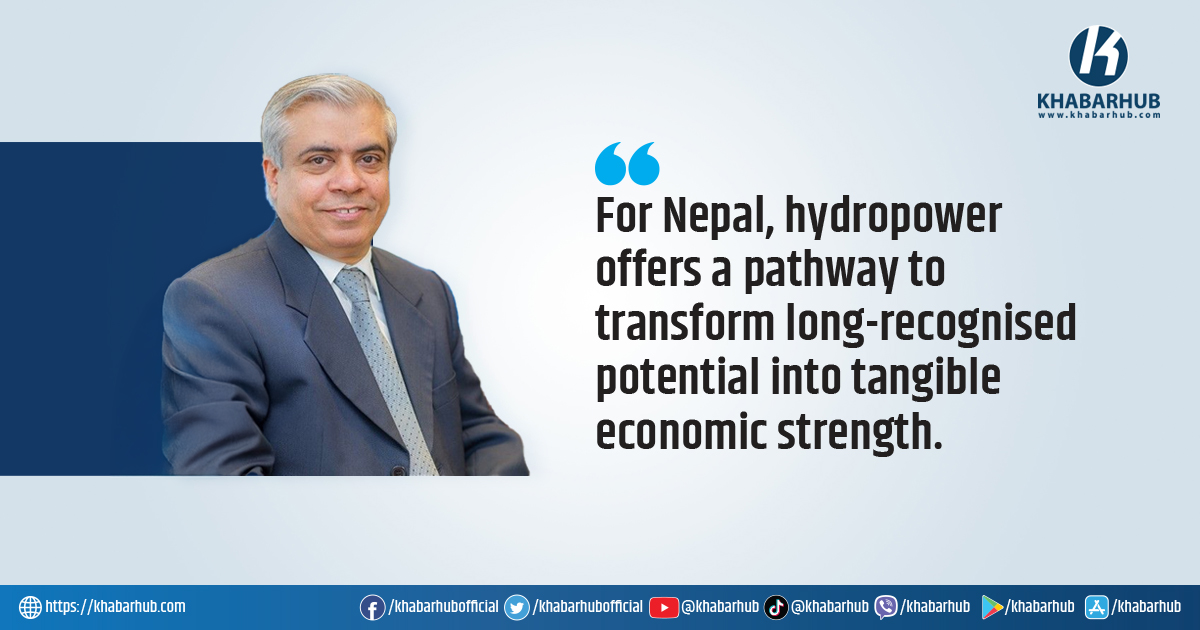
For Nepal, hydropower offers a pathway to transform long-recognised potential into tangible economic strength. The country can move beyond a narrative of constraints and position itself as a provider of clean, reliable energy in a region that urgently needs it.
The opportunity has been there for decades. What is different today is the urgency—and the cost of inaction. The need now is to act—decisively and strategically—before this opportunity narrows further and the costs of delay become irreversible.
(Manmohan Parkash is a former Senior Advisor in the Office of the President and former Deputy Director General for South Asia at the Asian Development Bank (ADB). The views expressed are personal.)






Comment