




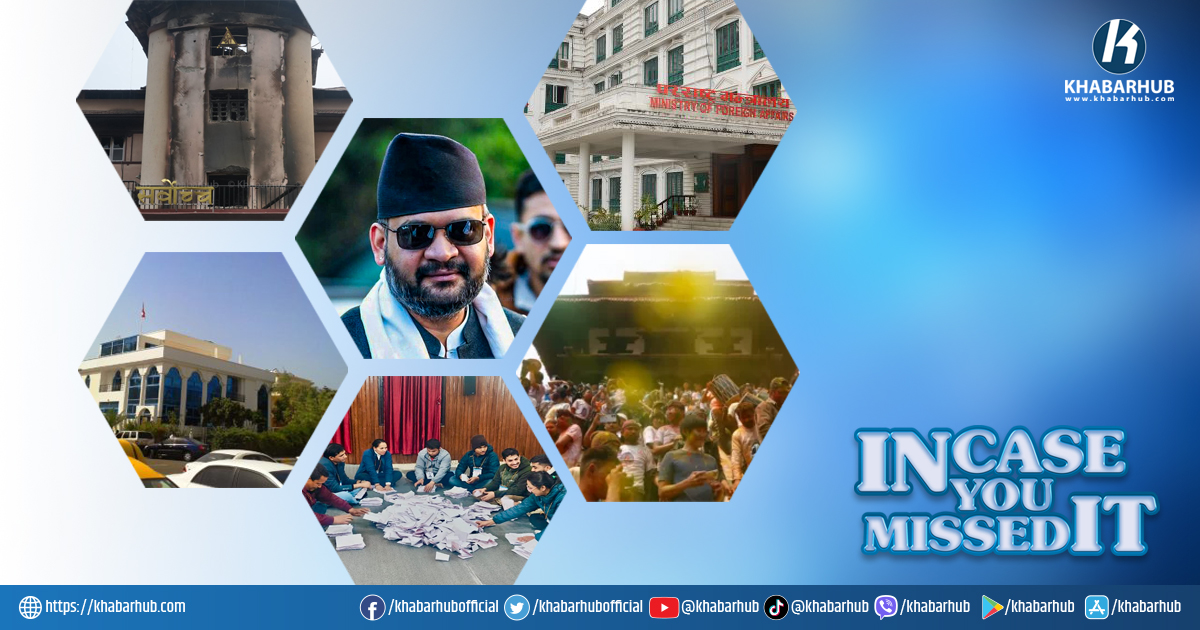
KATHMANDU: Last week was a pivotal period for Nepal, marked by a confluence of major political, diplomatic, and social events that together reflected the nation’s ongoing journey of democratic consolidation, the challenges of international geopolitics, and the vibrancy of its cultural traditions.
At the heart of these developments was the nationwide voting for the House of Representatives (HoR) on March 5, an exercise that underscored both the strengths and the logistical complexities of Nepal’s democratic system.
On the day of the elections, citizens across Nepal participated in a significant democratic ritual. The election saw a robust contest under the first-past-the-post (FPTP) system, with 65 political parties registering to compete using 61 election symbols. This resulted in 3,406 candidates vying for FPTP seats, the vast majority of whom were men (3,017), alongside 388 women and one candidate representing the “other” category.
Parallel to this, the proportional representation (PR) system featured 3,135 candidates, with women actually outnumbering men (1,772 women versus 1,363 men) reflecting a deliberate effort to ensure gender inclusivity in the legislative process.
These numbers reveal a dual narrative about Nepal’s political landscape. On one hand, the sheer number of parties and candidates highlights the vibrancy and pluralism inherent in Nepalese democracy, demonstrating that diverse political ideologies and voices have a platform.
On the other hand, the disproportionate representation of women in the FPTP race versus the PR system highlights persistent structural barriers for women in direct electoral politics. While gender quotas and proportional systems are enabling greater representation, they also signal that deeper reforms may be required to integrate women more fully into mainstream political competition.
Simultaneously, the government grappled with international crises affecting hundreds of thousands of its citizens abroad, demonstrating proactive policy and crisis management. Domestic governance initiatives, particularly in fiscal policy, signal forward-looking reforms, while law enforcement and judicial interventions remind citizens of the responsibilities accompanying democratic rights.
The scale of the electoral operation itself was unprecedented, involving 18,903,689 registered voters, including a near-even gender split and 200 individuals registered under other categories. This massive electorate was served by 23,112 polling centres across 10,967 locations, supplemented by 143 temporary polling sites.
Ensuring security and smooth conduct of elections required mobilizing nearly 215,000 personnel, including forces from the Nepali Army, Nepal Police, Armed Police Force, and temporary election police. Such logistical planning reflects not only Nepal’s institutional capacity but also the high stakes of the electoral process, given that parliamentary elections directly determine governance and national policy direction.
The Election Commission of Nepal emphasized the significance of these elections beyond merely filling seats. Acting Chief Election Commissioner Ram Prasad Bhandari highlighted that elections are a constitutional exercise aimed at renewing democratic legitimacy.
By assuring voters that ballot boxes would be collected securely and FPTP results would be published within 24 hours, the Commission sought to instill confidence in the process and minimize invalid votes. The combination of logistical scale and transparency efforts points to a maturing democratic apparatus that, while not free from challenges, is capable of handling complex electoral processes in a credible manner.
Beyond domestic politics, Nepal’s foreign policy and concerns for its citizens abroad dominated headlines last week due to escalating tensions in the Middle East. Following the United States and Israel’s joint attack on Iran, and Iran’s subsequent retaliatory strikes, Nepal urged all parties to exercise restraint, resolve conflicts diplomatically, and protect civilians. The Ministry of Foreign Affairs emphasized that differences should be addressed through dialogue, reaffirming Nepal’s commitment to international law and the sovereignty of nations.
These diplomatic statements were not purely rhetorical. They reflected real, immediate concerns for the welfare of Nepali citizens abroad. With approximately 1.7 million Nepalis employed across the Middle East, including large populations in Qatar, the UAE, Saudi Arabia, and Kuwait, the government’s advisories carried significant weight.
The Nepali Embassy in Qatar, for instance, urged its citizens to remain indoors, follow official guidance, and maintain contact with authorities to mitigate risks from potential military escalations. Tragically, the conflict claimed the life of Diwas Shrestha, a 29-year-old Nepali security guard in the UAE, who died while attempting to neutralize a drone incident.
This loss highlighted the human cost of global geopolitical tensions and underscored the responsibilities of the state to safeguard its expatriate population.
In a preemptive move to protect its citizens, Nepal suspended labor approvals for employment in twelve Middle Eastern countries, including Saudi Arabia, UAE, Qatar, Kuwait, Bahrain, Oman, Iraq, Yemen, Jordan, Lebanon, Turkey, and Israel. This policy decision demonstrates a pragmatic approach to foreign employment management, prioritizing the safety of Nepali workers over economic imperatives in times of geopolitical uncertainty.
The suspension also signals the government’s attentiveness to real-time threats in a highly volatile region, balancing domestic labor needs against international risk factors.
While national security and foreign affairs dominated one sphere, domestic governance and economic reforms remained equally prominent. The Revenue Advisory Committee of Nepal called for public and stakeholder input on tax rates and revenue policies for the upcoming fiscal year 2026/27. This committee, backed by the Ministry of Finance, was tasked with reviewing tax structures, customs rates, revenue administration, industrial policies, and sectoral reforms. Its inclusive design, involving central bank officials, academia, and private sector representatives, reflects an effort to formulate fiscally sound, equitable, and growth-oriented policies.
The committee’s mandate spans a wide spectrum: income tax, VAT, excise duty, digital taxation, trade facilitation, customs reform, agricultural and industrial policies, and financial sector oversight. This comprehensive approach illustrates the government’s recognition that fiscal policy is not merely a matter of revenue generation, but a tool to shape economic development, encourage investment, and promote fairness across sectors.
Moreover, attention to intergovernmental revenue coordination highlights the ongoing effort to strengthen federalism in Nepal, ensuring that local, provincial, and federal entities have harmonized revenue streams.
Meanwhile, the judiciary and law enforcement faced challenges stemming from social movements. A case was filed against thirteen individuals accused of arson and vandalism during the Gen-Z protests, including incidents at the Supreme Court, Singha Durbar, and police stations.
The events caused significant property damage, reportedly amounting to Rs 1.23 billion in the Supreme Court alone. The charges, criminal mischief and robbery-related offenses, demonstrate the state’s commitment to uphold law and order while navigating the delicate balance between freedom of expression and public security.
Cultural continuity and social cohesion were also evident in last week’s observance of Holi, or Fagu Poornima, across Nepal. Celebrated with colorful rituals marking the triumph of good over evil, Holi’s festivities provide a stark contrast to the political and geopolitical tensions of the week. From Chhoti Holi (Holika Dahan) to Dhuleti, the ritual use of colors, ceremonial bonfires, and community gatherings underscores the enduring social fabric of Nepalese society, even as it grapples with elections, policy reforms, and international crises. Holi functions not only as a religious observance but as a social mechanism for reinforcing communal harmony, shared traditions, and intergenerational continuity.
Taken together, last week presents a portrait of a nation navigating multiple fronts simultaneously. The HoR elections exemplify democratic vitality and citizen engagement, revealing both strengths in institutional capacity and areas requiring greater inclusivity.
Nepal’s response to Middle Eastern tensions illustrates a responsible, citizen-centered foreign policy that balances humanitarian concerns with geopolitical realities. At home, the Revenue Advisory Committee’s efforts signal a forward-looking, technocratic approach to economic governance, while the legal proceedings stemming from protests demonstrate an active judicial and enforcement system. Simultaneously, the observance of Holi highlights the resilience of cultural traditions in grounding society amid complex political and social dynamics.
Analytically, these events reveal several broader trends. First, Nepal is increasingly capable of managing high-stakes democratic processes with logistical sophistication, yet structural inequities, particularly in women’s direct political participation, persist. Second, the government’s handling of international crises, particularly concerning expatriate Nepalis, reflects a maturing foreign policy that prioritizes human security and preemptive risk management.
Third, domestic economic governance is being approached in an evidence-based, participatory fashion, suggesting a commitment to long-term fiscal stability and equitable growth. Finally, the coexistence of vibrant cultural observances alongside political and social turbulence underscores the multidimensional nature of nation-building in Nepal: it is simultaneously political, economic, diplomatic, and cultural.
In conclusion, last week in Nepal offers a snapshot of a country navigating complex democratic, economic, and geopolitical landscapes. Elections proceeded with massive citizen participation and institutional oversight, highlighting democratic resilience.
Simultaneously, the government grappled with international crises affecting hundreds of thousands of its citizens abroad, demonstrating proactive policy and crisis management. Domestic governance initiatives, particularly in fiscal policy, signal forward-looking reforms, while law enforcement and judicial interventions remind citizens of the responsibilities accompanying democratic rights.
All of this unfolded against the backdrop of cultural continuity, exemplified by the celebration of Holi. Collectively, these events illustrate Nepal’s ongoing balancing act: sustaining democratic norms, ensuring citizen welfare, managing international relations, and nurturing cultural identity, challenges and opportunities that will shape the country in the weeks and months to come.





Comment